Wednesday, 20 April 2011

India 2011: Bandipur National Park


By an odd coincidence, the same company that owned and ran our hotel in Mysore had recently acquired the hotel that we booked in Bandipur National Park, so on Day 10 we left one Windflower Resort, drove 2 hours, then checked into another. Because it was located in the middle of a national park, Windflower 2 was not quite as "resort-y" as Windflower 1--sadly, there were no Ayurvedic massages on offer, or any wi-fi or television--but the facilities were just as nice. In fact, our cabin had been refitted so recently that you could still faintly smell the paint and wood glue, and it was just as beautiful--in a more rustic, "comfortable" way--than our lodgings at Windflower 1:


Also, though photographs do not do it justice (and, hence, are not shown here), the bathroom was lovely, with skylights and neat little Chinese rock garden-like areas on either side of the shower. The only thing that was subpar was the view off our back porch; the property was obviously still a work in progress, and our "back yard" was rather denuded and a bit rough. Even so, it was a cool, quiet place to sit in the shade, and of course birds don't judge aesthetics the same way that we do, so it was also a good place to watch the feathered wildlife.

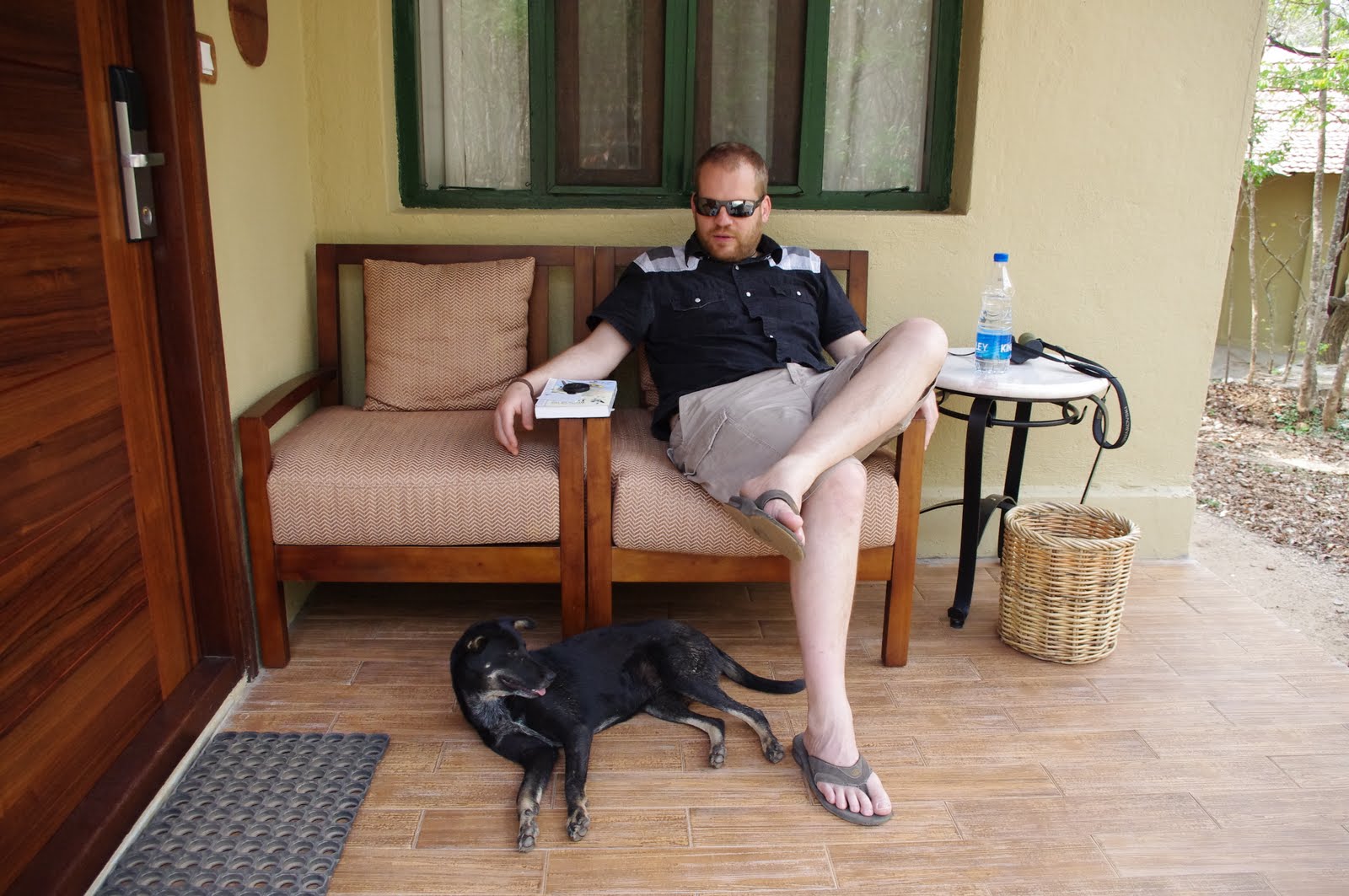
Within a few minutes of our arrival, we had managed to make friends with one of the dogs that lived on the hotel property; they weren't quite strays, since they lived there permanently and were tolerated by the hotel staff (likely because they would offer a timely warning of the presence of any tigers), but they were also not domestic in the Western sense of the word. Most especially, they were not animals that ever got much from people--most of all love or attention. All my husband had to do was say "Hello there!" in a friendly sort of way after being surprised by one young dog who had been hiding under a chair by the pool, and he earned a friend for life. She was young enough that she hadn't yet grown in to her oversized paws, but old enough that she knew she wasn't allowed to follow us into our cabin or the outdoor eating area. But she was content to sit on our porch and wait for us to come back out and give her some love; in fact, she curled up and slept in one of our porch chairs all night.
The pool, in addition to serving as a nice spot to make canine friends, was also a good place to spend an afternoon soaking up rays, which we did pretty much every day during our stay in Bandipur. It was the first time either of us had ever gone swimming in an "infinity pool." I didn't really feel as though I could keep on swimming to the horizon, but it still was kind of neat to have a more unobstructed view of the woods around our park.


Another interesting feature of our hotel was that it was in the path of at least one herd of cattle, who walked through the property on their way to the feeding ground every morning, and then back again late in the afternoon. It was weird to be sitting on the porch of our luxury hotel room, and then suddenly see a cow meander past, occasionally stopping to grab a mouthful of greenery.


Of course, when your hotel is situated in the middle of a national park, there is bound to be some interesting wildlife in addition to all the domestic animals. Every night after the porch light came on, geckos came out to perch on our walls and hunt. They also bark, which I didn't know until my husband pointed out that the noises I'd interpreted as some sort of frog or nocturnal bird were actually male geckos having vocal duels. Who knew? There were other reptiles running around near our cabin, including some brightly-colored agamids that I tried, but failed, to photograph one morning. To my surprise, when we went to lunch a couple hours later, we ran into a very large male of the same species I'd seen earlier, lounging photogenically outside the restaurant:


The restaurant was also a favorite spot for the local house crows, who obviously knew that many tasty snacks were to be had at the end of the meals (or even sometimes in the middle of them, if the diners turned their heads for a moment). My husband and I had a good time watching the crows coordinate with each other--often one pioneering individual would show up and deliver a bizarre and highly variable vocal performance; this attracted friends, who would perch in various spots around (and sometimes inside) the restaurant, eagerly watching for an opportunity to sneak off with leftovers. More often than not, all they got was a half-full package of butter, which they seemed to like better than nothing at all.


While we were in Bandipur, we saw rain for the first time since our arrival in India. Rather than being a disappointment or an inconvenience, this was actually kind of nice; the dramatic downpours--sometimes with rumbles of thunder--were a refreshing alternative to the annoying misty rain that we always get in the UK. The days could also get quite hot in Bandipur, and the cool breezes that accompanied the precipitation felt very pleasant.

Over the course of two days, we took 3 driving safaris and 1 hike, yielding a total of 2 dhole (wild dogs), 3 elephants, a half dozen mongooses, a couple gaur (bison), a few hundred chital (spotted deer), a barking deer, a dozen wild boar, several sambars, and lots of birds. We didn't encounter any leopards or tigers, but even though that was a possibility, it wasn't really something that we expected. Our evening safaris were quite pleasant because all the vegetation in the park took on a lovely golden hue in the setting sun. This was also the only time that we saw elephants. The morning safaris were more exciting because that was when the animals were most active--we could both see and hear them much more easily. Unfortunately, morning is also when my bladder is most active, and during our first AM safari I finally had to hop out of our jeep to find a place to pee. As was the case with my experience in the Masai Marai in Kenya, peeing in the bush was a rather daunting task given the very real possibility that a large, hungry, predatorial cat might be lurking in the shadows. Luckily, the park was full of deep holes that had evidently been installed to catch rainwater during the monsoon season. I was able to jump down into one of these and relieve myself out in the open, yet still out of sight of my safari-mates. It was a lot better than crouching behind the bumper of the vehicle, I can tell you that. I'm just glad I could continue my trend of urinating in the field on every continent I've visited; I'd hate to have a trip where I couldn't indulge in that little pleasure.

During our first two safaris, we shared a jeep with other tourists; on the first night it was two American engineers who were staying at our hotel after attending a conference in Bangalore, and on the second night it was a family that had traveled to Bandipur from elsewhere in India. Everybody was quite pleasant and we shared stories about our travels and passed on whatever wildlife ID information we could offer. All the same, it was a pleasant surprise to get a jeep all to ourselves during our final safari. This offered me the opportunity to ask the driver to stop so I could do some birdwatching--something I feel too guilty to ask for when there are other people around who are likely to be much less interested in avian wildlife than I am. As was the case with the safari drivers in Kenya, our Indian guides were very focused on the macro wildlife (elephants and tigers, in particular), but were quite happy to linger for birds after we made it clear that those were just as interesting to us. Unfortunately, one side effect of this was that the drivers then paused in front of nearly every peacock we passed, and there was a seemingly infinite supply of those in the park:


As had been the case in Kenya, I developed an affection for the porcine wildlife, which are so ugly you can't help but love them:


Lest anyone think I am single-minded, I had better state that I was looking out for interesting plants, as well. Unfortunately, Bandipur is so dominated by invasive lantana (a plant that is causing habitat problems throughout much of India, in fact) that it was often the only species I could see. However, one notable species was the aptly-named "flame of the forest":

(If you look closely, you might just be able to spot a bonnet macaque sitting amidst the flowers.)

Our walking safari was something that we stumbled into, so to speak, after the American engineers told us that one had been arranged for their group. Evidently this was not something that was routinely done, but the hotel staff were nothing if not accommodating, and they volunteered to throw something together for us, as well. We wound up going with another family who were staying at the Windflower just a couple cabins away from us. After a few minutes of chatting while we walked, we discovered that we had an unanticipated social connection: The cousin of the wife/mother was someone who worked at the IISC and was scheduled to meet with my husband after our return to Bangalore. What were the chances? One of the two children in the family was a budding biologist, so my husband took special care to point out all the wildlife he knew and tell her about the more interesting aspects of their life histories.

It was, yet again, a lovely evening to be out and about. With the exception of a couple waterbirds, we didn't see too many new species, but it was pleasant to enjoy the countryside on foot rather than in a vehicle. We also had some illuminating cultural experiences. Our destination was a local watering hole, and on our way there we walked through a small village. The people were in the midst of tending their lifestock and cooking dinner, so we got a small taste of what "real" life is like for a vast portion of the Indian population.

(A shepherdess pumping water for her goats and cow. One of the female goats--possibly the one on the far left--had a couple of kids that kept jostling into position for a suckle. They were ridiculously cute, prompting us to stop for the photo op. I would love to know what was going through the villagers' minds as they watched us photograph livestock. A rough equivalent would be if Indian tourists to the UK took pictures of the deli or dairy section at the grocery store. After all, what we might think of as a "pet" is what they use to get milk and meat.)

Between the village and the watering hole was a small ranger station, where we were told that we couldn't go any further. Our local guide informed us that the ranger was worried that we might be in danger of experiencing wildfires. However, he also indicated (although everyone but me seemed to know already) that this was just an excuse to put us in the position to offer a bribe. Sure enough, after a few bills had exchanged hands, the ranger reconsidered and waved us onwards. I can't imagine living in a country where bribery is routine (though it is much less routine in India now than it was in the past); think of the things you'd never be able to do if you didn't have enough money, and all the things that would suddenly become possible if you did.

On the way home from the walk, I found myself walking with our guide, who spoke very little English. However, he painstakingly managed to put together enough words to ask me about what it was like to travel to India from the UK. He also inquired whether "the Sir" and I ("the Madam") had any children. When I told him "no," he asked if it was because I "had the job." At first, I thought he said I had "done a good job" (which I interpreted as an odd joke), but then I realized that he was asking whether I had no children because I had chosen to work instead. I found that question to be very revealing of life in modern India, where women are increasingly foregoing families (or, at least, starting them much later) in order to establish a career. In other words, it's becoming very Western in that respect.

During this conversation, our party picked up an additional member--another young, friendly, and ridiculously needy dog. Although she started out tagging along with the kids in our group, she must have used her canine canniness to discern which among us was weakest; she soon was cuddling up to my husband and I. She was in for a rude awakening once we reached Windflower, where the resident dogs quickly established their dominance. Rather than see her come to any harm, my husband and I escorted her safely to the edge of the premises so she could escape without any damage.

However, when I ventured out early the next morning in order to do some birding, who should I spy running towards me but that very same dog, who'd obviously passed whatever test was necessary to earn her place at Windflower. Like her predecessor (whom I'd dubbed "Friend #1"), Friend #2 was eager to sit with us on the porch and receive some attention and affection:


If you love animals, which I do, it is very difficult to go to developing countries and see so many feral cats and dogs. It is especially painful when you observe how desperate they are to bond with someone and loyally follow at his/her feet, without asking any questions. More than once, I fantasized about arranging veterinary care and relocation to the UK.

After a while, Friend #2 reattached herself to our walking companions from the previous night, which was convenient because my husband and I needed to go to breakfast and were worried that she would try to follow us in. After breakfast, we walked down to the pool to have a peek at a strange toad I had seen there earlier in the morning; there, we stumbled across Friend #1. Unfortunately, we could only spare a few minutes of attention, because we were due to start the long taxi ride back to Bangalore.

On the way out of the park, we stopped near the ranger station so I could photograph one of the huge abandoned termite mounds out front. I hopped out of the car in order to get a closer shot, then received a surprise when I turned to go back:

(Bonnet macaque lounging in the luggage rack of our taxi.)

At first she was sitting on the hood of the car, but after "decorating" it, she relocated to the roof, from which she could bend over and stick her face through the open window. She seemed very unperturbed by my presence, and didn't even look at me as I cautiously edged closer. Because she was perched over the back seat door, I had to stand right next to her, and then bend underneath her, in order to get into the car. I was a little worried that eventually she would get alarmed by my proximity and then become violent, but these worries were unfounded. In fact, she didn't even seem to care when the driver started the engine and began pulling back onto the road; only at the last minute did she lazily hop off the car and wander over to the side of the road. This encounter capped a very animal-filled morning, which provided a fitting finale to our equally animal-filled stay in Bandipur.

---
Coming up: long journeys by taxi, on foot, and by air


Tuesday, 19 April 2011

India 2011: Bangalore to Mysore


The dearth of electricity and Internet was not miraculously fixed overnight prior to our departure for Mysore, which was one reason that we were excited about leaving town--we knew that free wi-fi awaited us at our destination. More importantly, we were also looking forward to upgrading our lodgings from "dorm room" to "deluxe," the only class of accommodation that the hotel could book us into when we called for reservations. But first, we needed to hop our train out of town.

If you are like me, then your first reaction to reading "train in India" will be to picture this:

I'm sure this kind of situation must happen fairly often, otherwise I wouldn't have found so many pictures like this on Google. However, this was not at all the experience that we had during our two-hour ride south to Mysore. In fact, our journey was similar in many ways to ones that I have taken in the UK; in fact, in many ways it was better. First of all, when we arrived at the train station we were able to hire porters who, for a ridiculously cheap price (less than $5), carried our huge duffel bags through the crowded station, located our train, and got us installed in our seats. I was glad to have the help because a) my bag was really heavy and b) if we'd had to find the train ourselves it might have left without us, since although we were assigned a platform letter and car number, nothing actually seemed to be organized in a logical alphabetical or numerical order.

Another upgrade from the UK train experience was the amount of leg room we had. Not only were our knees not touching the seats in front of us, but we also had foot rests and cup holders that could be used even when our tray tables weren't folded down. Our car was much more full than British trains usually are (with the exception of maybe one or two rides that I've taken near London during peak travel), and it did look a bit more worn. However, we soon discovered that we were to be given a complimentary bottle of water and two-course meal; had we desired, we also could have taken advantage of the complimentary newspapers. All of this for tickets that cost approximately $6 apiece.

Train tracks inevitably run through the poorer parts of a city, since nobody would choose to live near all that dust and noise unless they had to. Thus, we got a better look at the "real" Bangalore, including a few slums. However, one thing I noticed was that even the most run-down neighborhoods contained buildings with bright, cheerful paint and ornate facades; the inhabitants might not always have enough money or food, but at least they don't have to look at soulless gray concrete walls the way they would have to if they lived in similar neighborhoods in the West. These areas also contained shrines, which sat rather pristinely amidst the everyday squalor around them; the locals clearly placed religious obligations high on their list of priorities despite the fact that it must have required real financial sacrifice to keep those places in such good shape all the time.

Outside the city, we encountered some fairly dramatic habitat--giant rocky hills and cliffs, some of which I would have been tempted to call "buttes" had I been in the Western US. We passed a magnificent building under construction--something that looked like a modern palace or perhaps some sort of important government building. It caused me to remark to my husband that Indians really do know how to do impressive architecture, a statement that would receive further support once we arrived in Mysore and got a look at the palace there.

For a while we passed through countryside that looked fairly similar to what we had seen between Bangalore and the Rishi Valley, but soon enough it started to become greener and wetter. I am not sure what crops were being grown close to the city, but they were all things that could go for a while without water. Further south, however, we encountered rice paddies for the first time, full of egrets and ibises that waded through the several-inches-deep water in search of tasty arthropods. There were many farmers in the midst of plowing their fields the with a cow or two hooked up to a harness. It was extremely muddy work and it didn't look too fun for either the farmers or their livestock. Nor did the farmers' wives appear to be having a good time as they scrubbed laundry by the creek- and riverbanks. However, I would have loved to have been able to stop and take a picture of the clothing they had spread out to dry--no two pieces were the same color, and they formed a dramatic and vibrant patchwork against the bright green background of the grass. We even passed a few people in the midst of bathing, though luckily we didn't catch anyone in the buff.

We arrived in Mysore earlier than we anticipated, which was a nice surprise. We were met by a taxi driver that our hostess had arranged for us, so all we had to do was stand back and let the driver and his assistant pack our bags and usher us into the back seat. In this car, the standard Ganesha decoration had been placed in a surprising way:

(That's Buddha on the left and Jesus in the center, under the rosary. We also eventually encountered a car that featured Ganesha, Jesus, and Buddha; the driver was obviously wanted to cover all the bases. There was also a reference to Jesus on the taxi company's business cards.)


As we drove through town, the driver and his aide--well, mostly his aide, who I assume was there to act as translator--pointed out the sights. The most important two were the palace:

(Photo courtesy of http://www.bloggersbase.com/travel/amba-vilasa-palace-mysore-palace/)

...and Chamundi Temple:

(Photo courtesy of http://www.southdreamz.com/2010/03/some-magnificient-temples-of-india.html)

...with its accompanying statue of Nandi, Shiva's bull:

(Photo courtesy of http://travel.sulekha.com/chamundi-hills-pictures.htm)

It's a good thing we saw these from the car on the way into town, because despite all our plans to see them up close and in person, we didn't. To some extent, I regret this, because my mental image of a trip to India always included a visit to a palace and/or temple. However, that was a mental image I made before I got sick from the most lingering cold ever, and also one that didn't factor in my husband's need to take a "reverse day off" (when you take a break from vacation in order to work, as opposed to taking a break from work in order to vacation). Perhaps most importantly, I didn't envision that these cultural sites would be competing for my attention with the nicest hotel I've ever stayed in:


The truth is, once you check in to a room like this, you just never want to leave it...except maybe to experiment with artsy photography:

(Impatiens at night; I was experimenting with exposure times and aperture settings, can you tell?)

...lounge on your porch:

...have a shower in your private outdoor garden:


...or enjoy some Ayurvedic spa treatments:

(The statue of Buddha that welcomed guests to the spa. Can you guess what type of flower was floating in the pool at his feet?)

When I say "some" spa treatments, what I really mean is "three." I originally only scheduled two, but then they were so nice I had to indulge in a third. All three began with the singing of a prayer/chant and involved the most wonderful-smelling massage oil, which had been prepared right there at the hotel. The first treatment was supposed to lessen lower back pain; it began with a massage, after which a (wet) clay ring was fixed to my back so that hot oil could be pooled inside it. The second treatment was a head/shoulder massage, which I left looking like someone who'd been electrocuted, since my hair was sticking out at all angles thanks to the massage oil that had been liberally rubbed into my scalp. The final treatment was a foot massage, which, to my surprise, also involved my legs. During all of the treatments I was dressed only in my undies and an oversized bath towel; on the whole, it was not the sort of experience that would be good for people who have much modesty, because the masseuses (all female) end up seeing pretty much every inch of you in the course of flipping you over and bending you into various positions. Being a prudish American, I was, at first, a bit shocked and uncomfortable, but after breathing the relaxing scent of the oil for a while I decided I just didn't care.

The restaurant at the hotel could only have been named by someone who had been to the US, or had at least done research on American establishments. Not only was it named "La Olive Garden," but it used pretty much exactly the same logo as "The Olive Garden." The food was excellent, but the portions were huge and the waiters insisted on dishing out your meal for you, so I ended up feeling rather stuffed pretty much the entire time we were there. During breakfasts, we encountered some of the local wildlife:

(If you look closely, you can see a bonnet macaque sitting on the corner of the roof, letting its tail dangle down into the dining area below).

The menu had some interesting things on offer, including "tit bits," "ice cream with leeches," and this:

("Tit" bits and "leeches" were obviously typos; but this...?)

I have no idea what that means, but I do know that the waitstaff were anything but "idle," both in the restaurant and when delivering room service, which they did quite frequently to our room. Usually when I order room service, it is in the context of some sort of horrific disaster and results in my paying an exorbitant amount of money for a tiny amount of food--for instance, when I went to New Orleans during the middle of a hurricane and had to order room service after all the restaurants in town closed because the streets flooded, or when I was at the Balmoral in Edinburgh and had to order room service because I was so sick I could barely get out of bed. It was nice to finally have it the way it's supposed to be done--in a spirit of fun and frivolity and in a context that actually allowed me to enjoy it (time after time).

When I wasn't eating or receiving a massage, which admittedly wasn't often, I spent quite a lot of time lounging in our massive bed, reading and doing research for a freelance writing project. We also watched some of the World Cup cricket matches, and even got to view quality English films like "National Treasure."

All in all, our experience in Mysore sounds like the kind of thing that obnoxious and culturally-insensitive Westerners (let's face it--mainly Americans) do when they go somewhere interesting in another country--hole up in a nice hotel, ignore the local culture, and indulge. I do hate that we appear to fall into that stereotype. But sometimes you're sick and/or you're tired and/or you have to take some time off vacation in order to get something done from work, and when that's the case you might as well find a beautiful and comfortable place in which to do it. When we stepped into the taxi to leave the Windflower Spa & Resort after 2 days, I finally felt rested, and relaxed, and semi-weaned off the tissues, and that was way better than touring a palace would have been.

---
Coming up: encounters with Indian wildlife


Wednesday, 13 April 2011

India 2011: Bangalore


You know how sometimes, when you're feeling dreadful at the end of a long day, all you need is a good night's rest in order to wake up feeling refreshed and positive? I was hoping that would happen to me in Bangalore, but it didn't. Unlike my husband, whose cold only lasted 3 days, I was still wallowing in misery on Day 4, the one full day that we had to explore the city. This caused me to be a bit, shall we say, grumpy--precisely the wrong mood in which to set off, on foot, across an unfamiliar campus and into an unfamiliar city.

When we'd been driven to campus the previous night by our hostess, we'd seen a bunch of shops and restaurants on the nearby main street, and had noticed how close it was to our hotel. Although we hadn't taken note of the exact route between the guest house and the main street, we figured we could wing it, especially if we asked one of the gate guards which way we should start walking. He quickly and emphatically pointed us right, so we set off in that direction thinking it would only be a brief walk before we could sit down for lunch. Boy were we wrong.

Before long, we came upon a construction site that closed off the sidewalk on our side of the road, so we had to dash across 2 busy lanes of developing-country traffic (read: "chaos") in order to use the sidewalk on the other side. As we walked, autorickshaw after autorickshaw slowed down and pulled up next to us to ask if we wanted a ride, but we kept waving them off because we thought we didn't have far to go.

(View of an autorickshaw from inside another autorickshaw. These are more commonly known as "autos." They give you the feeling of being in a very breezy car, but in fact they are not very sturdy and, safety-wise, are more like sitting on a motorcycle that happens to have a roof. Because they are much cheaper than taxis, people ride these all over the city, over fairly long distances and even in incredibly dense traffic. They're extremely handy, but if you are at all safety-conscious, you will feel quite exposed.)

After a while, I began to have some second thoughts about this "adventure." Even though I could barely breathe, I could tell that the thick air around us was really unpleasant--it was filled with the fumes of environmentally unfriendly automobiles running on unregulated fuel sources. It was also getting increasingly hot and, although I'd put sun cream on my arms before leaving the hotel room, I could feel my scalp turning pink. Also, the dust was outrageous--my feet were filthy, my legs were filthy, and I could feel the grit settling on every square inch of my sweaty skin. I was also incredibly irritated to reach a stoplight and discover that we would need to cross back over to our original side of the road, again dodging two busy lanes of traffic. All in all, I was beginning to think that walking hadn't been such a good idea.

To cut a long story short, we ended up trotting around Bangalore for somewhere between 1 and 2 hours before we finally made it to the main street that I recognized from the previous night. We walked down small alleyways, back over to semi-main roads, past homes (and even a few slummy areas) and shops, through a college campus, and even across the grounds of a very large hospital complex before we finally got there. Along the way, we passed feral dogs, cows grazing on small plots of grass in the middle of the city, and a whole lot of people who seemed very surprised to see us there. Throughout this journey, I was getting increasingly irritated at my husband, who I really felt was to be blamed for all of the unpleasantness. After all, he was the one who gave me the cold. He was also the one who thought we should walk to lunch and take the auto back (I thought we should take the auto to lunch, see the path it took, and then walk that back home). More importantly, he seemed to be quite chipper about the whole situation, whereas I was just getting more and more frustrated--and you know there is absolutely nothing worse than someone who is feeling upbeat at a time when you are most definitely not. Of course I know that none of these things was a deliberate assault on my happiness, but I needed a target for my frustration anyway, and if you don't have a fight at least once while traveling with your spouse, it's just not a real family vacation.

I thought that my mood would improve once we reached the main street, but in fact we just realized how out of our depth we were. All we wanted to a nice safe place to eat a meal--somewhere that would have clean facilities, use clean preparation methods, cook everything thoroughly, and not give us food poisoning. But it's not easy to judge that from the sidewalk; some places that look clean might not be, and others that look like dives might actually be your best option. In the end, we used the same rule of thumb that we'd employed in the airport--go American. Thus it was that we ate lunch at Pizza Hut. My husband decided to Indianize his pizza a bit by ordering a local flavor (chicken masala, I think), and although I went with a plain cheese pizza, I at least ordered a local fruity beverage.

After the meal, at which point I was feeling considerably friendlier thanks to no longer having a pizza-shaped hole in my stomach, we caught an auto back home. Imagine our surprise when the ride took less than 5 minutes, and we approached the main gate from the left--the opposite side from which we'd departed. I could have throttled the guard who gave us the faulty directions. (I've since pondered whether he misinterpreted our question, deliberately pointed us in the opposite direction just for a laugh, or directed us that way for some other unknown reason.)

Back in the hotel room, we turned on the TV so we could see what was happening with the World Cup of Cricket--as we'd already seen, it was a good idea to stay abreast of the cricket, since that gave us a nice point of conversation with the locals (for anyone that doesn't know, India went on to win the championship, so the Indians were quite justified in being almost obsessive in their pride and support). Along with the sports, we also got a healthy dose of Indian commercials, which are absolutely ridiculous. If you've seen a Bollywood film or video, then you might be able to picture the level of campiness achieved in television ads, though they manage to be even more over-the-top than regular Bollywood fare. The other interesting thing about Indian commercials is the products they are designed to sell. You wouldn't believe the number of ads for cars, car parts, motor oil, and cement--cement, for Heaven's sake. If you didn't already know that the Indian economy is booming right now, you could figure it by watching a few minutes of television.

Later in the afternoon, our hostess arrived to escort us on a little shopping trip. We were surprised (the emotion of the day) to find ourselves, after a brief drive through campus, at a side gate almost directly across from the Pizza Hut where we'd eaten lunch. *sigh* From there, we went to Fabindia, a popular Indian chain featuring handcrafted items from workers all over the country; it is kind of like a co-op version of Pier 1, but it also sells clothes. My primary concern was stocking up on good gifts to give everyone when I got back home, but of course I also wanted to buy a few items for myself. For once, I turned out not to be the only one shopping--even my husband picked out a few shirts to add to his wardrobe. We'd hoped to also go to a local outdoor flower/food market, which I thought would be a particularly good place to get some colorful photos full of local flavor (sorry for the bad pun). However, rather than keep our hostess away from her dinner-making duties any longer, we decided to go the next day, instead.

My husband and I headed back to the hotel for dinner, some more cricket, and--of all things--the Johnny Depp version of Alice in Wonderland (I was amazed at how many of the movies on TV were Western, rather than Indian). Sometime in the middle of the night, I was awakened by a less entertaining performance--one or more feral cats howling in the dark. Like the nightjar calls, that was another sound I hadn't heard for over a decade, but it was not one that I had missed much.

----

The next day, my husband was scheduled to take care of his academic obligations. Unfortunately, we woke up to a power outage that lasted, intermittently, most of the day. This also meant that we had no access to the Internet, which was a shame because I'd hoped to spend at least part of the day getting some work done. With little to do indoors, I decided to go outside, instead, and explore the campus. As I mentioned earlier, it was a fairly natural area, with big patches of field and trees that were perfect for birding. I found several new species--including a wagtail that, inexplicably, bobs its tail back and forth instead of up and down, as all other wagtails do. I also observed some humans...

(Women sweeping outside our hotel.)

...and studied the architectural features that are used to make the Indian heat more bearable in places where there is no electric air conditioning...

(In addition to letting in more air, all these windows and grilles make attractive patterns of light and dark.)

At midday it was getting a bit too hot to be out wandering around outdoors, so after lunch I rested in my room for a while before resuming my exploration of the campus. This time, I headed in a direction opposite to the one I'd walked in the morning, mostly because when I was leaving I heard a bunch of kites clamoring up in the trees. I just really couldn't get over how many kites were hanging around, and how they could be found pretty much everywhere you could imagine. I also got lucky and ran into this little guy:

(A blue-capped rock thrush. I briefly saw him do a bit of fly-catching amongst the trees, before he vanished into the shadows. I wasn't 100% sure on my ID because the shade can play tricks on your eyes, but luckily I saw him again the following week on our last evening in town. Thanks to http://www.team-bhp.com for the photograph.)

I also started playing around with all the fancy settings on my new camera, in order to take shots like this:

(Enterprising ants.)

Not all of my photographs were up to my standards, so after a while I went back to my room in order to re-read the instruction manual. I know that doesn't sound very exciting, but one of the reasons I bought the new camera prior to going to India was that I wanted to re-learn photographic techniques that I had not used since I was in photography class in high school. India is a pretty inspiring place to take photographs, given how exotic things look to my eye, and the colorful nature of even the most everyday things and places. It was actually quite fun to adjust to the new camera and produce noticeably better-quality images than those I had generated during my other recent travels.

Late in the afternoon, our hostess met me in the hotel lobby in order to escort me to my husband, who was still busy chatting about science with students and faculty. As evening fell, we enjoyed drinks on the patio at the campus cafe and were told about some of the local fauna we might encounter during our upcoming trip to Bandipur National Park; one of the professors at the IISC studies a population of bonnet macaques in the park and told us some interesting facts about their life history. By the time we all finally dispersed, it was too late for us to go to the flower market, as planned, so instead we just headed back to the guest house. As a consolation prize, while we were walking we enjoyed the sight of fruit bats passing overhead through the darkening sky. When I first saw them, I thought they were some kind of oddly-shaped duck that I wasn't familiar with, but it was up to my tropically-raised husband to make the correct identification. You know you are looking at a big bat when it is comparable in size to a duck. The amazing thing was how many of them we saw--they just kept coming throughout our entire 15-minute walk; we must have seen hundreds, or even thousands. Where they all go to eat, I have no idea, but it must be a place with a lot of fruit.

When we returned to our hotel room, the power was back on, but within a few minutes it had gone out again. We sat in the dark for a couple hours before finally making our way down to the dining room to see if they were serving dinner. The server who met us at the dining room door informed us that "It is dark," which struck me funny because he seemed to be surprised that we hadn't noticed that on our own. We eventually worked out that, although at least some food was ready (tantalizingly, we could smell it just through the doorway!), they didn't want us to eat in the dark, and so they weren't yet serving. We went back up to our room to wait a bit longer, and just when we were ready to give up and go to bed early, the lights struggled to life one more time. Thus it was that we found ourselves eating dinner at 10:30 PM. Shortly after we returned to our room, the lights went out yet again (what timing!), so we decided to follow our very late meal with a very early bedtime--after all, we'd need our energy the next day for our big railway adventure and relocation to Mysore.

----
Coming up: Our first luxury resort, Ayurvedic treatments, nighttime photography, and amusing menu typos.

Saturday, 9 April 2011

India 2011: The Rishi Valley


On our first evening in India, we consulted with our hosts and decided upon the following travel itinerary: Drive to the Rishi Valley on Wednesday, 16 March. Explore the field site and get acquainted with the facilities on Thursday and Friday, then head back to Bangalore on Saturday. From our new base at the Indian Institute of Science, explore Bangalore on Sunday and Monday; during this time, my husband would go do additional academic duties at the Indian Institute of Science. Leave Bangalore on Tuesday, 22 March, and take a train down to Mysore. Visit the local temple and palace, swim in the hotel pool, and receive spa treatments on Wednesday and Thursday morning. Hire a taxi on Thursday, 24 March, and drive to Bandipur National Forest. Go on safari on Friday and Saturday. Hire another taxi on Sunday, 27 March, for the long return drive to (and through) Bangalore. Have dinner at our hosts' house and say farewell. Fly home on the morning of Monday, 28 March.

If that all sounds a bit complicated, perhaps a map will be useful:

(A visualization of our trip, thanks to Google Maps. Bangalore--originally named Bengaluru--is point A. From there we drove northeast for about 3 hours in order to reach the Rishi Valley, point B. Then it was back to Bangalore (point C, which you can't see here). From there we headed southwest for about 2 hours until we reached Mysore, at point D. Another 1.5 hours' driving southward got us to Bandipur at point E.)

A journey that long and complex requires a bit of energy, which was exactly the thing we were most lacking when we woke up on our first full day in town. At the time of our arrival, India was 5.5 hours ahead of the UK; by the time we left, the UK had shifted into daylight savings time, and that difference had increased to 6.5 hours. Our bodies were very perplexed by all this time travel. I originally found myself wide awake at 6:30 AM local time, but forced myself to go back to sleep; the next thing I knew, it was 10:30 AM and our hostess was knocking on our door in order to politely inquire just when, exactly, we planned on getting out of bed.

She provided us a delicious homecooked breakfast/lunch to give us some fuel to withstand the long journey to the Rishi Valley. This was to be undertaken in her biology department's brand new field vehicle:


This looks rather spacious until you factor in the passenger list (5 adults and 1 child) and the cargo (luggage and field equipment for all of the above). We were all packed in quite cozily, but because the vehicle was so new, it had A/C, so at least we were not both squished and sweaty. On the dashboard, I noticed a little statue that, I was to discover, was a pretty constant presence in all Indian vehicles. It was an image of Ganesha:

(Ganesha is the elephant-headed Hindu lord of obstacles, who can help ensure that you have a clear path while you are traveling. I chose this particular image because, of course, I had to buy my husband and I a Ganesha for our new car, and it was this leafy style that I chose. Thanks to www.indiaflowerplaza.com for the image.)

The drive to the Rishi Valley, while somewhat long, was also fairly pretty and definitely very interesting. As we drove, our hosts told us about life in India, covering the topics of politics, standard of living, religion, language, food, transportation, clothing, and pretty much about everything else you can imagine. We also got to take in the scenery, including the aforementioned hordes of black kites, local grape crops for the up-and-coming Indian wine market, fields of bright golden marigolds in bloom, and the activity of life on the all small farms, and in all the small towns, that we passed. The many shrines and temples that we saw--some that were set off the highway but advertised with large, colorful, ornate arches placed next to the road; others that were small buildings right next to the highway and clearly designed explicitly with the traveler in mind--made it clear that we were not, so to speak, in Kansas anymore. For me, the most memorable sighting was of a farmer riding in a cart pulled by a cow whose horns had been painted bright blue and topped with golden tassels; we saw these and many other ornate cow accessories throughout our trip, during which we also ate not a single bite of beef. It is good to be a cow in India.

Our destination in the Rishi Valley was the Rishi Valley School, a facility that we Westerners would call a boarding school. It had students ranging in age from approximately 10-17 years old. The school was founded by a philosopher, Jiddu Krishnamurti, who was relatively well known during the middle portion of the 20th century. Our room contained quite a collection of Krishnamurti teachings in book form (as far as I know, he was predominantly known as an orator), as well as a pamphlet outlining the philosopher's beliefs.

(Some of the many teachings of Krishnamurti available in our room for use as light bedtime reading.)

Basically, Krishnamurti believed that there is no god (or gods) and that it is up to every man or woman, individually, to find his or her "truth." Furthermore, this "truth" cannot be obtained by following the instructions or directions of any organized institution, including not only churches but also groups such as his own philosophical society. Thus, he disbanded his organization and told people to stop following him, yet also continued delivering speeches and giving advice. Unless I am mistaken, this is a bit contradictory.

In any case, the current headmistress (if that is the correct title) of the school was a very friendly and gracious woman who thoughtfully had our dinners delivered to us so that we could relax and eat on our porch after the long drive, rather than having to deal with throngs of students in the mess hall. After the meal, we headed over to her house for some homemade ice cream and freshly-baked waffles, which was quite a nice way to end the day--which would, in fact, turn out to be my last fully healthy day for the remainder of the trip.

----

After a very long and sleepless night, during which I was tormented by jet lag, hot temperatures, a hard bed, and a power outage that cut off electricity to our much-needed fan, I was awakened from a brief dawn "nap" by quite an intense dawn chorus of birds. I was further shoved into consciousness by the sound of the concierge (this is the closest term I can think of, given the role this man played during our stay), banging on our door at 6:15 AM and shouting "Tea, please, sir!" At first we thought he was asking us for tea, but in fact this was his way of letting us know that he had brought us a thermos of tea with which to start the day. It was, in fact, very good tea--what we in the US would call "chai," with spices and milk already mixed in.

It is worth briefly mentioning breakfast in the mess hall, since it is an experience so different to what we are used to in the West. By and large, Indians do not eat sweet things for breakfast. They do sometimes have toast, which can be accompanied by jam and/or peanut butter, and fruit also sometimes makes an appearance. But for the most part, the components of breakfast are also those that are used for lunch and dinner; like those other meals, it is predominantly savory and often spicy. My favorite breakfast food was something our hostess called "chow-chow" (that is my phonetic interpretation of the phrase), but which was given other names at our various breakfast locations. "Chow-chow" is a two-part concoction; one bowl is savory (with, generally, a couscous-like texture) and the other bowl is sweet (with a more polenta-like texture). In fact, both are made with semolina. The savory one contains spices, chopped nuts, and bits of vegetable; I have no idea what makes the other one sweet, though I'm sure it involves sugarcane and, in the case of the bright orange variety, some sort of fruit such as pumpkin or apricot. It was all delicious, though if you are used to a Western breakfast, it can be a bit intense.

The rest of the morning was spent tagging along as my husband, our hostess, and our hostess' doctoral student traipsed up into the rocky hills and examined the student's field site. His project focused on a species of agamid lizard that dwells on and around sheet rock. While everyone else hunted for reptiles, I was busy searching for birds. Unfortunately, it was a bit hot and bird activity was pretty low. However, we went out again at dusk with a local guide and easily saw a couple dozen species.

For someone who prefers lush deciduous forests, and has recently come from the verdant Cornish countryside, India during the dry season can seem a bit...lacking. My husband and I would definitely like to re-visit in the midst of the wet season, when all the flowers are in bloom and the animals are in the midst of their breeding efforts. Still, even when hot, dusty, and parched, the countryside has moments of extreme beauty. Particularly at dawn and dusk, you can easily see how someone could happily make his or her home there:


Towards the end of our evening bird walk, we dropped by the house of the local doctors (a husband-and-wife team). Their circular home, fairly recently built and surrounded by the most magnificent garden, was amazing. They had a little rock/sand/bamboo garden in the very center of the house, which was topped by an open-air skylight to facilitate breezes in the house. Next to this, they had installed a wooden swing--inside the house--as part of the sitting room/visiting area. The garden outside contained a colorful mixture of flowers and vegetables and fruits (including a mango tree whose fruits were just a week or so away from being ripe).

A feral cat had recently discovered that the roof of the house (accessible via an outdoor staircase) was the perfect place to hide her very young kittens, so we went up and had a peek. Just to drive home the fact that they were feral, and not friendly domestics, even the puniest of the kittens hissed, spat, and swatted at us--behaviors that looked very comical when performed by such tiny and unthreatening little animals. We also took a walk down to the cow shed, where I was given quite an intense tongue-bath by one of the cows. I can only assume it was enjoying the salt from the sweat on my skin. All I know is, cats' tongues feel like silk in comparison to cows' tongues, and I don't recommend taking a bovine spit bath any time soon. To complete the animal extravaganza, we also discovered a sunbird nest hanging on the front porch and, in the falling dark, could see the female tucked safely inside, keeping her eggs warm for the night.

Throughout the evening, my throat had become increasingly more sore and raw, and I could tell that I was coming down with the same cold that my husband had suffered from on the plane ride over. In high school, I became legendary for creating little piles of used tissue on my desk during class, and for going through multiple whole boxes of Kleenex in a day. Thus, I was feeling a bit worried about this developing sickness, because I had almost no tissues; I was also completely without pharmaceutical assistance. My only consolation was the knowledge that my husband's cold had only lasted a couple days, so I was likely to suffer greatly but improve rapidly. Or so I thought.

----

The developing cold kept me awake for pretty much the entire night; never in my life--and I mean this literally--have I ever had such a sore throat. Swallowing brought tears to my eyes. As bleary-eyed as I was the next morning, at least I didn't yet have a stuffy nose. With nothing better to do, I got up before sunrise and went out birding. As much pain as I was in, it was still a great morning out--I saw tons of species without wandering very far from my door. One of the fun things about birding in India is that there is a surprising number of fairly large birds, which makes it quite easy to spot individuals up in the branches. There are also many brightly-colored species, so I was seeing flashes of blue and yellow and red everywhere I looked.

My husband went up into the hills for another day of lizard-catching, but I decided to stay closer to home so that I could retreat and wallow in misery when the cold finally hit in full force. I did a bit more wandering around the school grounds, checking out their mango grove and the many interesting bird species it contained. By mid-morning I had to go back to the room to lie down, and by lunch I was absolutely miserable. I couldn't breathe, I was blowing my nose incessantly, and for some reason I had lost my voice. Never in my life have I weathered a cold without drugs, and this didn't seem like a good time to start, so I decided to visit the school's doctor.

The doctor turned out to be a tiny, round, middle-aged Indian woman who had the voice of a 7-year-old. When she spoke, it was simultaneously high-pitched and husky (as though she, also, had a bit of a throat problem), and she had an incredibly strong accent. Needless to say, we were able to communicate only with great difficulty and quite a lot of repetition and hand gestures. In the West--and in the US in particular--we are used to more or less going to the doctor, telling him/her what we want, and getting it. Elsewhere, doctors still perform examinations and make their own decisions; India is one of these places. I was asked a series of questions, poked, prodded, and informed that I had a slight deviation of my septum, before finally being given a 6-part prescription: 1) Rest. 2) Eat bland foods. 3) Perform a warm saltwater gargle multiple times a day. 4) Take some herbal supplements to help prevent a sinus infection. 5) Periodically inhale a Vicks Vaporub-like oil to clean out my sinuses. 6) Use Strepsils (throat lozenges) when necessary. In other words, after all that trouble, I didn't even get any drugs, but instead received a treatment that could practically have come out of a 19th-century medical manual.

Before I continue, let me just say that the doctor herself was extremely nice, especially given that I essentially marched in and told her that I expected medication, now. Also, I would like to acknowledge that medical treatment in India is of a very high caliber--so much so that many Westerners fly there specifically to undergo procedures that they either can't get, or can't afford, back home. I am in no way disparaging either the tiny Rishi Valley doctor or the state of Indian medical care when I flippantly describe my own experiences. People in different places do things differently. In general, a cold is not going to kill someone, and drugs aren't actually necessary for survival, so the doctor was as worried as she needed to be--which is to say, not very. All the same, it's moments like that when I most miss the pharmaceutical heaven that is America.

For the rest of the afternoon I moped about our guest quarters, alternating trying but failing to sleep with sitting on the porch watching birds fly past. In no mood to drag myself to the dining hall, I skipped dinner, but was soon surprised by a knock on my door from our concierge, who brought me some food so I wouldn't go hungry:

(The traditional food-porting setup in India. Each layer can contain a different type of food--rice, gravy, chapatis, buttermilk, etc.--and then all are hooked together and held in place by the handle. You'll notice that, like the food container, the dishes and cutlery are made of stainless steel. I suspect this is a popular material because it is so long-lasting.)

That night, I was again unable to sleep. As I lay in the dark, I periodically heard a strange "snip snip" sound outside, followed by a quiet, leathery thunk. I eventually realized that large insect-eating bats were snatching up bugs that had been attracted to our porch light (the "snip snip" was their jaws banging shut around their prey; the thunk was their wings as they abruptly changed direction in order to avoid crashing into the light and the wall behind it). Given the intensity of the sound, I guessed that these were the larger of the two sizes of insect-eating bats that we saw in the Rishi Valley, though these were still quite a bit smaller than the fruit bats we saw there hanging out (literally) in the tree canopy:


----

The following day brought our return to Bangalore. I was very much looking forward to reaching the city, where I could visit a pharmacy and buy myself some over-the-counter medication. (You may be wondering why I didn't do this before, while I was at the Rishi Valley School. The answer is that the school is in the middle of nowhere; there were no pharmacies to visit.) The ride in this direction was slightly more comfortable, as we were leaving the doctoral student behind. The extra space meant that I had a nice spot in which to pile up my used tissues (or, rather, toilet paper, since this was all I had available to me at the school once my pocket packs of tissues ran out).

During the ride, we had a very exciting bird sighting: an Egyptian vulture circling overhead. Vultures are quite rare in India these days; over the last several decades, their populations have been severely impacted by nasty agricultural chemicals that accumulated up the food chain. This problem has made headlines around the world, particularly in the context of having altered traditional Parsi "sky burial" practices in northern India; because there are so few vultures left, the dead bodies become a hazard to human health because they are not "removed" quickly enough.

Another thing I noticed during the drive was the presence of gargoyle-like faces or heads atop many buildings, houses and businesses alike. Our hosts informed me that these are "friendly" demons who scare away more malicious demons. I was really hoping to get a picture of these later on, but I saw them much less in the city than in the countryside; the only place I saw them in Bangalore was along the street, where they were being marketed by local sellers. Our hosts also described another country-city dichotomy. In urban India, house sparrow populations are reportedly declining. In the country, however, their numbers are stable (if not increasing) because the locals provide them with nest boxes attached to their homes and businesses. This practice stems from the Hindu belief that one needs to accrue "credit" for doing good deeds in this lifetime in order to be reborn in a better station in the next lifetime. Hinduism isn't any less common in the cities than it is in the country, but it seems that urban Hindus simply have found another way to practice kindness and earn their merit points.

After a couple hours of driving, we stopped at a small roadside shop to buy some cold drinks. I hadn't realized that we'd be going out in public, so I had worn one of my more "risque" outfits--a knee-length skirt. Even in a relatively westernized city like Bangalore, few women show much, if any, leg, so I probably seemed a bit slutty to the locals who passed us as we sat and drank our bottles of Thums Up (the local Coke-like drink that is, in fact, owned and distributed by the Coke company). Indeed, when one local family came and bought drinks at the same shop, I caught the woman not-so-discreetly looking me up and down. For my part, I was thinking how lovely she looked--despite the fact that it was just the middle of the afternoon on a regular work day, she was decked out in a gold-trimmed sari, toe rings, ankle bracelets, wrist bangles, necklaces, earrings, and a nose piercing that was linked to her ear by a gold chain. Nobody actually made any rude faces or gestures towards me, so perhaps they were more interested in the fact that I was "different," rather than "whorish." I certainly hope so. In any case, the woman's husband asked where we were from. When my husband answered "the UK," the conversation immediately (and affectionately, for both parties) turned to cricket, since the World Cup of Cricket was then underway in India. It was, as my husband pointed out, a prime example of how sports can unite people of all cultures and creeds.

To my very great disappointment, once we returned to Bangalore, we did not immediately go home. I was feeling incredibly exhausted and just didn't have the energy to concentrate on anything, but I had to gather myself together and make it through lunch at a local restaurant. Outside there was a fruit stand, and when our hosts stopped by to pick up some produce to take home, the proprietor handed them a free sample to give to my husband and I, saying that it was good to "honor" foreigners. Further down the street, we spotted a man whose shirt had been splashed with something bright purple; this reminded our hosts that the celebration of "Holi" had just begun--the festival of colors. Originally a harvest festival, Holi in urban areas has simply turned into an excuse to take some time off from work and get crazy. People buy bricks of color that can be crumbled into pebbles or a dry powder for throwing, or can be mixed in with water for splashing. They then take to the streets and turn each other into rainbows. For the sake of all the laundresses in town, I hope the dyes are easy to wash out of fabrics.

After we finally reached home, I was able to take a much-needed nap, which gave me the strength to wait until our hostess was free and could take me to a pharmacy. When we did eventually go out, it was already dark, but the city was just as lively--if not even more so--than it had been when we'd been out earlier in the afternoon. On the single street where we ran our errands, there were dozens of vendors sitting on the ground in front of blankets spread with flowers, and dozens more standing at carts full of produce. We stopped by one of the carts to get veggies for dinner, and I noted that the salesman was using an old-school set of scales--complete with little metal weights--to weigh our purchases.

Like a good portion of the other shops in the area, the pharmacy was not actually a walk-in store; the doorway had a counter across it and we just stood on the sidewalk while the vendor inside went around grabbing whatever products we needed. As we stood waiting to be served, I was treated to another common feature of Indian streets: the sound of "Fur Elise" being played by a car horn. Do you know how big industrial vehicles in the US go "beep, beep, beep" when they back up? Well, a lot of drivers in India install a similar feature in their cars--presumably because the streets are so crammed with vehicles that it helps to advertise your driving activity in every way possible. Rather than simply going "beep," though, these alarms play "Fur Elise"; as a result, our hostess remarked, this is the only example of classical Western music that many Indians are familiar with.

At the end of the evening, once I was finally drugged up and stuffed with another tasty home-cooked meal (the Indians really do delicious things with cauliflower--I have never experienced another cuisine that is so kind to this vegetable), we made our way to our new quarters--the guest house of the Indian Institute of Science:


Staying in the guest house brought back memories of living in a dorm during my college days, but the conditions could have been much worse. We had a TV and free wireless, and who can complain about that? The beds were a bit hard, but by this point I was so tired that I could practically have fallen asleep standing up, so I didn't much care. The biggest problem--which I only discovered once I achieved a bit of clearance in my nasal passages--was that the housekeeping people had put tiny moth balls in both our sink and shower drains. I have no idea why, but every potential explanation I can come up with makes me wish I hadn't considered it, so I won't do so here. There are few smells I dislike as much that of moth balls, and these were particularly strong. Even when I was sitting as far from the bathroom as possible, I was still periodically subjected to a whiff that hit me like a punch in the face. When I felt inclined to complain, though, I just reminded myself that I was lucky to be able to smell at all.

But smelling was still a couple days in the future. On the night of our check-in, we were happy to revel in the relative peace and quiet of the guest house setting--although the IISC is located in the middle of Bangalore's hustle and bustle, its walled grounds are remarkably forested and garden-like. The guest house was positioned somewhere in the center of this little sanctuary, so we could hear the gentle night sounds of crickets and tree frogs. We found a TV station that was playing British football and settled in to watch a bit of the game. However, I found myself falling asleep within about 10 minutes, so I rolled over and prepared myself to receive my first full night of rest in India. At last.

---

Coming up: Out and about in Bangalore

Friday, 8 April 2011

India 2011: From Falmouth to Bangalore


It seems like every time I undertake a major journey, my life disintegrates into chaos mere hours before I am due to depart. I'm not talking about the regular hectic nature of last-minute packing or rushing to the airport in the midst of bumper-to-bumper traffic, but rather additional emergencies that inevitably spring themselves upon me and leave me thinking that it will be a miracle if I not only make it to my final destination, but also do so with my sanity intact.

Such was the nature of our trip to Bangalore. Our visas had been taken care of several weeks prior; I had painstakingly laid out appropriate clothing a few days beforehand; I had carefully packed my bag with the utmost of organization on the evening of our departure. We didn't have to be at the train station until 2, leaving us plenty of time to lounge around drinking tea after breakfast. Everything was under control.

But then, as is so often the case when I make any sort of long journey, I awoke with a migraine. I think I must secretly fret about traveling (even in my sleep!), so that no matter how calm I think I am, there's actually a lot of tension under the surface. This is the most logical explanation for why I so consistently get headaches when I go anywhere. This particular headache was truly awful, to the point of preventing me from concentrating on anything--I literally couldn't see straight. Thus, you can imagine that I was particularly dismayed to suddenly receive a surprise e-mail from a scientific journal alerting me to the fact that one of my recently submitted manuscripts had been "unsubmitted" because they needed me to fix two minor formatting mistakes (which, I might add, were only "mistakes" because they changed their formatting requirements in the tiny space of time between when I submitted the manuscript and when the editor got around to looking at it; *sigh*). Anyone who is familiar with publishing scientific results will know that speed is of the essence, and I simply couldn't bear to let this matter wait for two whole weeks while I was away; I simply had to resubmit the manuscript before I left. Unfortunately, I couldn't do this from home, so suddenly I found myself racing into work.

To cut a long story short, I just barely managed to make the edits and submit the manuscript by 1 PM, the absolute latest time that my husband and I could leave for our 1.5-hour trip to the train station. Because of my extreme migraine, I immediately got carsick and had to lower my seat almost completely horizontal and cower with my hands over my face. This had the beneficial side effect of preventing me from seeing how incredibly fast my husband was driving in order to get us to the station on time. An additional worry was finding our parking spot once we'd arrived: We had arranged with a friend to leave our car at his house, but we had never been there and had no idea where it was; on top of this, there was road construction that our GPS unit hadn't taken into consideration when giving us directions. Needless to say, we were feeling very tense.

Luckily, the story had a happy ending...for a while at least. We got aboard the train and safely stowed our luggage; I popped my second migraine pill of the day and crossed my fingers that it would work better than the first. My husband went to the concession car and bought us some teas; predictably, given the tone of the day, I managed to spill mine all over my lap. All the same, this was the point at which my luck finally started to turn. The drugs kicked in and my headache began to recede. Then we arrived at Paddington Station just in time to make our connecting train to London Heathrow. There was no line at the check-in counter and we breezed right through, and kept on breezing all the way through security and into the gate area.

We had chosen to fly with Kingfisher Airlines, a relatively new, India-based company that has developed a reputation for having excellent food and relatively luxurious service despite charging what are, effectively, bargain prices. We were curious to see whether the reality lived up to all the hype, and it was, in fact, quite a comfortable flight. The TV screens for the in-flight entertainment systems were huge, we had tons of leg room, and, indeed, the food was restaurant-quality. As per usual, my husband embarked on a mission to watch every movie on offer, though he was dismayed to discover that they had all been edited so as to be "family-friendly" ("Kick-Ass" is just not the same once the swearing has been removed). I, on the other hand, continued my recent embargo of in-flight entertainment, and devoted myself to napping (I don't know why, but lately I just can't seem to concentrate on films; it's a shame because when else do I have that much free time to devote to movie-watching?).

Eight hours later, upon our arrival in the international arrivals terminal of the Delhi airport, I was feeling fairly well-rested and my husband was feeling pretty bleary-eyed. We made our way to the immigration area, where we stood in line behind a group of female Sri Lankan tourists. They seemed pretty uninterested in us until I reached into my purse and pulled out my roll-up travel case for jewelry in order to stow my rings. I'm not sure what about that process or object was so intriguing, but from then on I could tell that we--and I, in particular--really held their interest. There was much surveying of my attire, as well as several whispered conversations. I did not have the impression that I was seen as scandalous, or that I was receiving any consternation, but beyond that assessment I just couldn't figure out what to make of the situation.

Luckily we weren't on display for too long before it was time to hand over our passports at the immigration counter. Without speaking a single word to me, the officer took my passport, wrote some things down, gave back the passport, and waved me through--not a very friendly welcome to the country! In fact, nearly every official that we encountered anywhere was fairly stone-faced (though not outright unfriendly); this very much contrasted with the extremely gracious and helpful attitudes we were later to encounter.

The Delhi airport was obviously fairly new, so it was the sort of place where you don't mind spending a couple hours while waiting for your next flight. When we stopped by the restrooms in order to wash up, I noticed that the woman next to me at the sink was wearing a Cincinnati sweatshirt. Time and again I encounter people from home (or its vicinity) in the most random, distant places, yet I still feel surprised all over again the next time it happens. There I was, literally half a world away from home, in a country filled with a billion other people, and I find myself next to a fellow Ohioan. Uncanny.

Just to continue the American theme, my husband and I elected to eat lunch at Subway, following that useful rule, "When in doubt about what to eat in a foreign country, choose an American chain because you probably won't get food poisoning." We were later told by a friend that when she recently stayed in an Indian ashram for 2 weeks, Subway was the food of choice among Westerners after they'd reached a state of "curry overload." This was a phenomenon we were soon to become acquainted with ourselves.

At our departure gate, we were pleased to discover reclined seats in which to wait for our flight:

(My husband making good use of the lounge chairs to catch up on his sleep. My parents happened to be taking a trip to the Florida Keys while my husband and I were in India, and my mom sent me a very similar picture of my dad. Scary.)

From Delhi, it was still a couple more hours to Bangalore. We were to be met at the airport by a driver holding our names up on a sign board, which, for some reason, is something I have always wanted to experience. Unfortunately, the sign board only had my husband's name on it, so I will have to wait a little longer (until my travel blog makes me famous, perhaps?) for my moment in the sun. On a positive note, our driver was extremely efficient and he immediately whisked us away from all signs of hustle and bustle, got us bundled into the taxi, and began our journey across town to our hostess' house in the "suburbs."

We ended up arriving at our destination early, and the only person at home was the housekeeper--who didn't speak a word of English. Well, actually, she spoke one word--"water," which she offered us to drink. She appeared to be incredibly shy, or potentially just very uncomfortable around weird foreigners who couldn't speak her language. Luckily there was a dog on hand to break the ice--Lulu, our hostess' young golden retriever. Lulu is the kind of dog who knows no strangers, and within seconds of our arrival she was happily slobbering all over us, gnawing on my wrist (in a friendly way), and playing catch. The spectacle of our fawning all over the dog sent the housekeeper into a fit of giggles, and even prompted her to cross the language divide and tell us Lulu's name.

Before long, our hostess returned home with her three-year-old daughter, who was even cuter (but also even more energetic) than the dog:

(Shama, enjoying the view of the park across the street from her house.)

Our hosts, who are Indian-born but British- and American-educated, are quite familiar with the discomfort of long-distance travel to and from India. They very kindly provided us with a home-cooked meal and then let us slink off to the guest room for some much-needed rest. By this point, my husband was not only exhausted from the lack of sleep, but also battling a vicious cold that had ambushed him during the flight over from England. As you will soon see, it was a cold that would have serious consequences for the rest of our trip.

Thursday, 7 April 2011

India 2011: An Introduction


(Evening in the Rishi Valley--a perfect time to take a stroll and see bee-eaters, sunbirds, kingfishers, honey-buzzards, prinias, coucals, and a variety of other exotic-sounding wildlife.)

I've been back from my trip to India for nearly 2 weeks but I find that the country and the experience have still not left my brain. When, out of the corner of my eye, I see gulls wheeling in the distance, my first reaction is to mistake them for the black kites that were soaring and diving all over Bangalore and Mysore (and, I suspect, most of the rest of southern India and perhaps the rest of the country as well). It feels strange to see the quiet and emptiness of High Street after sunset, having recently been exposed to the crowded, bustling markets of nighttime Bangalore, open at least until 8:30 and often until 10 PM. After dark, the Indian air was punctuated not only by the sounds of people, but also by those of frogs and insects and night birds--including nightjars, which I haven't heard for almost a decade; although I love the calm rhythms of water and wind that we can hear from our balcony in the evening, they don't really make the pulse race in the same way that the noises of the jungle do (perhaps because those jungle sounds remind both my husband and I of the nighttime noises of our homelands). And, of course, it hasn't been easy to reacclimate to the weather here, where we have experienced cooler, wetter conditions than the 90-plus-degree sunshine we had nearly every day in India.

For pretty much as long as I can remember, the one place I have wanted to go more than any other is India. I am not sure why or how it caught my imagination, but I'm guessing that it was something about all the colorful saris, the abundance of spices (and tea!), the intricate religions with their ornate shrines, temples, and artifacts, the haunting sitar music and infectious Bollywood numbers, and just generally the fact that it was all so different. In high school I tasted Indian food for the first time while visiting London with my parents; that cuisine soon beat out Mexican and Italian as my favorite ethnic flavor (I have a particular weakness for a meal of mutter paneer, mango lassis, and roti). In college I had an Indian friend who introduced me to Hindi movies (not just Bollywood, but other equally epic, non-musical stories as well). During this period I encountered two of my all-time favorite films, "Lagaan" and "Dil Chahta Hai," which I couldn't help but think of repeatedly while I was in India last month; of course, the more recent "Slumdog Millionaire" also came to mind, as did Thritty Umgar's painful novel "The Space Between Us." Of all the things that fed my desire to travel to India, Gregory David Roberts' novel, "Shantaram," probably tops the list; his writing was so detailed and evocative that reading it was practically a trip to India unto itself.

(Local women walking home after a day's work at the Rishi Valley School. Saris are usually only worn by married women, suggesting that ladies are probably headed home to cook dinner for their husbands. These outfits are probably pretty average by Indian standards, but to my Western sensibilities they are quite beautiful and elegant--I wish I looked that lovely after a hard day's work!)

Yet, despite all my pre-trip excitement, even while I was in India I couldn't help but feel that my experience wasn't as "India-tastic" as I'd expected it to be. This is why I am surprised and interested in my lingering Indian state of mind. The whole trip came about because my husband received academic funding to visit a colleague there and initiate a collaboration. Because I had always wanted to go, and because the timing of the trip coincided very nearly with the milestone of my 30th birthday, I decided to tag along. The first week was devoted to academic activities in Bangalore and the Rishi Valley; the second week was set aside for a mini-vacation in Mysore and the Bandipur National Park. I think maybe one of the things that affected the mood of the trip was that our primary, or at least initial, purpose was work-related; it is hard to really relax and soak up the local flavor when you are talking and thinking shop--especially when you are doing so in an academic setting, which is invariably similar to other academic settings all over the world. Another thing that affected my mindset was my recent trip to Kenya. There were so many superficial similarities between Kenya and India--the heat, the dustiness, the developing-world aura, the crowded streets/roads and psychotic drivers, women in colorful traditional dress, people with empty water jugs biking to a nearby pump--that it was easy to slip back into the mindset of being back in Nairobi, rather than appreciating the fact that I was in a whole new, and very different, place. Because of where we were staying--a friend's house, two difference school facilities, and two different high-end resorts--we found ourselves rather removed from some of the first things you think of when you hear the word "India"--teeming and dense populations, brand-new skyscrapers devoted to IT-related businesses, slums, food poisoning (sorry, but it's true--everyone warned us of "Delhi Belly" before we left!). And yet, we also rapidly encountered some very atmospheric reminders of where we were--there was a huge Hindu shrine next to the road on the way to our hostess' house; our hostess' housekeeper spoke no English and could only use hand gestures to communicate; we were surrounded by people wearing brightly-colored traditional clothes; the streets were lined with vendors selling marigolds and other small flowers as hair and shrine decorations (reminding me of the movie "Monsoon Wedding"); and, of course, there was the pungent smell of the Indian food we had for breakfast, lunch, and dinner.

In retrospect, I think that our experience in India was less shockingly different than I expected because it felt very comfortable. As in Australia, even though I was conscious of being half a world away from my usual life, I immediately felt relaxed--it was the kind of place I could imagine living quite happily; even though I was conscious of doing things in a different way, I didn't feel surprised or awkward doing so. I think my reaction also reflects the power of both education and the modern media. Thanks to my pre-exposure to India through music, movies, news pieces, and both fiction and nonfiction writing, I almost felt as though I'd been there before. Being able to draw on this wealth of knowledge didn't make the trip any less interesting or fun, but it did remove those panicky "What do I do?!" moments that one is prone to experience when visiting a foreign country where things are done in unfamiliar ways (and in unfamiliar languages). Experience with traveling, in general, also makes it easier to hit the ground running when you visit a new place; this is particularly true when traveling to developing countries, which have the potential to be quite a shock to the system.

After our return, everyone kept asking "How was the trip?" As always, this was a difficult question to answer in just a few words or sentences. Of course, I said that it was good, which it was, but a more accurate answer is that it was complex and, to some extent, contradictory (as interesting things so often are). How else could I describe a journey during which, for example, I was perpetually sick (from a cold, not the dreaded Delhi Belly!) but also had three delightfully indulgent Ayurvedic spa treatments; did not manage to visit a single shrine, temple, palace, or museum, but did take in an abundance of local wildlife; slept terribly as a result of heat, mosquitoes, and a stuffy nose, but used the early mornings to do some great birding; and was forced to abstain from produce for two weeks for fear of contamination, but also ate an abundance of delicious local dishes? I didn't really know what to expect of India, but I do know that, for the most part, it wasn't what I got. But then, I suppose that would have been a bit boring, which is certainly not the word I would have used to describe our trip. I think the best way to think of our visit to India is as an amuse bouche--just a little taster to put us in the mood for the next round (which I hope comes soon).

----
Coming up: From Falmouth to Bangalore to the Rishi Valley.