Sunday, 30 June 2013

Foodie Penpals Reveal: June 2013

My foodie penpal this month was Heather Tucker, a fellow American expat living in the Netherlands. Before I got involved with the FP program, I had no idea just how many expats were living in Europe, or how many of them were American. Or maybe there aren't that many, but we all happen to participate in Foodie Penpals. Either way, it's nice knowing I'm not alone over here.

Although I rarely make specific requests when asked about parcel contents, I couldn't resist the opportunity to ask Heather to look for some more of the strawberry cream rooibos tea that a previous Dutch penpal had sent me back in November; it was delicious, but, sadly, seemingly not on sale anywhere in the UK.


It turns out that Heather couldn't find any in her neck of the woods, either, but she did the next best thing: She bought virtually every other flavor made by the same brand. She also threw in a couple of others just for good measure. I have already had some of the vanilla and cocoa black teas and can confirm that they are as tasty as you would hope from something that essentially blends into one container both a warm beverage and the cookies that you might eat alongside it. I'm intrigued by all the other flavors, as well, but am particularly looking forward to having some of the caramelized pear; I have purchased a couple of other pear-flavored teas over the years and have very much enjoyed them.


Not wanting to be too limited in her selection, Heather also threw in some snacks:


She didn't know it at the time, but Sasha is a particularly big fan of the rice crackers on the left, so I generously handed the bag over to him. I am always happy to munch on fruit-and-nut mixes, but I was a bit skeptical about the wasabi peas. I had some college friends who really loved those, but I could never quite see the appeal and so tended to avoid them. However, in the spirit of adventure, I gave these a try, and quickly understood why my friends would make the long drive to the health food store specifically to stock up on this particular snack. They are, as the Brits would say, extremely "moreish," and I find it hard to stop eating them once I've begun. Plus, they really help clear out the sinuses!


In the note that Heather included inside the package, she informed me that she'd done all of her shopping at Lidl and Aldi, two stores that are considered quite respectable in Holland, but are fairly low on the poshness ladder here in the UK. I find these sorts of regional differences quite interesting. We don't have an Aldi here in Falmouth, but we do have a Lidl, and I have shopped there from time to time because it is on my walk home from school. The majority of the products there are foreign--some with little or no English anywhere on the packaging. The prices tend to be pretty rock bottom, and while you do sometimes get what you pay for, you can also find some awesome bargains. I am particularly enamored of an Eastern European brand of chocolate-and-banana flavored granola bar (£1 per box!), and Lidl is one of the few places in town that sells standard pretzels. Some Brits complain about the influx of foreigners (Poles, in particular) into the country, but it is thanks to them that places like Lidl stock international foods, and continue to thrive despite intense competition from British shops. No complaints from me--though, of course, I am a foreigner myself, and so I am inclined to feel sympathetic to other outsiders.

In any case, thanks very much to Heather for all the goodies, and for giving me an excuse to consider purchasing an additional tea caddy to add to my collection.


Saturday, 29 June 2013

Enjoying Nature's bounty: Bodrifty and Gurnard's Head

I honestly can't remember a time when I did not crave the ability to identify all the wildlife I encountered. Ever since I was a young girl, I have admired people who are so familiar with their surroundings that they can name virtually every species they pass--flora, fauna, or otherwise. Particularly interesting to me are birds (because they are my favorite animals) and wildflowers (because they are pretty and, often, edible and/or medicinal). When I was younger, I had no idea how many organisms there were in the world--not to mention how many of them looked exactly alike--and so it came as quite a blow to realize just how much work it would take for me to make any headway at learning names (...and habitats, morphologies, distinguishing characteristics, distributions, and so on).

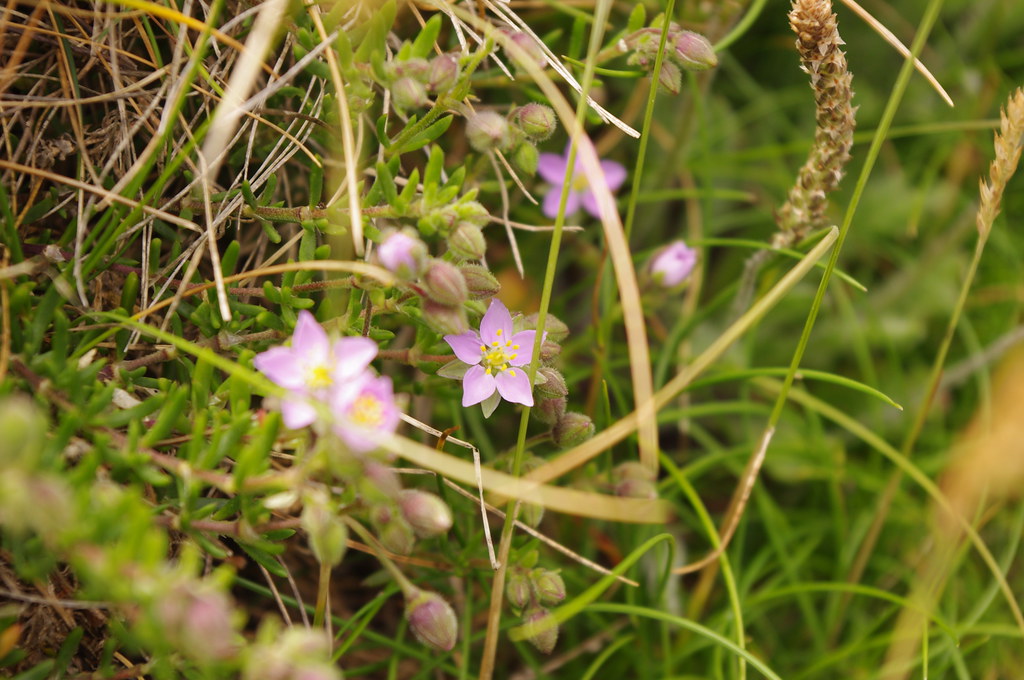
Rock sea-spurrey

Out of necessity, there are certain key species that most of us will learn as children. These vary from region to region and generally fall into two categories: things that are bad and can hurt you, and things that are good and may even be useful in some way. In Appalachia, the "bad" species include poison ivy, black widow spiders, copperhead snakes, and yellow jackets. "Good" species are things like yellow woodsorrel ("sourgrass"), raspberries, American robins, and white-tailed deer. Beyond this, it's really up to you to do the legwork and expand your horizons.

This can be accomplished alone, but having a partner (or partners) in crime can really be helpful...which brings me to the point of this post. I've now been living in the UK for four years (!), and I have been slowly but surely learning new species along the way--an achievement that helps me feel more and more at home here. (Just as most people feel more comfortable when they are surrounded by familiar faces, I am most relaxed when I know my habitat.) However, I've reached a bit of a plateau, both because I keep visiting the same spots again and again, and also because, I admit, I have limited knowledge and abilities. At this point, if I want to improve, I need to travel, and I need to start conferring with others.

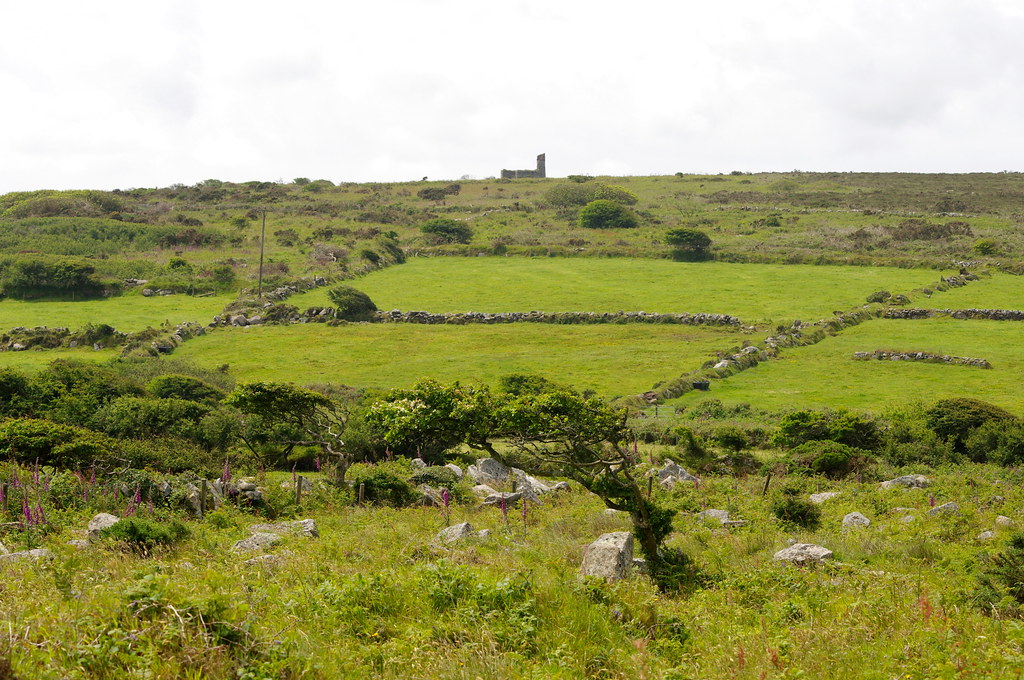
An old tin mining facility sits on a hilltop above Bodrifty

Last week, I achieved both of these goals by going on a local adventure with friend, former colleague, and former student Amanda Scott. Like me, Amanda is a transplant here in Cornwall, but she is probably more enthusiastic about local culture and wildlife than many of the natives are; she travels around the county in order to explore all that it has to offer so that she can provide descriptions and recommendations on her blog. She invited me to accompany her on an expedition to Bodrifty, site of an Iron Age settlement dating to somewhere between the 4th and 7th centuries BCE.

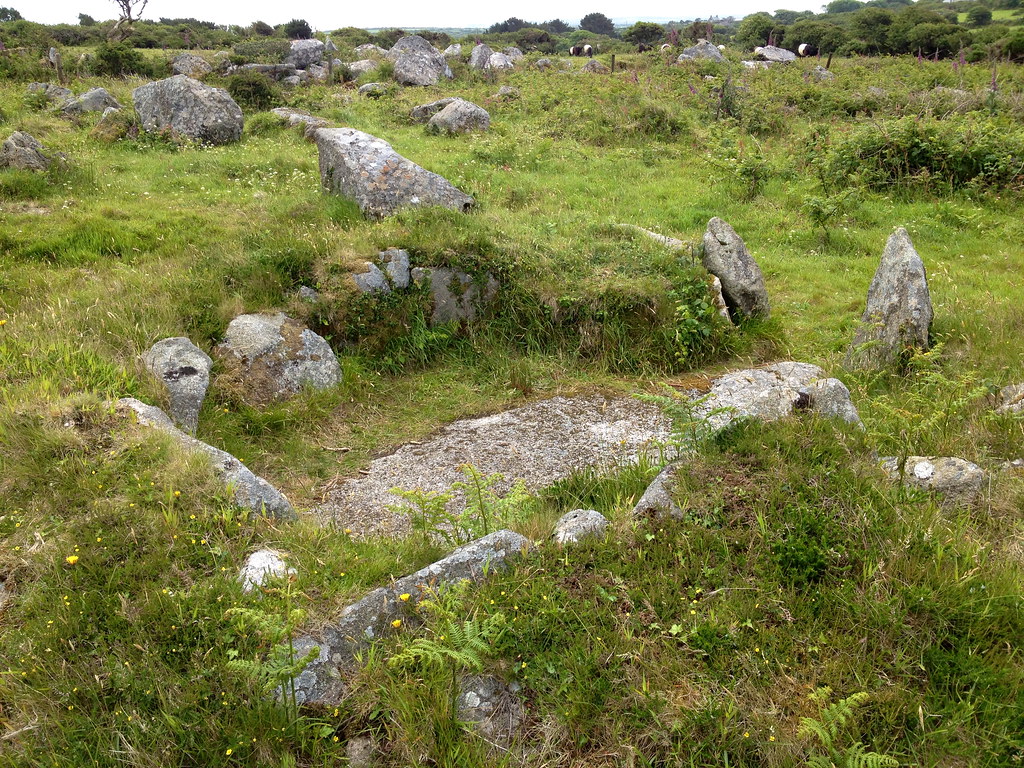
In its heyday, Bodrifty comprised eight stone roundhouses, the remnants of which can still clearly be seen at the site. The area was excavated in the 1950s, yielding a haul of pottery shards that are now housed in the Royal Cornwall Museum (Truro). It is fascinating to walk through the ruins and note the tininess of all the buildings and imagine what the area would have been like 2,500 years ago. Because Bodrifty is undeniably rural (despite being only three miles from Penzance), it was noticeably calm and peaceful; during our entire visit, the only sounds Amanda and I could hear were insects, birds (including a distant cuckoo), and, of course, wind.

Remnants of a small roundhouse at Bodrifty

Bodrifty is by no means exciting, but it was very pleasant and relaxing, and chock full of wildlife--which, of course, is one of the main reasons why Amanda and I had gone there. Within just a couple minutes of exiting the car, we had already stumbled across species I'd never before seen. Amanda is very knowledgeable about plants, and for some reason my memory is better when I learn from people rather than books, so it was a match made in heaven; I was able to add several new wildflowers to my repertoire.

Milkwort (we saw both common and heath, and I am not sure which one is shown here because I can't see the distinguishing feature in the photograph; sorry, botanists!)

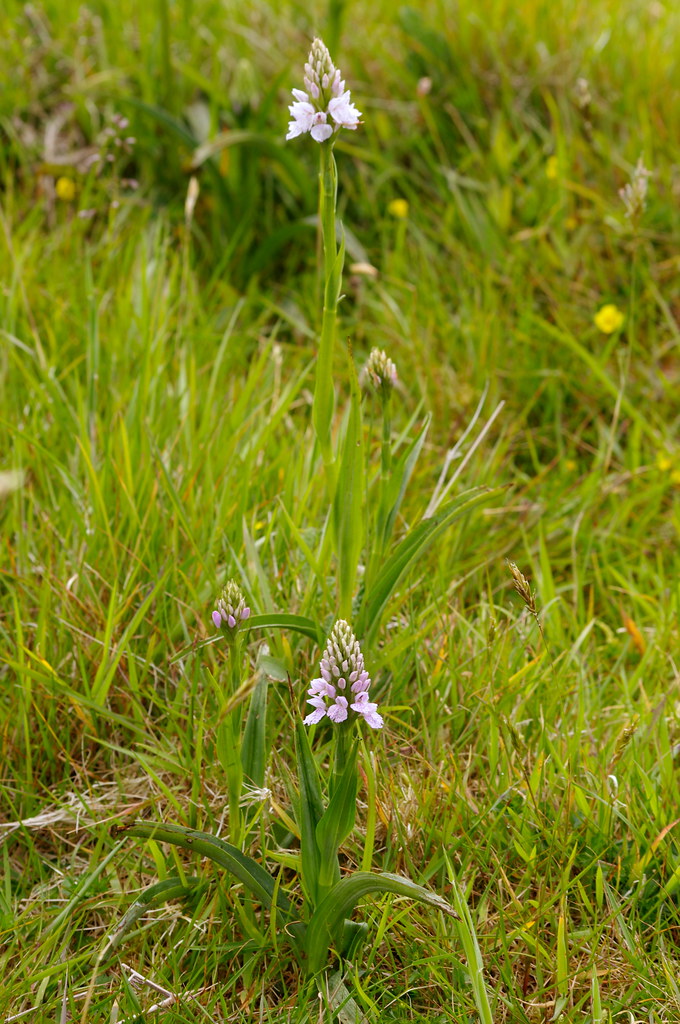
Heath spotted-orchid, trying its best to confuse us by not having spots on some of its leaves

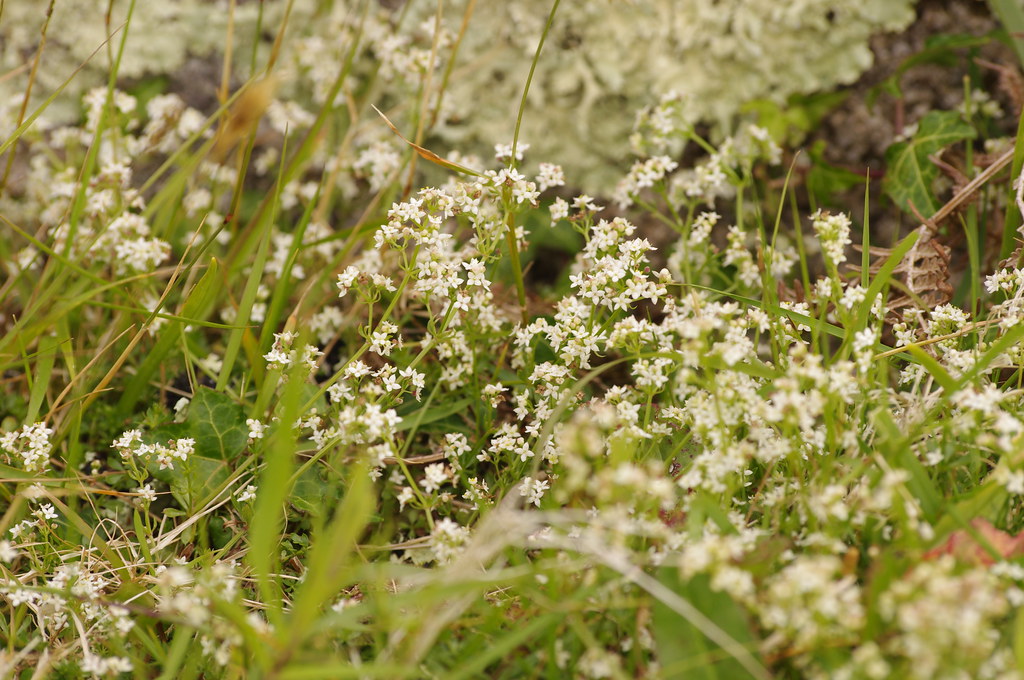
Bedstraws. I'm not sure what kind because these all look pretty similar, and there are several different species to choose from. I'll be able to tell them apart some day, I promise!

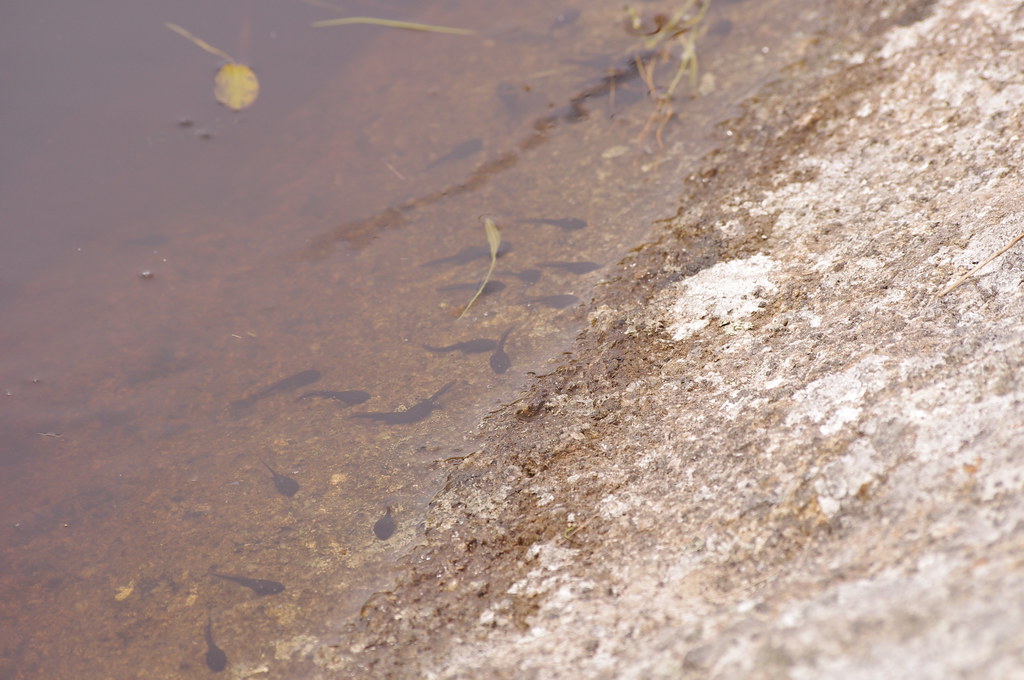
We also discovered a pond, which not only yielded a new species of plant, but also our only amphibians of the day:

Tadpoles!

Can you believe that I was twenty-five years old when I saw my first tadpoles in the wild? I still find them absolutely captivating. There were hundreds in this tiny pond, and I probably could have sat and stared at them all afternoon.

Once we'd had our fill of Bodrifty, Amanda and I decided to extend our adventure by visiting another local spot. Amanda's map indicated that there were several potentially interesting destinations nearby; we chose to head almost directly north towards Treen, which has a crossroads where the Southwest Coastal Path meets a public footpath that leads out to Gurnard's Head--a tiny finger of land that juts out into the Celtic Sea.

I would happily live in either of the two houses in this photo.

We had a fantastic view of the ocean and could clearly see the nutrient-rich currents running towards and along the shoreline. These are the sorts of areas that basking sharks love, but Amanda and I never did spot any--though it wasn't for lack of trying. We did, however, see a variety of other interesting species.

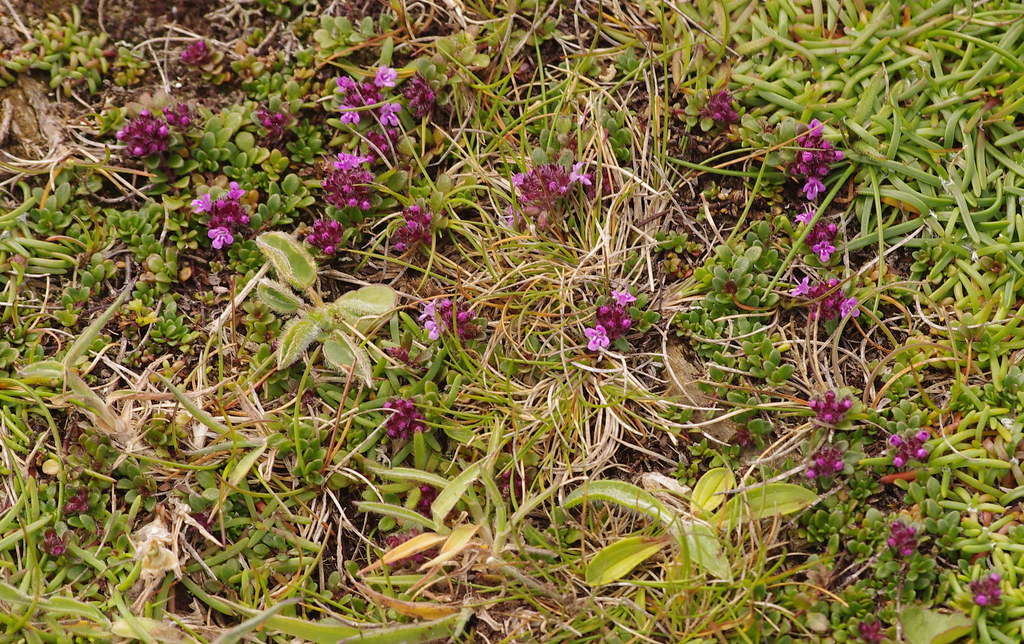
Wild thyme (the pink flowers)

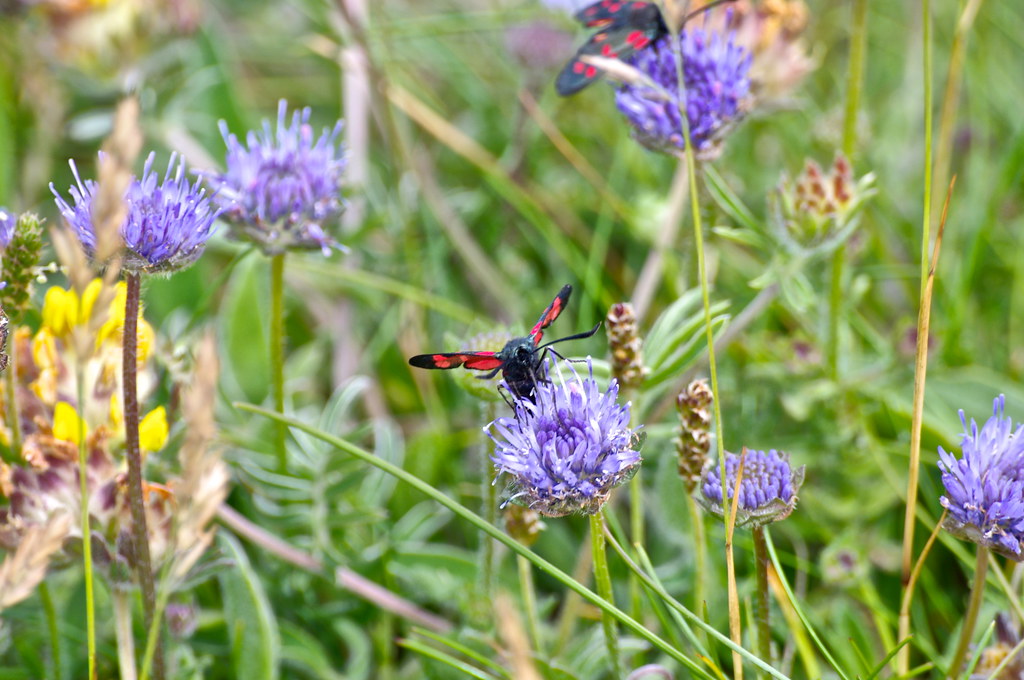
Burnet moths on sheep's-bit, with some kidney vetch in the background

Cream-spotted tiger moth on some sort of umbellifer (potentially cow parsley?). Amanda and I were later told that this was quite an exciting sighting, though we didn't realize it at the time.

Once we reached the head, Amanda and I found a nice spot of soft grass to sit on while we enjoyed our picnic lunches. The skies cleared as we ate, and soon we were basking in sunlight and reveling in the amazing colors of a Cornish summer. Overhead, peregrine falcons, northern gannets, kittiwakes, and fulmars added to the show. All in all, it was pretty spectacular, and it was with great reluctance that we finally headed back up the hill to begin the journey home.

Given the loveliness of the ruins, the diversity of species encountered, the beauty of the sunny afternoon, and the pleasure of good conversation, I'd say the day was a success. Thanks again to Amanda for inviting me along, and here's hoping that I get to poach some more of her knowledge on another trip in the near future!

The farewell committee at the public footpath

Sunday, 16 June 2013

Death by shanty

If you were monitoring my Facebook and Twitter feeds this weekend, you may have noticed my displeasure at inadvertently having "box seats" for the 2013 Falmouth International Sea Shanty Festival:


I don't intrinsically have anything against sea shanties. After all, I am a lover of both history and music (although fans of music can often object to shanty performances on the basis of, as I referred to it above, "spurious harmonizing"). The problem is that even the best shanty performances grow tedious after about, say, 30 minutes. Since I live in the square where the Shanty Festival activities were concentrated, I had to listen to far more than 30 minutes--not just during a single day, but over a 2.5-day period that corresponded with the weekend that I needed to use to unwind after a very stressful two weeks at work. As you might imagine, exposure to 50 performances of "Sloop John B" does not facilitate relaxation.

The only thing you can do in such a situation is try to make the best of it, so I did a little research in order to learn about the culture to which I was being exposed. Many audience members were dressed as pirates (it doesn't take much to prompt that sort of thing in Cornwall), but shanties were traditionally sung by any workers on "square-rigged ships in the Age of Sail." The point of the songs was to keep all the workers in rhythm with each other. To this end, there were three types of shanty: short haul, halyard, and capstan. The first were associated with quick movements lasting for only a short period of time; the second were associated with slower handiwork involving heavier items; the third were associated with sustained, repetitive work. (Thanks to Andrew Draskoy for this information.)

View of the festivities from my balcony

One thing I've always wondered is why songs like "Proud Mary" and "Sloop John B" (*shudder*) are always rolled out at the Sea Shanty Festival, since they are obviously not shanties. The answer to this was provided by the official Falmouth Sea Shanty Festival website, which states that these non-working songs are called "forebitters," or tunes that were sung when the crew were getting some R&R. Apparently, sailors would often use these songs to air complaints about the captain, ship, or working conditions; if questioned, they could say that they merely learned the song from someone else, or that it was about another ship. In other words, shanties were useful for promoting harmony on board the ships (see what I did there?).

According to the website, the last working shantyman was a sailor named Stan Hugill, who once said that it was more important to have high volume than "tonal clarity," since the songs needed to be heard by men working high in the rigging. I can see the logic of applying that strategy to shanties sung on board ships, but I really wish that modern-day recreational performers weren't so hung up on this idea--or that, at the very least, they would strive for volume and clarity in equal measures. Off-key singing is bad, loud off-key singing is worse, and an entire weekend of loud off-key singing is like a nightmare come true.

Herring gull at Swanpool Beach. Because the weather was windy and rainy this weekend, the gull and I pretty much had the beach to ourselves. Bliss.

My coping mechanism this weekend was to periodically leave my apartment for a couple hours at a time. On my first trip, I headed to the theater to go see a film. Much to my dismay, I passed several groups of shantyers along the way--including a team in Seasalt, one of my favorite clothing stores in town. (Someone has finally devised a way to keep me from shopping there!) The theater was overrun with children attending a birthday party, so that was a bit of a frying pan/fire kind of situation. I was finally able to escape the shantyers by walking along the coast. The sounds of nature are always soothing, but never more so than this weekend.

A group of female mallards hanging out at Swanpool. The only unpleasant sounds here were the occasional grating squawks of coots.

All joking aside, the shanties can actually be quite interesting to hear--especially if you come from a non-nautical background and have never before been exposed to such things. The Festival is good at not only highlighting and venerating the music, but also providing a place for people to celebrate maritime culture and Cornish history. From my lofty perch, I could see sailors' stripes in a variety of patterns and colors, old-fashioned fishermen's caps, amazing pirate cosplay, and many an impressive grey beard on a grizzled old face; I could also hear a good number of thick Cornish accents and lots of audience participation. It is great to see and hear so many people interested in the region's heritage. Also, the event raised hundreds of pounds for charity. Yay!

In order to give everyone a taste of what it was like to be me this weekend, I whipped out my recorder after a particularly talented group took the stage on Saturday afternoon. Clips of their performances are below:


---
(I love how my Soundcloud profile photo makes it look as though I'm singing the shanties.)

I won't lie to you: I'm very relieved that the Shanty Festival has drawn to a close. (Though, as I type this at 11:30 PM, I can hear strains of late-night shanties coming to me from the local pubs, which are at least 200 m away on the other side of several buildings; shantyers a) have a lot of stamina, and b) really do know how to generate high-amplitude songs.) However, I'm glad that the Festival exists, allowing a hugely diverse group of people to come together for a couple of days. As I said above, I love music, and not just for aesthetic reasons. As this past weekend demonstrates, upbeat, harmonious, multi-part songs like shanties can promote goodwill and inclusiveness--even touching the heart of this grumpy landlubber Yank. (If only momentarily.)


A hint of sun as the Festival draws to a close...

Friday, 14 June 2013

Kenya 2013: The Sounds of Africa

Many months after the fact, I have finally gotten around to writing about this year's adventures in Kenya. Although we had many interesting adventures and sightings, they were, overwhelmingly, similar to the adventures and sightings I've written about from previous trips (Kenya 2012, Kenya 2011 a, b, c, d, e, f, and g). I also stole my own thunder by posting on the University of Exeter's Africa blog site throughout our journey, and by posting most of my 2013 photos on Flickr shortly after I returned. So, what on earth could I possibly have left to share?

We weren't the only foreigners at Lake Naivasha. Also staying at the campsite was this peacock, a native of Asia.
No wonder Paul Simon was inspired to write about the goings-on "under African skies."
Frolicking vervets.

Well, all right, so I did have a few extra photos that I didn't post on Flickr. But, even better, I have a bunch of sound recordings I made as we traveled around Kenya. I wanted to try something new this year, so I packed my audio recorder in addition to my camera. I collected recordings of the ambient noise at each new location, plus I targeted individual sounds that I thought were particularly interesting.

Part of the reason it took me this long to listen to the clips was that I was worried they wouldn't turn out very well. Last night, though, as I sat and waded through all 40 audio files, I was pleasantly surprised by the quality of what I'd captured. I'm not saying this to pat myself on the back; all I did was press record. It's actually a compliment to my wonderful Marantz PMD620!

Sound is so intensely evocative; I find that it is even better than photos and videos at bringing back memories and returning you to a previous state of mind or feeling. Listening to the clips--particularly the ones of the nighttime noises--I could almost have closed my eyes and believed I was back in Africa.

So, without further ado, here is an acoustic summary of our Kenya trip. If you want a really immersing experience, you can listen to the recordings while browsing through my photo gallery!


Kenya at night Kenyan birds Kenyan mammals Masai voices

Sunday, 9 June 2013

Foodie Penpals--May Reveal

As far as I can recall, all my previous Foodie Penpals exchanges involved partners in either the UK or The Netherlands. This month, however, two more countries were added to the list: Germany, the destination of the package I mailed, and Switzerland, the origin of the parcel I received.


Luckily my parcel arrived in much better shape than the one I mailed. The original package seemingly vanished in the post, and I was on the cusp of mailing a replacement when my penpal wrote to say that the first one had finally shown up (on the reveal day itself!), looking very much the worse for wear. I was relieved to hear this news, though it's a shame that it didn't happen before I bought all new edible treats to send. I guess I know what next month's penpal is receiving (just kidding, Miriam!).


My parcel--which, as you can see, arrived on a sunny spring day--was full of Swiss goodies. The first thing that caught my attention was the home-grown bay, the scent of which came bursting from the package as soon as I opened it. The difference in leaf size between store-bought and home-grown is pretty amazing, as is the difference in the intensity of the smell and flavor. I wasted no time experimenting with the leaves, using one that evening in a homemade pasta sauce.


My penpal sent along some Swiss-style muesli, which I have been using to make a fancy version of Overnight Oats. Also included were some meringues, which I need to find a use for. I'm thinking some Eton Mess, which I might serve at the upcoming viewing of the Game of Thrones season finale?


I also received some Swiss chocolate, which is tantalizingly good. One evening after work, I went to have a couple pieces of the crunchy nougat bar, but then wound up eating the whole thing. It's hard to resist chocolate that smooth.


In addition to the fragrant bay leaves, the other "floral" component of my parcel was a bag of edelweiss tea. As someone who loves both tea and the song "Edelweiss" from The Sound of Music, I was quite excited to see this particular item. I had no idea that edelweiss ("little white flowers") were edible. I still haven't had a chance to brew a cup because I've been running around so busily over the last couple weeks. However, I am very much looking forward to finding out what this tea tastes like.


As much as I liked all the food that I was sent, I think my favorite part of the package was the accompanying card, which included a hand-drawn map of Switzerland showing me where all my different food items came from. For me, one of the most interesting things about the Foodie Penpals program is tasting regional specialties that I can't get down here in Cornwall; this map really emphasized how great these parcels are at expanding your culinary horizons and taking your taste buds on a little vacation. Thanks very much to Kadri for the enlightenment and the excellent choices for my package!

Sunday, 19 May 2013

Where to Eat in the Isles of Scilly: Juliet's and Spero's


I had intended to take a break from food blogging while on the Isles of Scilly food course because, let's face it, it can get a little tedious to read about someone's every meal. But then this happened:


This is the "edible garden," a new appetizer served at Juliet's Garden Restaurant, one of our favorite restaurants on the Isles of Scilly. Juliet's used to specialize mainly in teas and baked goods, but then the restaurant got a bit more serious about cuisine. We first started having meals there a couple years ago, and now we make sure to have a Juliet's dinner at least one night during our stay on St. Mary's.


We also tend to eat lunch there after we take the students rockpooling on nearby Porthloo Beach. That was the case on the afternoon when I ordered this fascinating dish. The veggies were "growing" in "soil" composed of sour cream, bread crumbs, Marmite (they sneaked that in on me), and probably some other stuff that I'm forgetting. In addition to home-grown carrots and radishes, the garden also included some wildcrafted plants, including three-cornered leeks and other edible wildflowers. The toast came with a delicious olive tapenade spread that I think was probably also created to mimic the appearance of soil. The whole thing tasted very fresh and wholesome, plus it looked gorgeous and was just really interesting.

The waitress asked me to provide some feedback, because the chef was uncertain about his new dish and wanted to know what customers thought of it. I told her that my only complaint was that I ran out of veggies to dip in, and use up, the "soil" in the little pot. Apparently the dish had been selling very well, so obviously I was not the only one intrigued by the concept. It will be interesting to see whether it remains on the menu; I hope so, because I would definitely order it again next year!

Once I'd begun documenting my meals, I couldn't stop, so I carried on the following evening when we ate out at Spero's. Like Juliet's, Spero's is near Porthloo Beach and has fantastic views of the bay; then again, there aren't too many bad views anywhere on St. Mary's. Spero's is housed in a building that used to be a boatshed; it has giant vaulted ceilings high enough to fit the mast of a yacht, but can only accommodate a few tables because it doesn't have a lot of square footage. As a result, it manages to simultaneously be spacious and intimate.

I have always loved the food here, to the point that I have a hard time choosing whether Spero's or Juliet's is my favorite Scillonian restaurant; usually I pick based on whichever one I've eaten at more recently. Our meal this year was really phenomenal, and was made all the better by the fact that the waitstaff squeezed us in on an evening when all the tables had been booked--extra points for excellent customer service.


I started my dinner with a bowl of apple and celeriac soup with truffle oil and some rosemary focaccia bread. It was rich and velvety and really fantastic. Usually it drives me crazy that 99% of all British soups are blended rather than chunky, but, as this dish showed, sometimes that is the perfect method of preparation.


Two of my colleagues ordered the scallop and chorizo kabobs, which looked beautiful and, I am told, tasted equally lovely. As I have probably written a hundred times already, you can't go wrong with Cornish scallops.


For my main course, I ordered the same thing I had last year: the baked field mushroom stack with veggies, goat cheese, and pesto. I have a hard time saying "no" to goat cheese, and I also have a weakness for mushrooms. This is a really tasty meal, and a hearty alternative to meat.


Some people, of course, aren't interested in avoiding meat at all; two of my fellow instructors ordered steaks. Spero's offers a choice of sauces (pepper, bleu cheese) to accompany its steaks, and we had one of each at our table. Both were highly praised by the carnivores.


Sasha ordered the chicken saltimbocca, which was served with sauteed tarragon potatoes, seasoned vegetables, and a red pepper sauce. Sasha is not a huge fan of cream, so he wasn't in love with the heaviness of the creamy sauce. On the whole, though, I think he did enjoy the flavors of the dish.

Although I don't often indulge in dessert, I did have to break with tradition and try the lemon tart, served with vanilla ice cream:


There are few sweets I love as much as a lemon tart, and this was a good one. As far as I'm concerned, lemon is the best flavor for dessert because you can make it sweet and rich, but the sharp citrus taste ensures that the dish is not overwhelming and heavy. Delightful.


My fellow diners chose finales that were a bit more intense. Sasha got a sticky toffee pudding (above), while Julian ordered the Jack Daniels cheesecake (the cheesecake flavor of the day; below):


Both were quite rich and intense; they were praised by Julian and Sasha, but I have a suspicion that I ended up with the best selection.

With dishes like these on offer at terrific restaurants all over the island, you can probably see why it is a very good thing that we spend our days burning calories by hiking around and trudging up and down the big hill to our campsite! Another great thing about both Juliet's and Spero's is that they are quite affordable; their dishes cost more than our students want to pay (which is great for ensuring some "alone" time!), but they are very reasonable considering the quality of the food and the incredible scenery that you get to enjoy while dining.


Sunday, 5 May 2013

Isles of Scilly 2013

During the final week of April, I ended my 2013 academic travel season by journeying to the Isles of Scilly with second-year University of Exeter biosciences students. This was my fourth year as an instructor on this particular field course; I've written about previous trips here and here. Even though the itineraries are fairly similar from year to year, each trip always has its own personality--in large part, I think, because of the different students that cycle through (though, as ever in Britain, weather fluctuations are also very important!).

St. Michael's Mount, Penzance

One huge and wonderful difference this year were the conditions during our trip to the islands. If you read my account of last year's trip, you may recall that the 2012 journey was the most sickening thing I have ever experienced, thanks to the powerful winds and huge swell. This year, the sky was perfectly clear and the sea was amazingly flat, and everyone kept remarking on how it was the most beautiful day that had ever been seen for a crossing. It was truly lovely, though, as always, a bit chilly up on deck--I was shivering despite being thoroughly bundled. I was also incredibly drugged; I wasn't taking any chances with motion sickness, so I popped a Dramamine before every aquatic outing and therefore spent quite a bit of time feeling dopey (but not nauseous!).

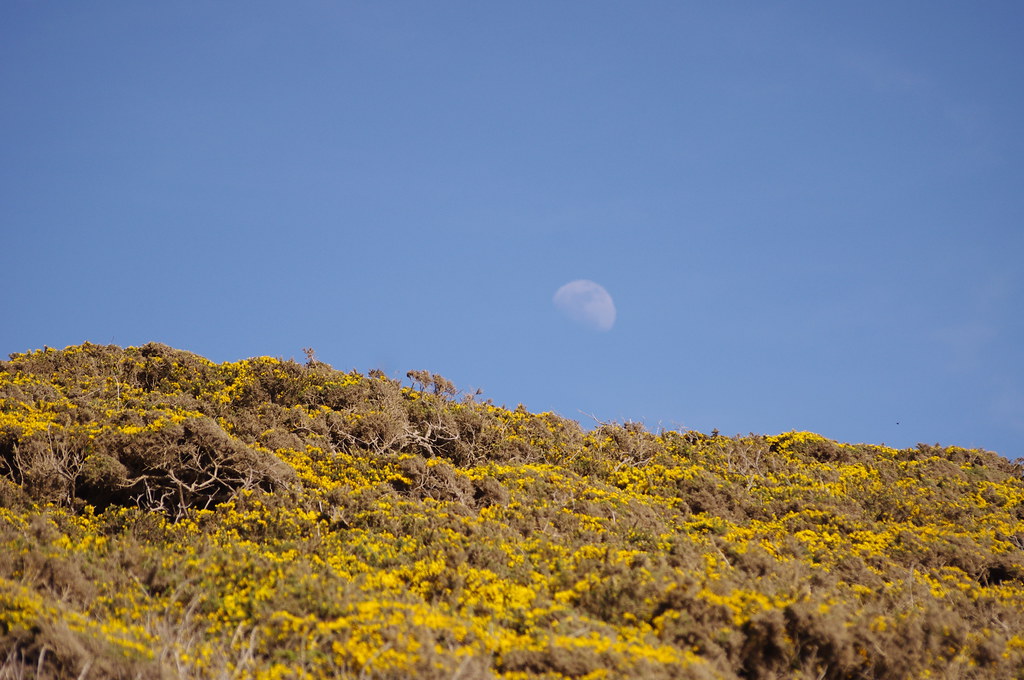
Our arrival on the Isles coincided with the last few days of the moon's waxing, which gave us some incredible views and allowed me to take one of the most beautiful photos I've ever taken--though this says less about my own talents than it does about the insane beauty of the Cornish landscape:


The only problem with the increasingly full moon was that it obscured the Lyrid meteor shower on the couple cloudless nights we experienced during our stay on the Isles. Nevertheless, to my great excitement, I did manage to see a single, blue-tinged meteor go streaking across the sky. This was actually a pretty big feat because even though the Lyrid event can bring hundreds of meteors per hour during its peak, they are often quite faint--especially when there is a giant full-ish moon in the sky. I got lucky because there was some partial cloud cover that intermittently covered the moon and allowed me to see the other celestial bodies more clearly. While stargazing, I also managed to see several satellites zipping past, though sadly I was unable to get a glimpse of the International Space Station (with which I have become a bit obsessed after beginning to follow Commander Hadfield's space-based Twitter feed).

Daisies and lesser celandine decorated the lawn near the Garrison

This year, the students started their research projects right away, giving the staff almost two full days of alone time before we did any group activities. I did quite a lot of grading each day, but I also took advantage of the opportunity to hike around the island and look for wildlife. Thanks to changing weather patterns, the Scillies have looked different each time I've visited. On one of my first couple journeys, a mild winter had ushered in an early spring, and I can clearly recall the masses of beautiful pink thrift in bloom everywhere I looked. As the winters have gotten harsher and longer over the past two years, the thrift has bloomed later and later; this year there was only a handful of flowers and buds, with most of the plants still in hibernation. Instead of pink, the islands were dominated this time around by yellow--mostly the yellow of gorse and lesser celandine. It is amazing how different everything looks and feels with different things in bloom.

The other huge ecological difference this year was the lack of auks seen during our boat trip out to the Western Rocks. Puffins in particular were quite scarce; we saw a couple during our ferry ride to St. Mary's, but none were seen subsequently (to the great disappointment of the students). We did see a few guillemots and razorbills, but nothing like the numbers encountered previously. Here's a visual to help you see the disparity:

Both of these photos were taken of the same island--and even, I believe, of the same outcropping--at the Western Rocks. The top photo is from 2012 and shows just how many auks we encountered during our cruise; the bottom photo shows the much reduced number of birds we saw in 2013.

I hope this pattern stems only from differences in weather; if so, the birds are likely just delaying their migration by a few weeks because they're waiting for conditions to become more favorable in the Scillies. However, thousands of seabirds died off the southern coast of Britain this winter after a ship illegally dumped some sort of sticky oily substance in the Channel. Thus, it is also possible that the Scillies has low numbers of auks because many of them perished after becoming coated with pollution. Pointless, unnecessary, and utterly sickening.

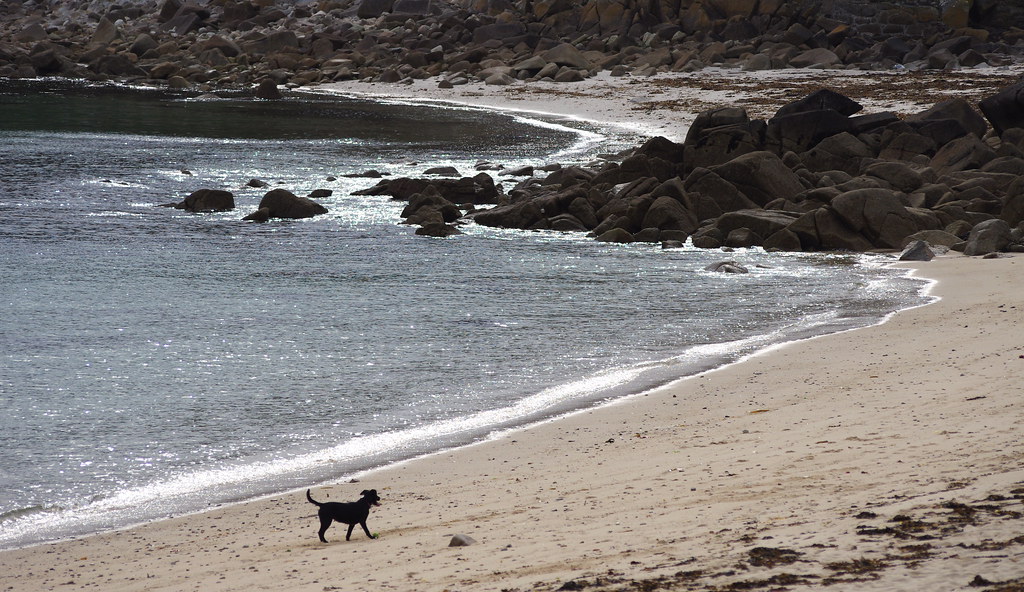
A dog frolics on Porthcressa Beach, St. Mary's, Isles of Scilly

On a happier note, there are a few places I always visit when hiking around St. Mary's; I'm particularly fond of the wetland areas and their waterfowl hides. This year I was massively excited to spot two snipes--birds that I haven't seen for at least a decade. There was also a beautiful pair of pintails, and an egret that strode around confidently snatching up a seemingly endless supply of fish from one of the small ponds. In order to get a little variety, I visited some of the island's Bronze Age and Iron Age ruins, which I'd previously glimpsed from the boat but never seen up close.

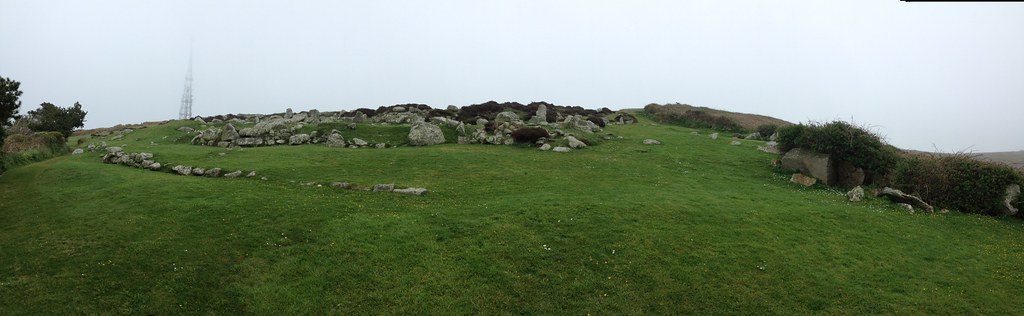
Bant's Carn, St. Mary's, Isles of Scilly

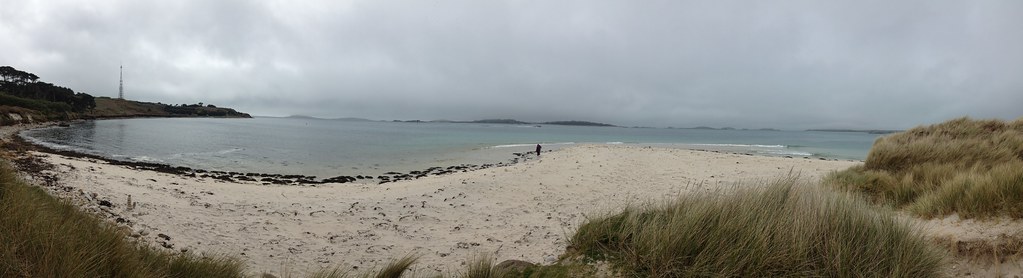
Part of the reason I headed to the ruins was that they were in the vicinity of the telegraph tower, which was the location of a recent shrike sighting. I was never able to find the elusive bird, though I saw a good many old burial chambers and hiked along a large section of the coast that I had never visited. During the several hours that I spent wandering around the northwestern portion of the island, I encountered maybe a half dozen other people; mostly, it was just me, the birds, and the wildflowers--pretty heavenly. I discovered all sorts of sandy beaches that I didn't even know existed on St. Mary's, and got good views of Tresco and St. Martin's not far off the coast of the island.

One of St. Mary's "hidden" beaches, with Tresco and St. Martin's islands off in the distance

The one thing that bothered me about all this hiking was how poorly marked the area was. There were really clear signposts to the various ruins, but then nothing else was labeled. There were bits where I couldn't tell the difference between the coastal path and someone's private road, and at no point could I clearly tell how on earth to get back to Hugh Town. I was beginning to think that I might have to circumnavigate the entire island just to get home. On a whim, I decided to take a random path inland and just follow my inner compass; luckily, it got me where I needed to go without any ridiculous detours. In the process, I was able to see even more portions of the island that I'd never encountered before--the predominantly non-touristy areas where the Scillonians actually live. I was left feeling very jealous.

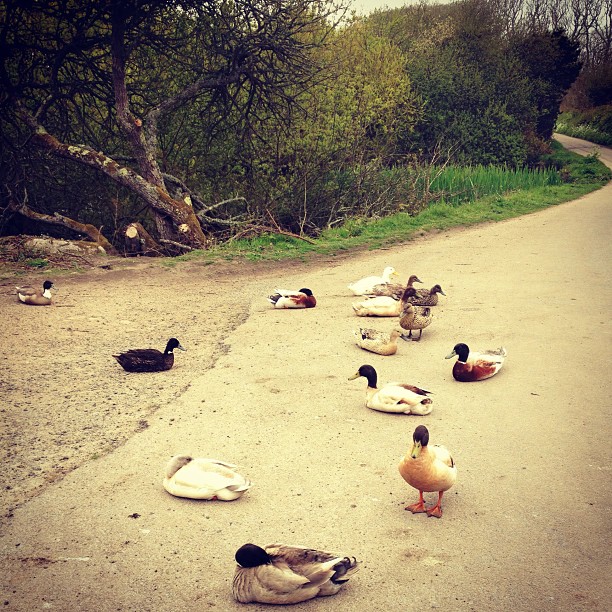
Mallards, domestics, and mallard-domestic hybrids hang out by the side of a little-used road

My least favorite part of the Scillies trip is usually the rock pooling trip during which we teach the students about different tidal zones and adaptations allowing organisms to survive periodic exposure to sunlight, air, and saltwater. In general, I love looking at wildlife and learning new species, but I struggle with this particular exercise. For one thing, I have a (ridiculous) hangup about seaweed--namely, I do not want it to ever touch any part of my body (except when it is in sushi format, in which case it may touch my mouth and stomach). I also hate the idea of sticking my hand down into a rock pool and blindly fishing around for something to grab onto (are you crazy? there are crabs down there!). Also--perhaps most importantly of all--I hate trying to balance on top of slippery, wet, algae-covered boulders; it really hurts my knees and one day I know I'm going to fall and break something.

There is, however, a big part of me that would like to just get over these hangups and have fun with this activity. I love being able to recognize wildlife, and there are so many tidal species to see and learn--not to mention that many of them are edible and can make valuable contributions to one's diet! In the spirit of adventure and education, I tried to get more enthusiastic about the rock pooling this year, and, as a result, I did end up having a much better time with it. The students found some really interesting species, including one of my favorites: a pipefish.

Worm pipefish

We almost made it through the entire trip without any major drama, but on one evening a huge fight broke out amongst some non-Exeter people at the far side of our campsite. One of the campers involved in the dispute shoved her two young children at a group of our students that happened to be nearby at the time, asking them to get the kids out of harm's way. This motivated our trip leader, Frank, to wade in to try to settle the argument and get our students as far away from it all as he could. Although Frank was the embodiment of reason and peace, he ultimately had to call the entire St. Mary's police force (all two of them!) to come mediate. The entire drama lasted for about three hours and was the topic of quite a lot of Scilly gossip the following morning. The speed with which news of this event reached everyone's ears was a perfect reminder of how small St. Mary's really is.

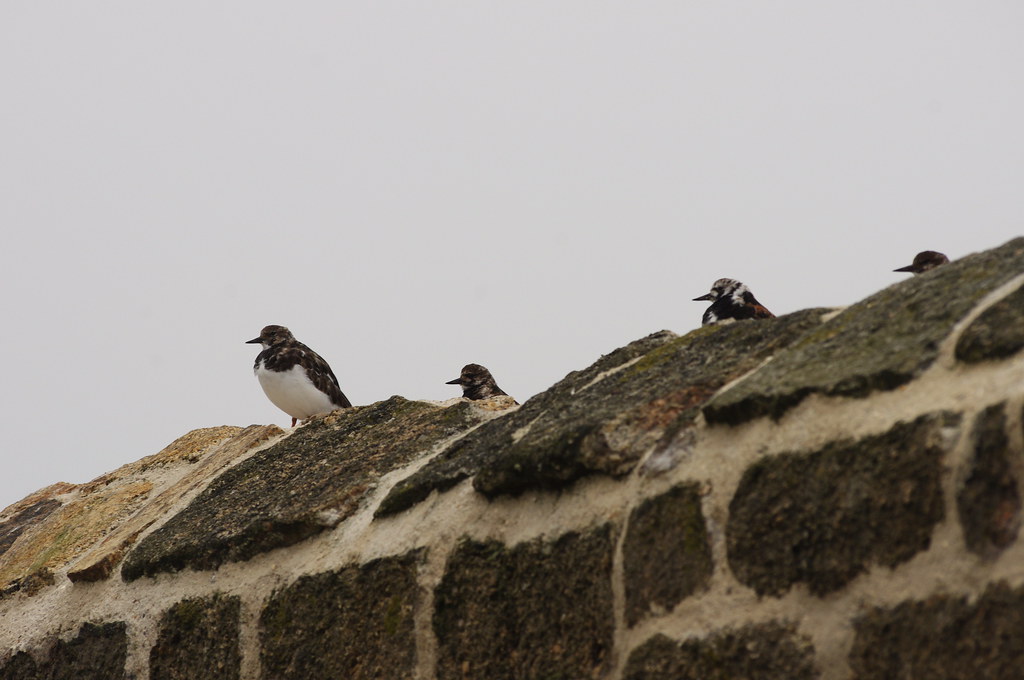
Other than that minor wrinkle, the trip went about as smoothly as we could have hoped for. The clouds unexpectedly parted during the students' presentations on the final afternoon, so we sat bathed in sunlight as we wrapped up our last few official orders of business. The fog descended again during our ferry ride back to the mainland, but was not so thick that it prevented us from seeing several pods of common dolphins out in the open ocean, and another pod of bottlenose dolphins near the Penzance harbor. The water was, again, quite calm--so calm that we arrived 45 minutes ahead of schedule. We were all pretty chilly while waiting for the bus to pick us up, but at least we had these guys to keep us amused:

Turnstones keeping watch along the Penzance pier

One day I'm hoping to return to the Scillies as a non-academic visitor and explore bits of the archipelago that we don't have a chance to see with the students. For now, though, I'm more than happy to earn my trip by pointing out wildlife and chatting about animal behavior. It's hard to believe that such an enjoyable experience could be considered work!