Although I've done my fair share of birding while on trips, I don't really think of myself as a person who goes places with the primary goal of seeing birds. Despite this, I seem to be engaging in ornithotourism (yes, that really is a word) more and more frequently. Last week, for instance, I took a trip up to the Slimbridge WWT (Wildfowl and Wetlands Trust) Wetland Centre in Gloucestershire, located a stone's throw from the banks of the River Severn. My trip coincided with the peak of a week-long tantalizing taste of summer we had here in the UK--and what better way to celebrate such lovely weather than with a long and arduous train journey?
As it happened, the day I needed to travel up to Gloucestershire happened to be the one day when there was construction on the rails between Plymouth and Bristol. As a result, an approximately 4.5-hour train journey took 5.5 hours and involved no fewer than
four transfers and a bus ride: I rode from Falmouth to Truro, where I hopped off and boarded a train to Plymouth, where I hopped off and boarded a bus to Tiverton Parkway, where I hopped off an boarded a train to Bristol, where I hopped off and boarded my final train to Cam & Dursley. Usually I can get a fair amount of work done on the train, but this trip was so disjointed that I barely managed to listen to music without getting distracted.
I am not sure what I was expecting to find in Cam and Dursley, but it was an even smaller train station than the one here in Falmouth; there weren't even taxis waiting in the parking lot, as I'd hoped. Luckily, I was able to connect my phone to the Internet long enough to download a list of numbers for local taxi companies, but not a single one of them had a free driver or car; while two of these were actually busy doing jobs elsewhere, I later learned that the rest probably just couldn't be bothered to leave home on a Sunday evening. *sigh* I was preparing to walk the 3 miles to my hotel, which wouldn't have been so bad except that I had a really full bladder, when a taxi suddenly arrived in the parking lot. The driver had been dispatched after one of his fellow chauffeurs called to say that there were two desperate travelers stranded at the train station. Yes, unbeknownst to me, a fellow train passenger had also been standing in the parking lot calling every taxi company in town, and it turned out that the two of us were even spending the night in the same B&B (not that big of a surprise when you consider how many there are to choose from in the area).
Our taxi driver--from the company A2B, in case anyone is in the Cam and Dursley area and needs a ride--turned out to be a very nice guy who had just spent his day car-shopping in Wales after working until 2 AM driving drunk people home from the pub. He was kind enough to agree to make this one little unscheduled run to the Tudor Arms B&B before going home for the evening, and I made sure that he got an American-sized tip for his efforts. Luckily for me, that's all I had to pay since my cab-mate insisted on paying the whole bill, which I believe was being covered by his company. Win-win.
Although my B&B room was ridiculously affordable, it was quite nice--no wonder the establishment has been given a four-star rating. Florian and I quickly made ourselves at home:
I had a delicious dinner of stuffed mushrooms at the pub next door before returning to my room to take advantage of the free wireless Internet. I had intended to actually get some work done, but instead got distracted by downloading Scrivener, a writing program with all sorts of bells and whistles for helping you organize your research materials and resulting manuscripts. I spent about an hour and a half doing the program's walkthrough and finding out about how incredibly cool it is. It was only reluctantly that I finally shut the computer and went to sleep.
The next morning I was up earlier than I expected, given that we'd just "sprung forward" the day before and I was still on an hour deficit. After having a perfectly poached egg for breakfast, I departed for the short walk to the Wetland Centre. It was already a beautiful day--starting off cool but quickly warming up. The fields were full of both passerines, singing like mad from the hedgerows, and waterfowl, nibbling on the grass just outside the wetland's gates.
Upon my arrival, I was greeted by the Centre's PR coordinator, Mark Simpson, who had helped me organize the trip. Although there would be plenty of time to wander around and enjoy the general bird life, the real reason I was visiting Slimbridge was to find out more about the Centre's captive flamingo population and the techniques required to keep these notoriously sensitive birds happy. Mark had gotten me an appointment with Phil Tovey, the aviculturist responsible for seeing to the flamingos' every need and encouraging the skittish birds to breed. Fortunately, I was not scheduled to meet with Phil until a couple of hours after my arrival, which meant that I had plenty of time to wander around and check out the grounds.
(The main building at WWT Slimbridge)
One of my first encounters was with a pair of wood pigeons, one of the
most common species in the country. Because there is nothing to
serve as a reference in this picture, you can't really tell just how
enormous these birds are.
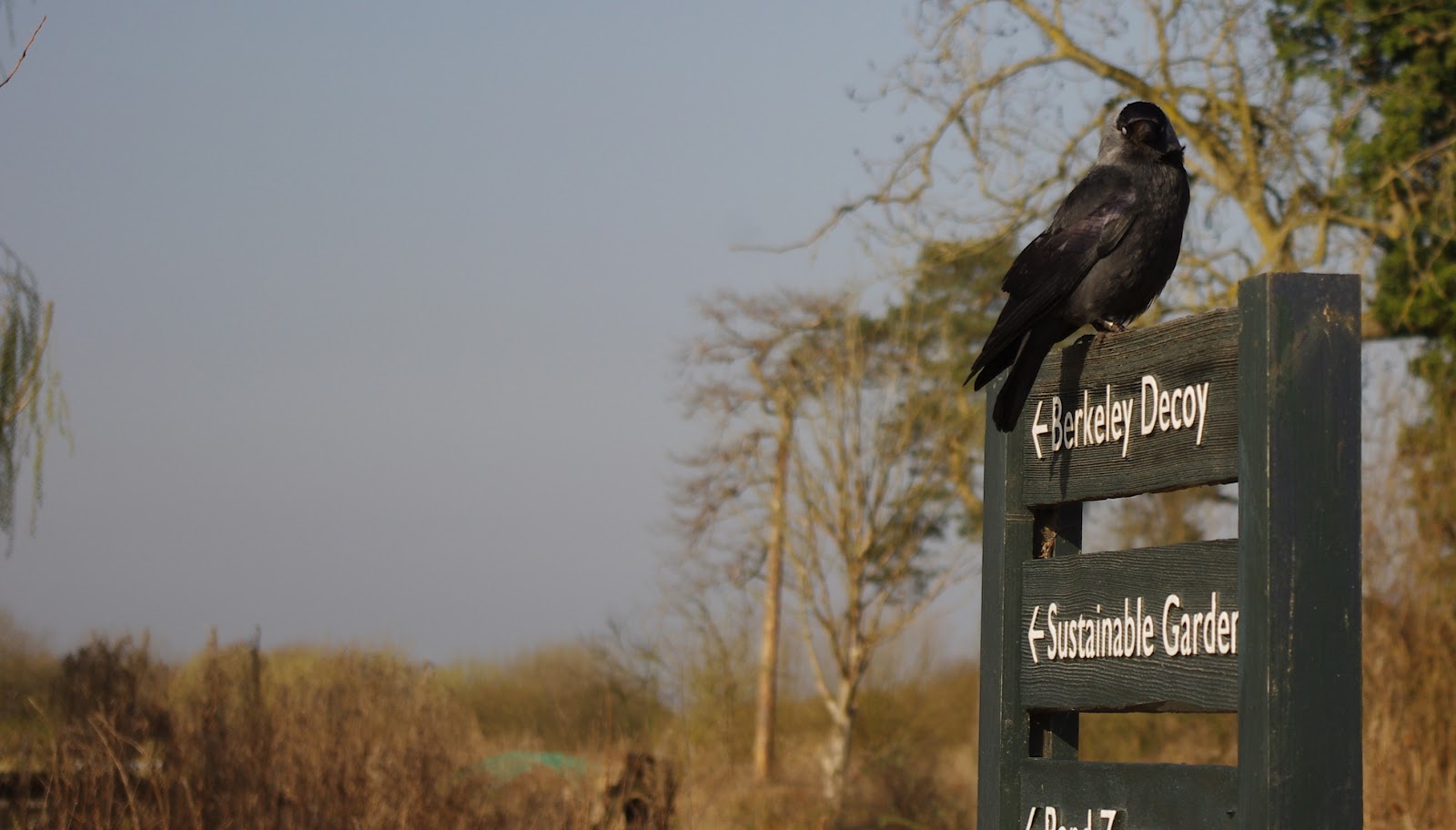
I also stumbled upon a jackdaw who was watching me almost as much as I was watching him. Jackdaws' eyes are a very pale yellow, contrasting strongly with their dark black and grey bodies. The birds look eerily thoughtful as they calmly regard you from their perches.
Since Slimbridge is a wetland, waterfowl were in abundance. The pools are divided up by biome, such that there is one area for North American birds, another for Asian birds, and so on. There are also several local species that hang out wherever they want to, since their wings aren't pinioned and they can come and go as they please. I believe this was the case with the greylag goose I spotted (below). If its face looks familiar to you, that's probably because greylags are the origin of most of our domestic goose breeds.
Among my fellow New Worlders at the Wetland were some red shovelers (below), which hail from South America. They look fairly similar to their northern cousins (the appropriately named northern shovelers) that I've seen in the US, and also to their more distant relatives, the ubiquitous mallard. These guys were amazingly relaxed despite my fairly close approach:
On the other side of the Wetland, I spotted a female coot--a native Brit--working hard to satisfy the appetites of her brightly-colored young:

I would have found this much cuter if I didn't know that coots have a nasty habit of preferentially feeding the stronger of their chicks, first ignoring, and then pecking to death, the weakling. Even though this female was still feeding both of her fledglings, I could already tell that one was receiving more attention than the other. I understand why this is a biologically sound reproductive tactic, but that doesn't make it an easier to watch.

I also picked up some botanical knowledge while wandering around the grounds. I discovered that these twiggy masses are not, as I had assumed, bunches of mistletoe. Rather, they are the trees' own twigs, growing in abundance due to an immunological response to infection by the tiny dwarf mistletoe--which, despite being only an inch or two in length, harnesses the power of water pressure in order to blast its seeds distances of up to 65 feet. The masses are colloquially known as "witches' brooms." If you look closely at the second one from the left, you'll notice a crow perched on one edge; it seems that the birds favor these as foundations for their nests, since half the construction work has already been completed by the host trees.
Soon enough it was time for me to meet with Phil, who was a very gracious and knowledgeable host. All told, he devoted about five hours of his day to showing me the flamingos and answering all of my questions about them. I won't say much more than that here--if you want to know about captive flamingos at Slimbridge, you'll just have to buy my book. =) I did get a few photos I can share, though:
(A mixed flock of (mostly) lesser, one James, and a few Chilean flamingos. The lessers are the ones with dark brown beaks and faces. The James is towards the top left and is the only bird here with a yellow bill; the only remaining James at Slimbridge, this gal (at least, she's thought to be a female) is a minimum of 70 years old. The greyish bird at the front right is one of three Chilean juveniles successfully bred on-site.)
(A mixed flock of greater and Caribbean flamingos. These guys are very closely related and can be hard to tell apart; some researchers think that greater flamingos made their way from the Old World to the New and evolved into the Caribbeans. Greaters are generally much lighter in color, with bright pink only in the wings; Caribbeans--such as the one sitting awkwardly in the center foreground--are much more crimson.)
(The greater-and-Caribbean flock from another angle. The birds are in the midst of a group breeding display--note the heads held high and the wings held outwards. In the foreground you can see the mud nests constructed by Phil and his troops to encourage the flamingos to breed. These are last year's nests; construction on this year's will start in the next couple of weeks.)
(Yep, this is what you think it is--the next step after a breeding display. Unsurprisingly, I've not ever seen flamingo copulation before, but I have read about it; the second I saw this male cozying up to his lady friend, I knew what was coming. As you can see, the female is supporting all of the male's weight, and she may in fact also be feeding...talk about multitasking. While I watched, this couple had several mating attempts--either because some were unsuccessful, or because they just really wanted to make sure it worked.)
(A mixed flock of Andean flamingos (foreground) and Chilean flamingos (out in the yard). The Andeans were standing inside one of the flamingo houses, in which the birds receive their supplemental food, and also where they are kept if the weather gets too nasty.)
Phil eventually had to get back to his aviculture duties, leaving me with another hour or so to explore the Centre before closing time. Unfortunately, all that time out in the hot sun--yes, hot, in the UK, in March!--had left me with a headache, and I had no drugs to alleviate the pain. I went to the gift shop in the hopes that they had some on sale along with sunscreen and batteries and other useful things people always leave at home when traveling, but I was told that they were not allowed. Because I could tell that a migraine was forming, I asked, in desperation, whether there might be a first aid station where I could get some help, and was again informed--quite rudely, I might add--that nobody would be allowed to give me any pain medication. These crazy Brits and their ridiculous health and safety laws.
This left me with no other option than to head back to the hotel, where I'd left my luggage and planned to meet my taxi (scheduled in advance this time!). I figured I might find some drugs hidden away somewhere in my toiletries bag. If not--as turned out to be the case--I planned to have my taxi arrive early so I could stop at a gas station before hopping on the train. I only describe this situation in detail because it is the epitome of one of the most frustrating things about Britain--inconvenience. You really do have to plan ahead for everything, because you can easily find yourself in places where there are no stores, or the stores are so small they don't sell what you want, or they've closed at 4 PM and you didn't realize you needed to go shopping until 4:15, and so on. In the US, of course, even the smallest towns routinely have a gas station with the basic necessities, and that gas station will be open until at least 11 PM. Ah, the convenience of America. But I digress.

As I approached the canal that separates the Wetlands from Slimbridge proper, the red warning lights started flashing and the gate arms came down across the road. At first I was confused because I didn't remember seeing any train tracks there, but then I realized that traffic was being held up for
boats. Because I am my father's daughter, I figured I needed to document the process in detail:
(The first boat through was a boring little leisure craft, but the second was this canal boat named the Ozymandias, a literary coincidence that, for probably the first time in history, collides my father's love of water vessels with my mother's love of British poetry. Incidentally, I often see canal boats while looking out the windows during my Cornwall-London train rides, and I always think how fun it would be to vacation on one.)
(After the two boats had made their way through the crossing, the bridge was swung back in place...)
(...and as I watched from the banks I had the strange urge to run and jump on the bridge as it moved. It was kind of like that weird feeling you get when you're up really high and you're terrified of falling but at the same time you think "I could just step out into that void..." The human mind is an odd thing.)
Once I got back to the pub and collected my bag, I had time for a quick sit-down (which felt wonderful considering that I'd been on my feet almost all day, lugging around my computer in my backpack) and a glass of Coke. When I went out to catch my taxi I discovered that I was to be chauffeured by the same driver I'd had the night before. He obligingly drove me to the Shell station, where I not only got some drugs but also something to eat for dinner during my journey.
My driver and I got to talking again and we covered everything from driving to settling in the UK to starting families. Brits are always asking me where I'm from--just as Americans probably ask the same question of everyone in the US with an English accent. Inevitably, one of the topics that comes up is my "patriation process," if you can call it that, and people seem to find it fascinating; the average person has no idea about all the flaming hoops immigrants have to jump through, and they are usually surprised at how stressful it all is. Another thing they find interesting is the fact that I can't just use my American driver's license over here, but instead have to go through the testing process all over again. They get used to how easy it is to move between the different countries of the EU, and forget that not all international relationships are that smooth. In any case, my driver was Welsh, so I suppose he himself knew a little bit about resettling.
Luckily for me, the train ride home only involved two transfers, so I was able to sit back and get some work done (once my headache went away, that is). The train was unbelievably hot, probably because nobody had adjusted the heating in response to the unseasonably warm weather. I had to strip down to my tank top, but even then I was still sweating. The car cooled down little by little as people disembarked; by the time we pulled into Truro, I was able to put my long-sleeved shirt back on and was also the only person left in my carriage--which was a bit nerve-wracking because it made me feel as though maybe I'd missed my stop. Fortunately, I hadn't, and was able to immediately hop on to my final train of the day. It was dominated--visually, acoustically, and olfactorily--by a group of about half a dozen guys who must have been heading out to drink in Falmouth after pre-partying elsewhere. They had consumed so much booze that the entire carriage smelled like a pub, and I don't think they once stopped shouting/talking during the entire 20-minute ride. At one point they started licking each other's nipples, and I'm not sure that even overconsumption of alcohol is a good excuse for that. All I can say is, it was not a boring journey.
I wish I could say that I will be visiting other flamingo-y places in the name of research--India, Spain, and the Caribbean are particularly enticing--but, sadly, that is not the case. I do have one good piece of news, though: I just bought myself a new camera lens in honor of my rapidly approaching birthday, so my next post should have some lovely visuals.