Sunday, 14 April 2013

Geo field trip to California: The Mojave Desert

No matter how hard I try to combat jet lag, I rarely win, which is why I found myself awake at 2:30 AM on our second day in California. The only benefit of this misfortune was that it allowed me to get online. This was the only time during the trip that I was able to detect and utilize a 4G connection via my iPad; during the rest of our visit, our remoteness prevented all Internet access--something I found simultaneously freeing and infuriating.

Despite my mid-night web browsing, I still awoke well before my alarm went off, and had plenty of time to take in the scenery before breakfast:
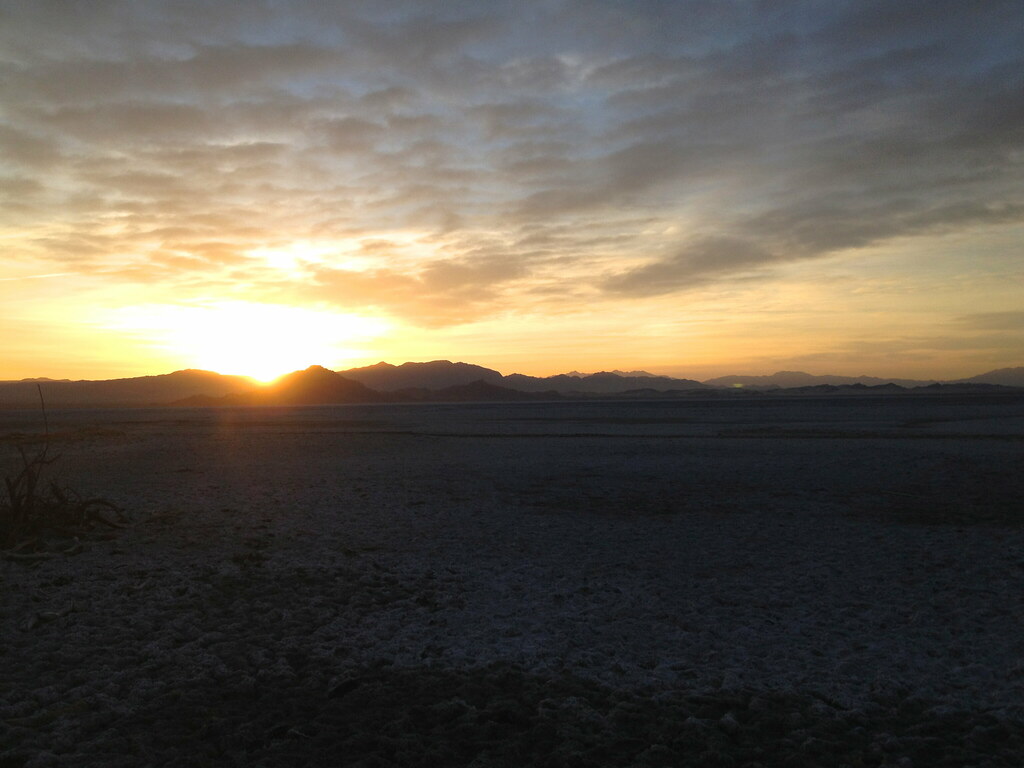
Sunrise over Soda Lake

Early morning at Soda Lake

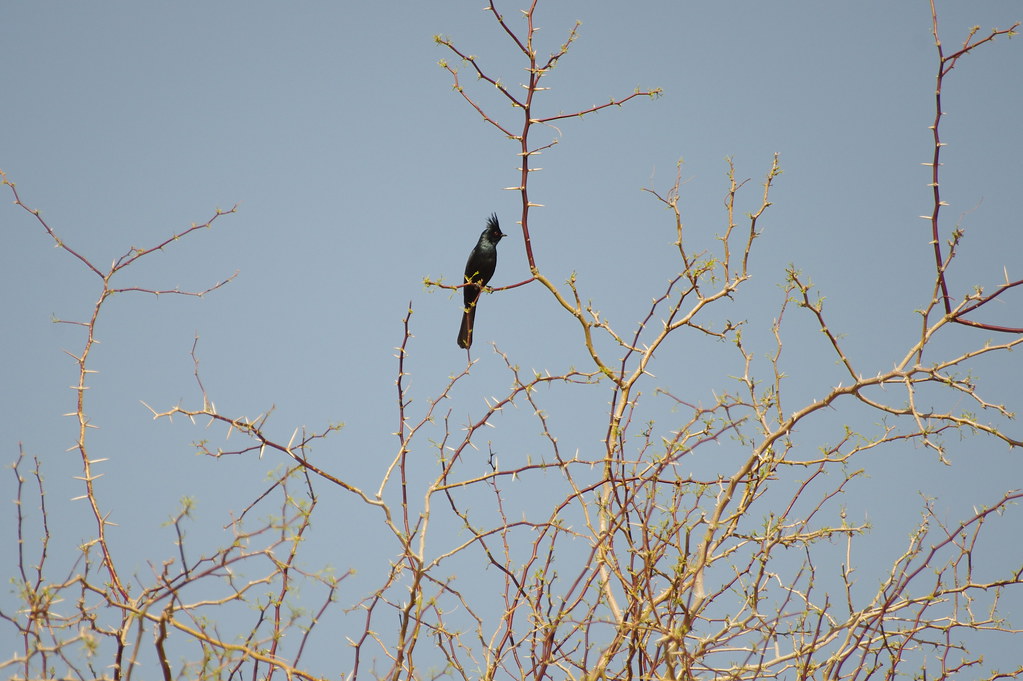
Male phainopepla--one of many species that I saw for the first time during this trip

I was impressed to see that many of the students were also up and about; a dozen or so climbed up the hill behind the DSC in order to see the sunrise from on high. I don't think any of the students packed binoculars, which is a real shame; there were many interesting things to be seen in the Mojave and, later on, in the redwood forest. The most common species at the DSC was, by far, the house finch; hundreds of the chatty birds could easily be seen flying around the oasis in big, noisy groups. There were also some smaller flocks of cedar waxwings and lesser goldfinches, the latter of which was another new species for me. I saw a number of black phoebes, dozens of ravens (some flying around displaying nesting material in an obvious bid to gain a breeding partner), and--to my tremendous excitement--greater roadrunners.
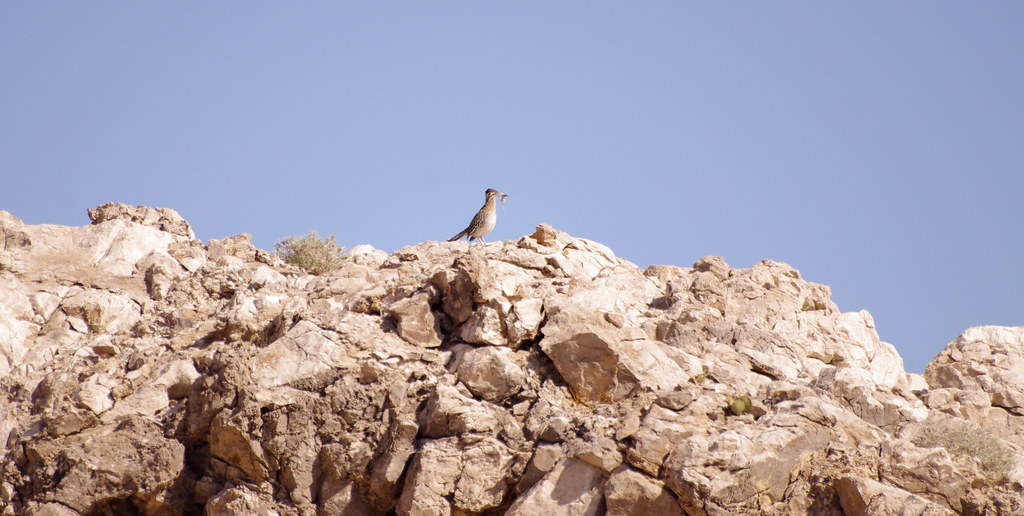
Greater roadrunner with a dead lizard in its bill. I first located the bird by ear; having a full mouth didn't stop this male from singing repeatedly from his hilltop perch.

Of course, there were many other interesting species, as well--not just birds, but also plants, reptiles, and insects. Some of these could be found right outside our doors:
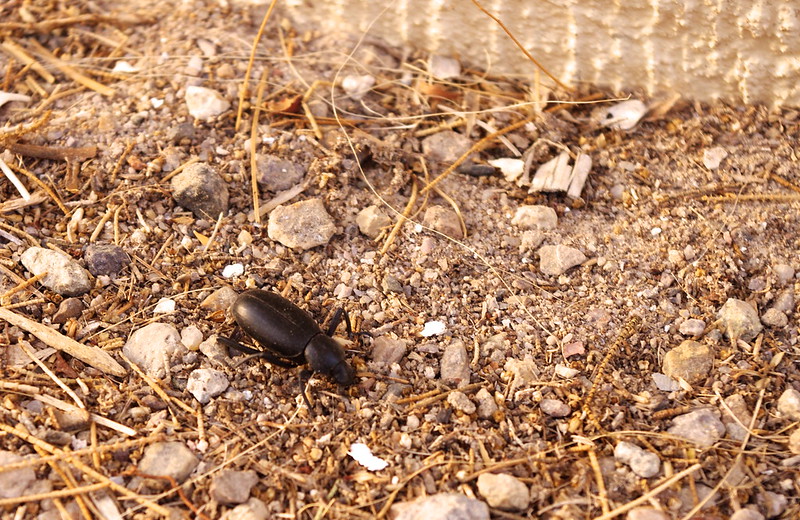
Unknown beetle species found just outside my room at the DSC

Although I could easily have spent the day wandering around looking at wildlife, I had been given a very different itinerary: Caitlin and I were taking our group of human geographers to Calico Ghost Town, about an hour away from the DSC and not far outside Barstow. Calico is a very odd place, which is exactly why we took the students there. It is an uneasy mixture of history, culture, and, above all else, commercialism. One can learn about the town's past there, but only through a good deal of effort; by both chance and choice, its primary purpose is to cater to tourists who stop there for lunch while driving between Los Angeles and Las Vegas.

Calico Ghost Town, as seen from the outlook point at the far side of town

Within about five minutes of entering the town, I was convinced that I was going to have an incredibly difficult time spending 7 hours there. To my surprise, however, I ended up quite enjoying myself. As a group, we spoke with the town's manager, an incredibly friendly and plain-speaking woman who welcomed both our questions and our feedback; she gave us a fascinating behind-the-scenes look at what it is like to run an attraction/preserve/historical monument on a small budget, all while generating enough funding to support not only that site, but also several others in the county. Talk about pressure.

All of us also did quite a bit of people watching--something that became much easier from about 11 AM onwards, as busloads of tourists began to pull up and descend upon the town to eat burgers, drink milkshakes, snap photos, and maybe pick up a few souvenirs. The vast majority of tourists were Asian; according to the manager, Koreans are particularly common there. Many of them spoke little or no English, which made me wonder whether they actually thought they were getting a genuine "Old West" experience (they weren't).
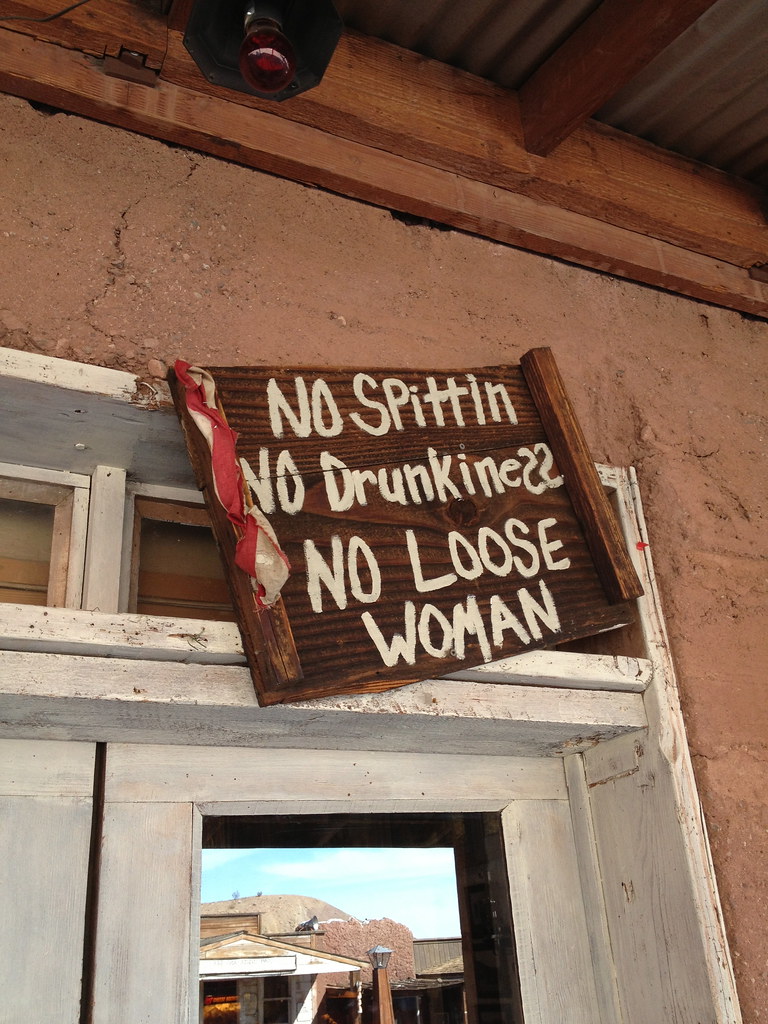
In their reports on Calico, several of the students referred to it as "cheesy." Indeed, much of the "culture" there was very calculated and inauthentic.

Native Americans are all but ignored at Calico, despite being the original inhabitants of the region; the only Indian references I could find was a pair of tribally-dressed dummies sitting on top of the general store roof, and this wooden carving near the restrooms. Pretty sad.

Calico schoolhouse in front of some of the area's remarkable geology

Only a couple of Calico's buildings are original; the rest are replicas built sometime since the park opened in the first half of the 20th century. I'm not sure how well the other replicas mimic their original counterparts, but the schoolhouse is amazing--there is a plaque showing a 19th-century photo of the first schoolhouse, and you really cannot tell that it is not the same building that is there today. I thought it was a shame that you couldn't go in and look around; all you can do is peer through the dirty glass of the front door.

Probably my favorite activity was climbing up to the lookout point and sitting in the sun while the desert breezes whooshed across the hilltop. Although the point is only slightly removed from the rest of the town, I couldn't hear any of the activity down below me; the only sound was the wind. I was hoping that the perch would be a good spot to do some birdwatching, but I failed to see or hear any avian wildlife. However, I did spot a Nelson's antelope ground squirrel--one of the few mammals that I observed during our adventure.
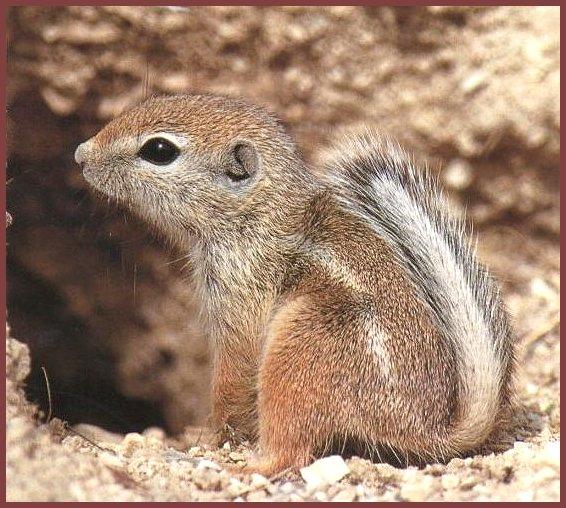
I was not close enough to the squirrel to get a good photo--this one is courtesy of memozee.com.

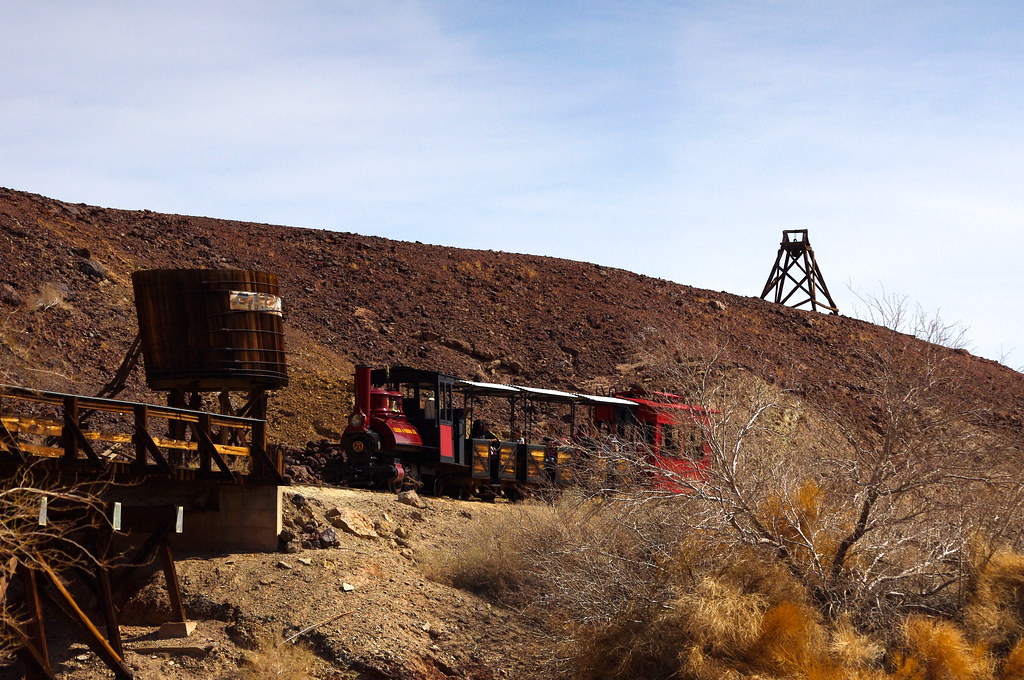
The Calico train, exploring old mines where silver and borax were once unearthed by people who worked 12-hour shifts underground

The overlook also provided a good view of the Calico Train, which offered short tours of the mines and their environs. I probably should have taken a ride on the train, but, like everything in Calico, it was very expensive and gave little information in exchange for the fare. So, I just looked at it from afar.

Eventually, the crowds began to thin and the students wrapped up their one-day research projects, so we headed back to the DSC. We didn't have any activities planned for the evening, so we were able to take in the sunset, enjoy another filling dinner, and then turn in early (hoping in vain for an end to the jet lag).
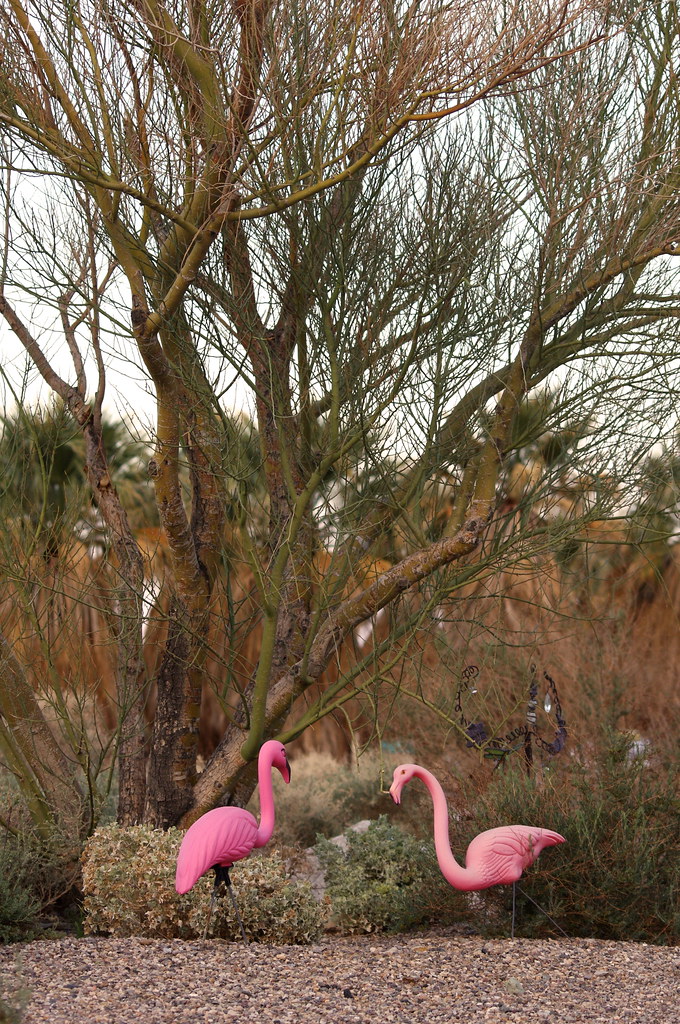
Alkaline lakes are the perfect habitat for flamingos--of both the feathered and plastic variety. These two are basking in another lovely desert sunset.

The next day, Caitlin and I hit the road again in order to take our human geographers back to Barstow to visit the Mojave River Valley Museum. Because she hadn't heard back from the museum staff for several weeks, Caitlin wasn't sure what we would find when we showed up; she half expected that the museum might be closed. Instead, we arrived to a friendly welcome and a magnificent spread of food--fruits, veggies, dips, chips, bagels, spreads, English muffins (just for a laugh), and hot beverages. The museum staff had invited several local experts to come speak to us and usher us around both the museum and several other sites in the Barstow vicinity. Also at the museum was a reporter from the local newspaper; his story about our visit made the front page of the Daily Press the following day.
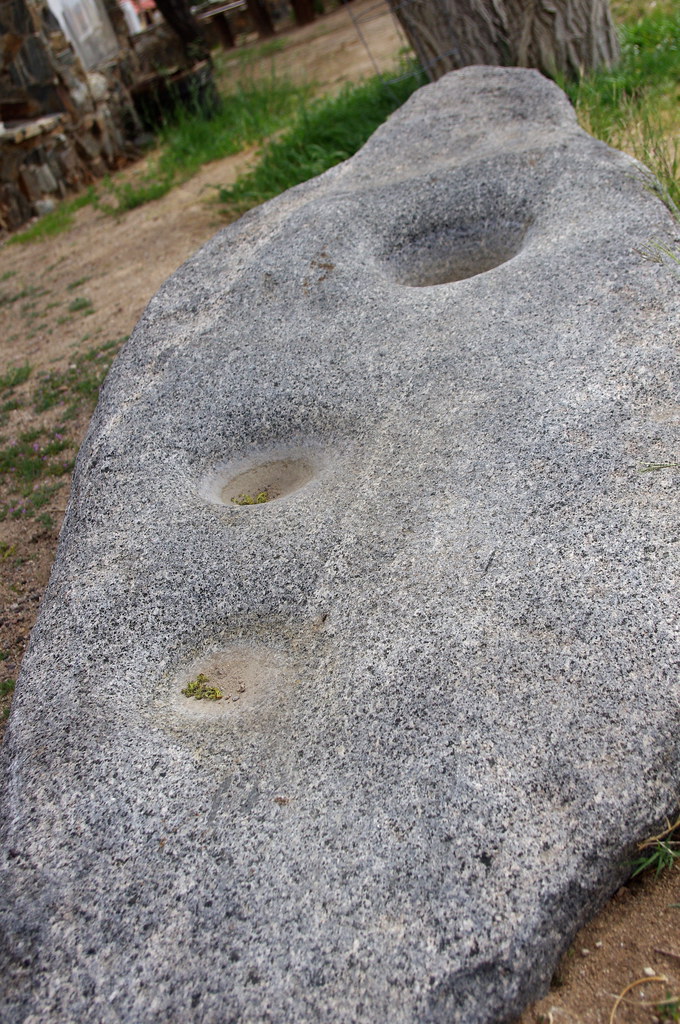
Mortar stone used by local Native Americans to crush various types of food. I had read about these in Tending the Wild, the book I read and reviewed on my airplane ride over to the US. It was neat to see one in person; this one was located in the outdoor portion of the Mojave River Valley Museum.

After we had finished looking around the museum's indoor and outdoor displays, our hosts escorted us to the Desert Discovery Center (DDC) a couple streets away. The DDC is primarily an educational facility, as well as the home of the Old Woman Meteorite--the second largest cosmic rock in the country. However, the most interesting thing at the DDC was not from outer space--though it was so weird that it might as well have been. I'm referring to our host there, an employee of the Bureau of Land Management. To my knowledge, I have never spoken to anyone under the influence of cocaine, but I imagine that such a person would act like this guy; he was a hyperactive fast-talker with a love of conspiracy theories and an inability to self-censor. He divulged that he had been on a "spiritual journey" for the past several years, and that this journey had involved "alchemy." I don't know what, exactly, that means, but I'm thinking that he probably does lots of drugs (simultaneously).

A fuzzy cell phone photo of the Old Woman Meteorite in Barstow
From the DDC we went to Daggett, about as random a location as I could possibly have imagined. This is what it looks like:

Not much going on out here

Daggett is no booming metropolis these days, but it used to be more exciting back when there was more mining activity in the region, and when there was more money to be made from railroads. We didn't really go there to see Daggett itself, but to meet with Bob, the president/director of the Mojave River Valley Museum. Bob, who is a professional blacksmith (yes, they still exist), generously spent his entire lunch break chatting with us; he wanted to show us some old wagons and tell us a little bit about how the blacksmiths of yesteryear used to fashion wheels and other metal bits and pieces.

Old wagons in Daggett

Bob was another real character--someone who looked like he had walked off a movie screen. As we chatted to him, we were standing outside, in a desert, under the midday sun, and yet he was wearing a woolly hat (with ear flaps), jeans, some sort of insulating undershirt, and a quilted flannel jacket. I was hot just looking at him. He was a wiry guy made lean and tough by years of smithing and, to judge from his comments about hiking, exploring the nearby desert. He was also incredibly knowledgeable about history, and I wish we'd been able to visit when he had more time to devote to answering questions and telling tales about his adventures in the Mojave.

Our final destination was the Marine Corps Logistics Base--or, to be more precise, a pile of rocks at its entrance. Many of the rocks were decorated with petroglyphs of unknown age; some were definitely hundreds of years old, others may have been thousands of years old. Those, of course, were made by the region's original inhabitants, though there were also some markings added by settlers later on.

Petroglyphs on rocks outside the Marine Corps Logistics Base just outside Barstow

I was thrilled to have an opportunity to see the petroglyphs, and impressed that the folks at the base had thoughtfully fenced in the rock pile to protect it from vandals and developers. It's amazing to think that the Mojave Desert is full of artifacts like this--petroglyphs, old spearheads, mortar stones, even plants that still bear evidence of historical management by Native Americans; they're all just waiting to be discovered by people with the fortitude to venture out into the unwelcoming land and do a bit of searching.

It would have been great to spend the rest of the afternoon learning from Barstow's local historians, but we had to get back to the DSC in order to make the van available for a post-lunch physical geography day trip. Although I was predominantly working with the human geographers during our time in California, I had been asked to act as chauffeur to the other students on this occasion because I was one of only two people with an American driving license. I was more than happy to oblige because it gave me an opportunity to see more of the desert and to learn about something I had pretty much no experience with whatsoever: volcanoes.
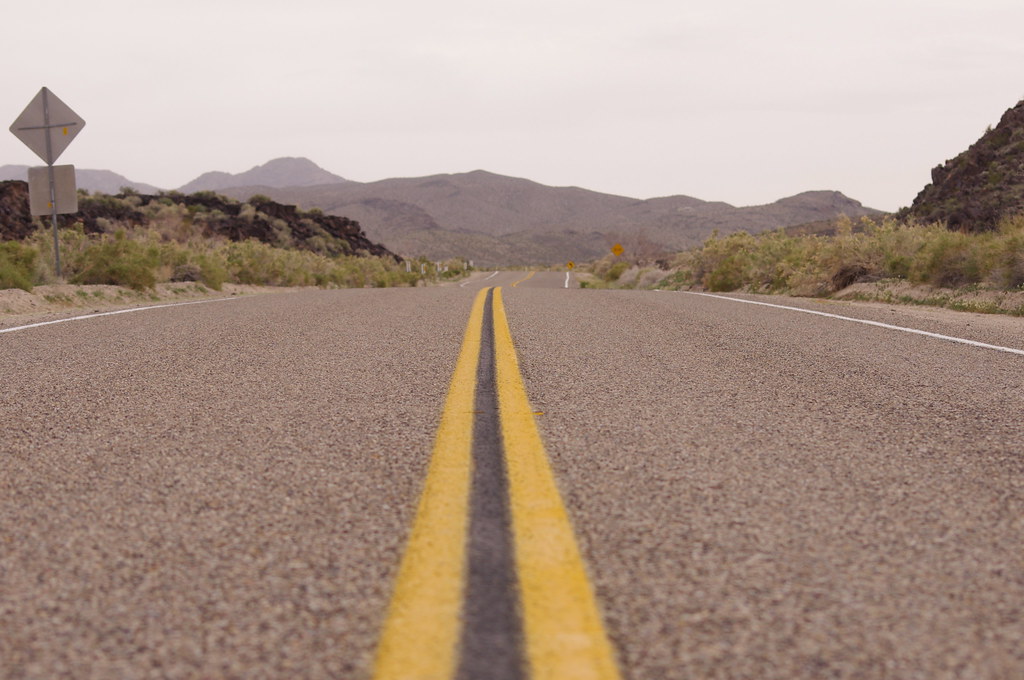
A view down Kelbaker Road, which runs through Mojave National Preserve. The dark stuff on the left is a hardened lava flow.

My colleague Kate is an expert in volcanoes, so she organized this side trip in order to give the physical geographers something more exciting to see than an alluvial fan (which is what they had been visiting for the first day and a half). The trip involved three main attractions: one of many lava flows by the side of the road, a lava tube at the end of a dusty dirt track, and the many cinder cones spread out between the first two destinations.

Panoramic shot of cinder cones in the Mojave Desert

As you might expect given that the area contains lava flows, lava tubes, and cinder cones (a variety of volcano that spews dust and rock), the Mojave Desert was once pretty geologically active. These days everything is dormant, but the evidence of past events is not hard to find. Many plants have colonized the lava flows, but it is still easy to see the dark volcanic basalt underneath all the cacti and wildflowers. The flows cover such incredible stretches of land that it is hard to imagine what the area must have looked like when the lava was still hot, spreading out across the landscape and consuming everything in its wake.

Barrel cactus nestled among the hardened lava

Because there was a shortage of hard hats, I never did go into the lava tube, though I did stand in the entryway and inspect some of the hardened lava up close. I was more interested in wandering around looking at desert flora and straining to hear any signs of bird life; I was much more successful at the first goal than the second.

Beavertail cactus in bloom atop a lava flow

Although we tend to think of deserts as barren, miserable places, they can actually be full of life; this was certainly true of the Mojave. Rather than finding the desert bleak and depressing, I found it to be surprisingly peaceful and calming. I'm not saying that I'd want to be there at midday in the middle of the summer, but late afternoon in springtime is certainly quite lovely.

We returned to the DSC after making a quick stop for medicine in Baker; one of the students had developed a severe cold that eventually infected two of my colleagues and, predictably, me. It seems I am not allowed to take a trip to America unless it involves some sort of illness. The cold, however, was not to materialize for a few days; before I got to that I had to weather a migraine that appeared the following morning. I was supposed to go to the lava tube again with the second of three groups of students, but instead I had to hand that duty off to Caitlin and hope that my headache medication would bring quick relief.

Indeed, terrible as I felt at breakfast, I was back on my feet within an hour or two. I took advantage of my remaining free time by exploring the grounds around the DSC. As per usual, I went looking for birds and flowers, but I also checked out the facilities--both the modern ones and the remnants of previous structures. I've always been drawn to ruins, and the ones at Zzyzx are very photogenic.
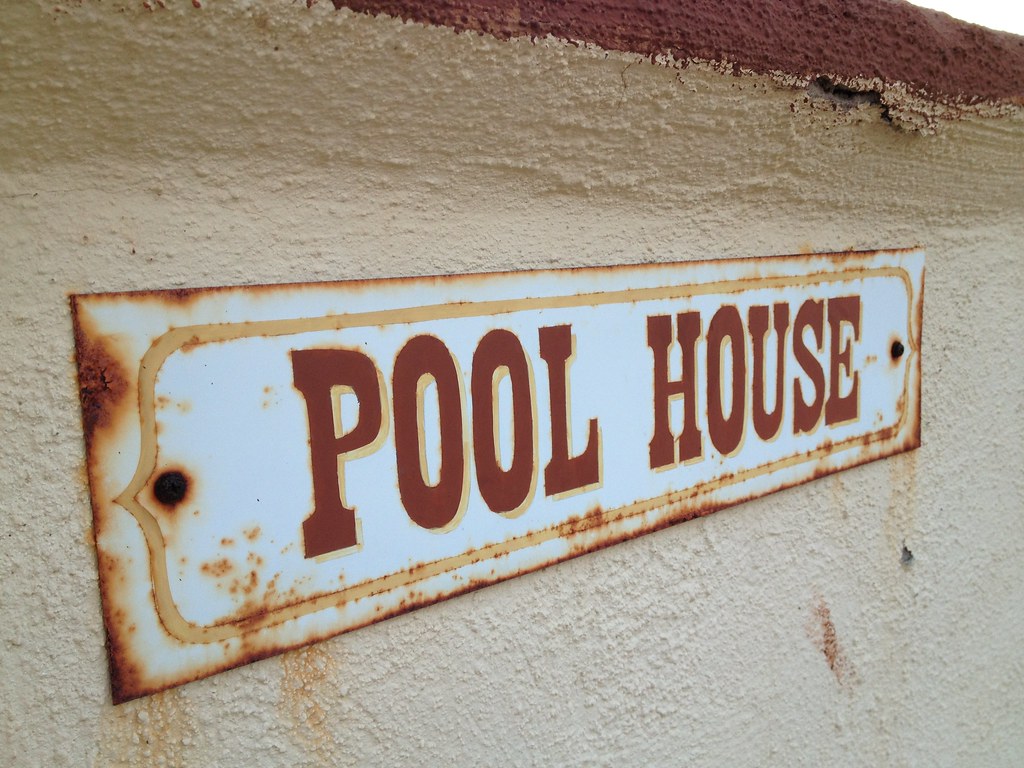
I love all the old signs at Zzyzx--the font is very "Wild West," though the signs are only about 50 years old.

The interior of the old pool house, plus bonus sunrise in the background.

Perhaps the most photogenic area was the "car graveyard," which contained vehicles that had died anywhere from 40-80 years ago. I had been reminded of the movie Cars while driving along the main street in Barstow, and those thoughts returned to me while I wandered around the graveyard; with their headlights and grills, many of the retired cars appeared to have sad little faces looking back at me.
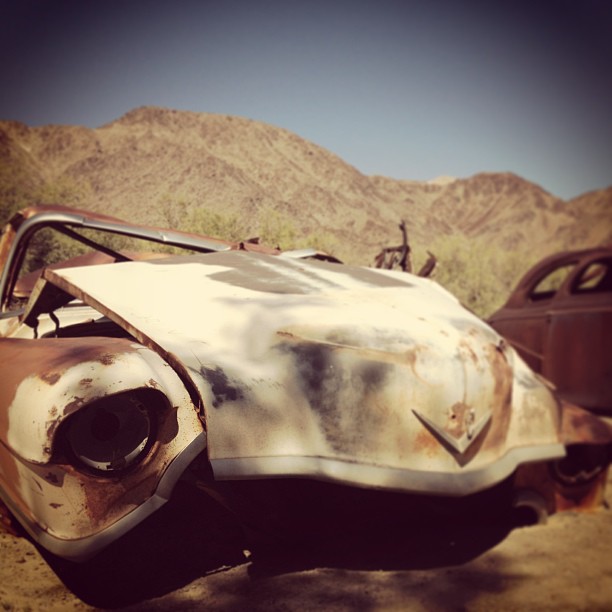
Sad-faced car


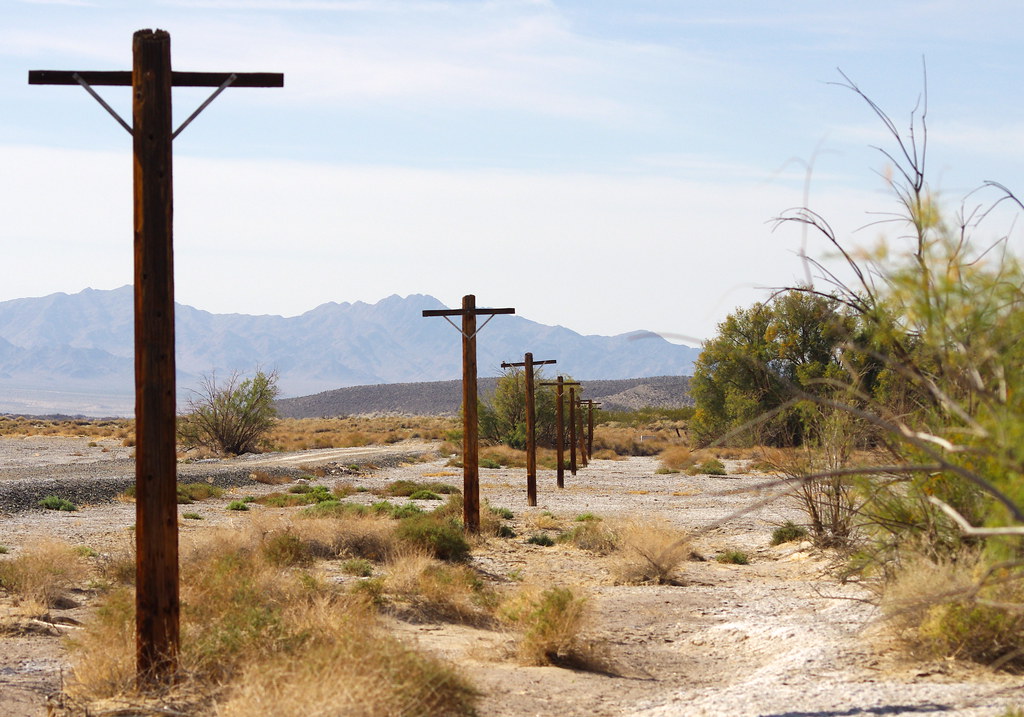
Power lines stretch into the desert
Also interesting were all the old tracks running through the desert. If you climbed up one of the hills and looked down at the lake bed and desert below, you could see the ghosts of old roads and train tracks. The oasis used to be a very important crossroads (as you might imagine for a place that offers water in an otherwise dry habitat), and there is much evidence of all the traffic that used to pass through--though it is not always easy to see from the ground.

After lunch, I headed out for the last of the three volcano trips. During this one, Kate decided to take the students up to the top of a cinder cone so they could look down into the crater. As a result of the elevation, we got an even better view of the desert and the remnants of the geological upheaval that had occurred there tens of thousands of years ago.

There are actually several cinder cones clustered together here, which means that this photo probably shows multiple craters. Craters form when the chambers below volcanoes empty out and can no longer support the weight of the structures above them; in this case, the chambers emptied of cinder, which piled up around the rupture site and eventually caused the underlying ground to collapse.

The rest of the trip was basically like the one the day before, except that a couple of the students had a mishap with a cactus during our visit to the lava flow. One of them grabbed a hunk of beavertail cactus because he "wanted to see what it felt like." While the first student was swearing and clutching his hand in pain, a second student decided to pick up the same chunk of cactus and nibble at it in order to investigate its flavor. Needless to say, he also wound up studded with cactus thorns. I could not muster much sympathy for either of them and, frankly, was more concerned about the poor cactus that they'd injured.
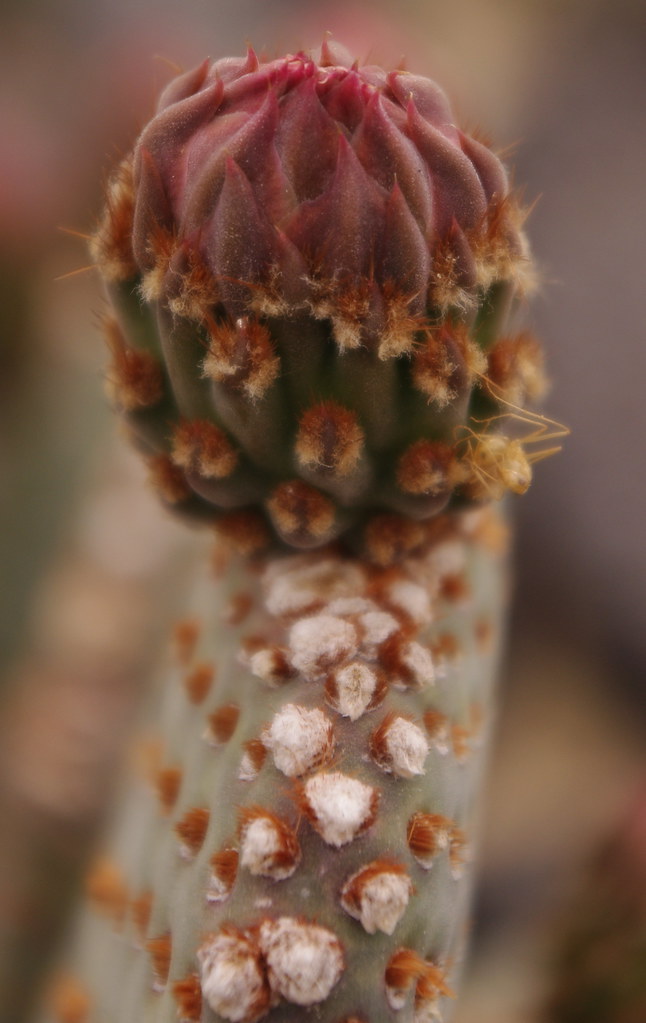
Beavertail cactus bud. Here you can clearly see the fine thorns growing in patches all over the cactus. The beavertail is known as a particularly uncomfortable cactus to encounter because its thin thorns are so difficult to remove.

Most of the evening was spent packing and preparing to depart Zzyzx the following morning. Shortly after dinner, though, Caitlin and I met with the human geographers in order to hear about what they had learned about the area; they had spent the past day and a half reading books, interviewing locals, and exploring the habitat while investigating the cultural significance of the oasis. They did an excellent job synthesizing information on ecology, hydrology, geology, culture, and history--no mean feat considering how disparate those fields are often thought to be.

I don't think any of us stayed awake for too long after the presentations, since the next morning was scheduled to be an early one, followed by a long and tiring day in the bus. Although I didn't waste too much time heading off to bed, I did pause long enough to make one last friend in the desert:

White-lined sphinx--a beautiful species of moth. There were all sorts of interesting night insects that gathered around the exterior lights each evening. I quickly gained a reputation for "staring at walls," though of course I was actually trying to identify flies, moths, and whatever else was gathering there.

Saturday, 13 April 2013

Geo field trip to California: From London to Zzyzx

I'm gaining a reputation as a professional field trip-taker, and I suppose that's not far off the truth. For the past several years, I've gone to both Kenya and the Isles of Scilly with University of Exeter biosciences students; this year I've added in geography trips to Wadebridge, Gylly Beach, Penryn, and, most recently, California. If you know your geography, you'll notice that the last of those geography trips is much more exciting than the rest.

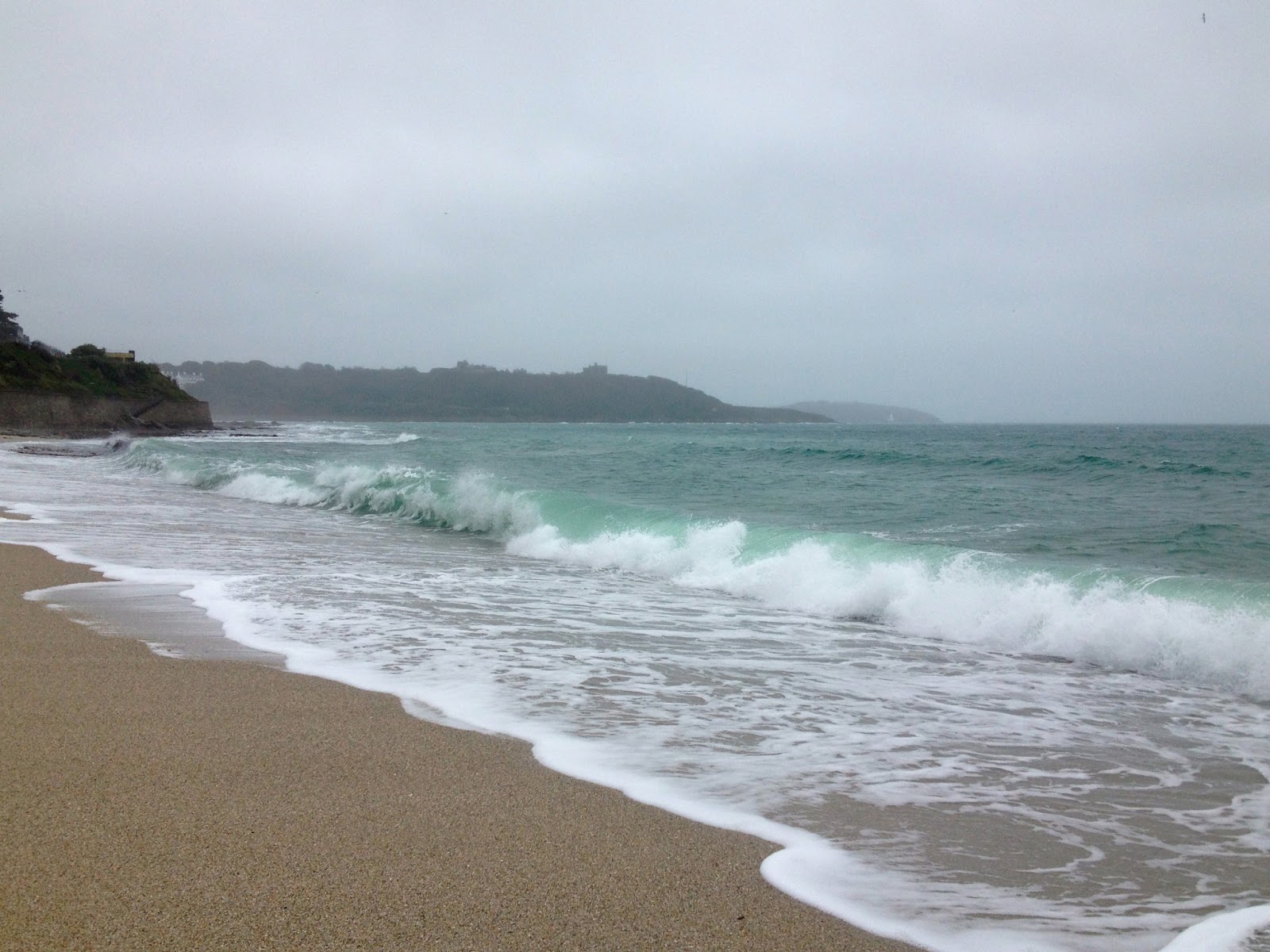
Stormy Gyllyngvase Beach during one of several geography field trips this spring

Because I like to make my trips as eventful as possible, I scheduled a public speaking engagement the night before my departure to Los Angeles. Rather than being a burden, this ultimately came in handy: After my talk, I spent the night in nearby Exeter, thus shaving 2 hours off my train journey to Heathrow on the day of my flight. 

Unfortunately, I began the trip with an infuriating incident at the Exeter train station. After waiting in line forever at the cafe, and being the person who should have been helped next, I was refused service because the woman behind the counter thought I had jumped the queue. I hadn't; I had merely been standing in an unconventional location because I was trying to keep my massive bag out of everyone's way. In my righteous fury, I angrily explained the situation and then threw my food at her before stalking off to make my train. Unfortunately, this left me not only indignant, but also breakfastless.

Later on in the day, I decided that the best way to combat my lingering feeling of anger was to do something nice for a random stranger. So it was that I found myself giving up my airplane seat--which I had specifically chosen when booking the flight months before--in order to allow two young sisters to sit together. I was thanked profusely by both the girls and their mother, which pretty well cured me of the residual ill will left by my morning encounter.

I had an unusually productive flight considering my usual propensity to succumb to motion sickness. I finished a book I'd been reading in preparation for the field trip, then wrote a review of it for Current Conservation magazine. I then finished a sci-fi novel that I had begun reading months ago, after which I made a start on its sequel. Once my eyes needed a rest, I switched to movies, watching both Hotel Transylvania and Rise of the Guardians (for some reason I always choose animated films when I fly).

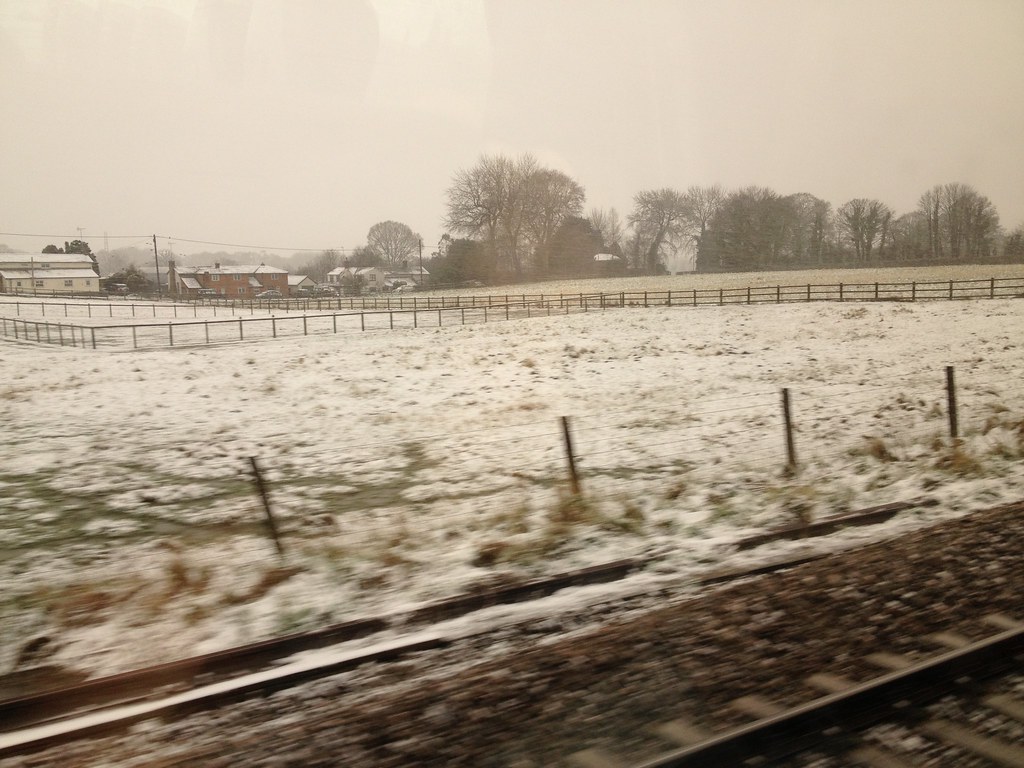
The British countryside as seen during my train ride from Exeter to London

As you might imagine, I was pretty exhausted when I reached LAX, and yet also strangely energetic; for some reason I was feeling unusually excited about being back in my homeland. I was even thrilled when I broke a sweat lugging my bag to the taxi rank; on my way to Heathrow it had been snowing, and here I was actually hot! I don't ordinarily like the US that much more than my adopted country, and I've always been particularly ambivalent (or even negative) about California. I think maybe my feelings were influenced by the fact that I was surrounded by a group of Brits with little experience with America or American culture. I felt kind of like a ringmaster waiting to reveal a jaw-dropping circus act.

When I reached my hotel (the LAX Radisson), I discovered that it was in the midst of hosting an all-night St. Patrick's Day party in its penthouse. The lobby was full of people wandering around in ridiculous green clothing; there was even one guy with a zoot suit and glittery green top hat. Since I was not appropriately attired and, more importantly, had been awake for about 24 hours straight, I just headed to my room.

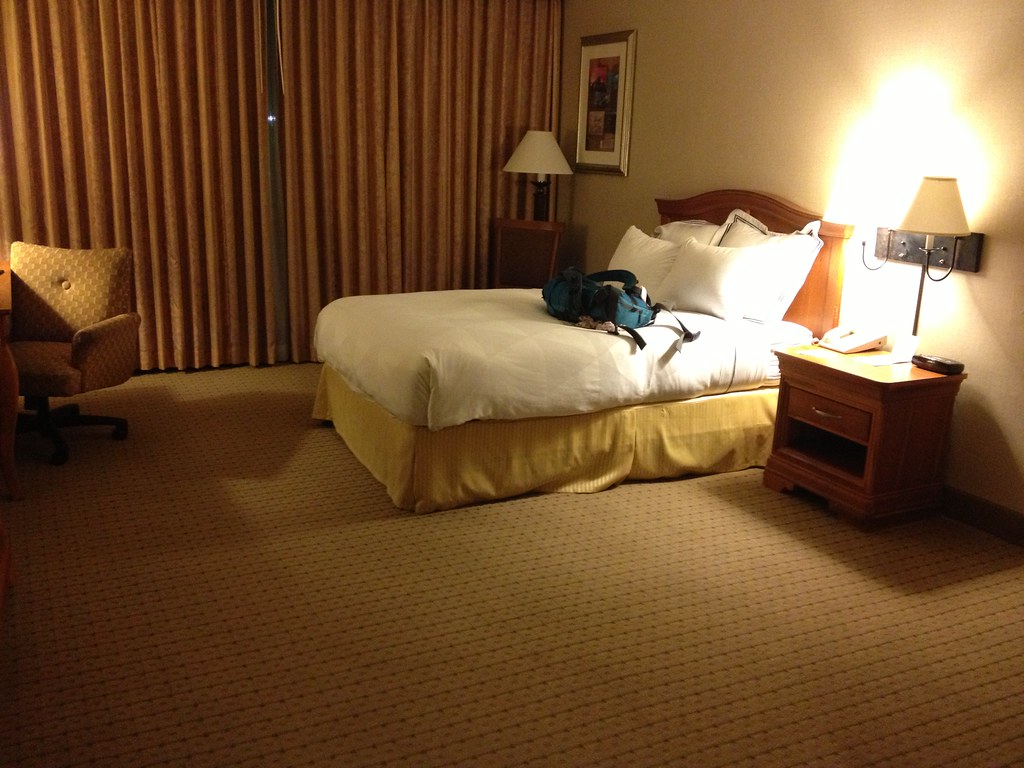
My room at the Radisson LAX
Upon arrival, I discovered one of the most spacious suites I've ever been given. It looked as though it had once had two double beds but now possessed only one. A small part of me really wanted to make use of all that floor space by doing yoga or Pilates or something. In the end, though, I decided to just have a shower, eat my dinner, and go to sleep. Maybe not as healthy, but definitely more sane.

The problem with crossing both the Atlantic and the entire continental US in a single flight is that it leaves you with some serious jet lag. I awoke at 2:30 AM and browsed the Internet for an hour or so before falling back to sleep; when I woke up again at 5:30, I gave in and just got out of bed. All of the field course lecturers were staying in the same hotel, so we met up in the lobby before shuttling to the airport to collect our students (strangely, unlike the other field trips I've been on, this one doesn't involve a single unified travel plan for everyone involved).

There seems to be some universal law stating that all field trips will begin with a transportation issue, and, indeed, our hired tour bus was a half hour late. However, it did eventually show up, and we were able to get all the gear and people loaded with remarkable ease. From the airport, we had a ~2-hour drive down to Barstow, where we were scheduled to pick up our rental van (needed for day trips) and make a grocery run.

For nearly the first hour of the journey, the scenery was pretty horrific: cement, billboards, commercial strips, and smog. Gradually, though, we moved away from inhabited/industrial/built-up areas and began to see ever more nature. Blue skies and sunshine would probably be enough to satisfy most Brits (and me, I admit), but they were only the tip of the iceberg; we could also see spring wildflowers beginning to bloom, leaves starting to emerge on trees, and, as we moved into the mountains/desert, some remarkable geological formations.

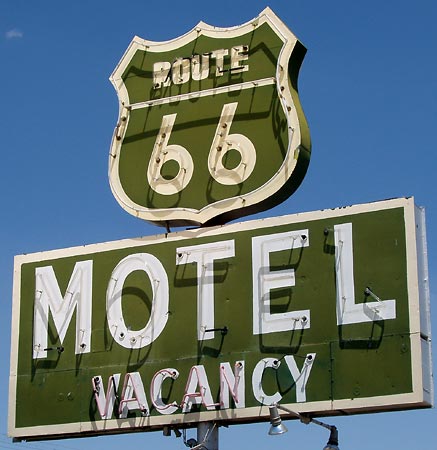
Barstow is full of amazing old signs like this. Sadly, we didn't get the chance to stop and photograph any, so this image is courtesy of The Lope.

Also strangely attractive was Barstow--in parts, anyway. We drove through town on old Route 66, along which you can still find plenty of diners and motels left over from the heyday of American motoring. The main street is heaven for anyone who loves vintage and/or Americana; there are murals and antique stores and shops selling greasy, high-fat dishes just the way Grandma (or...whoever) used to make them. Not so attractive is the strip, featuring every gas station and fast food chain you've ever heard of.

After picking up the van, Caitlin and I (yes, there were two Caitlins on the trip, and we are both American) rendezvoused with the others at the Barstow Walmart. I am responsible for suggesting this destination, since it seemed like the easiest and most logical place to stop for our grocery run: It is close to the rental office, it has a parking lot that can accommodate big buses, and it usually has a big selection of food and whatever other gear people might need when traveling. Also, it's a cultural icon, and I can't help but love the idea of taking British tourists to a Walmart.

Unfortunately, Barstow Walmart is not one of the superstores that has a huge variety of food and sells pre-made items that are perfect for hungry travelers needing some lunch. Instead, it's one of the old-school stores that always feels a bit dingy and seedy, and leaves you feeling slightly depressed for having visited. It was interesting to watch the expressions on the students' faces as they wandered around trying to locate familiar and/or useful snacks; I think that one or two might actually have gotten the impression that that Walmart was representative of all grocery stores in the US.

From Barstow it was another hour or so until we reached our home for the next several days: Zzyzx, location of the Desert Studies Center (DSC). Considering how remote Zzyzx is, it's really pretty remarkable that it is accessible via the type of road that a large bus can drive down. We had a couple of uncomfortable moments after encountering major potholes left by recent rains, but ultimately reached the Center unscathed. However, because the Center is very much an oasis in the middle of the desert, I couldn't help but feel a little vulnerable as I stood in the parking lot and surveyed the environment. Behind us was an imposing mountain, and on all other sides was a soda-encrusted dry lake. It was stunningly beautiful, but in a dangerous way; get lost or run out of supplies out here, and you'd be in trouble in no time flat.

Behind the DSC

Lake Tuendae, home to the endangered Mohave tui chub. We were explicitly asked to avoid interacting with the lake in any way, and what did our students do? Toss a football into it while playing catch...as though the only place to play catch was right by the lake's shore. *sigh*

Soda Lake at sunrise. Beautiful, in an austere sort of way.

As soon as we disembarked and unpacked our luggage, we were shown around the DSC and given a spiel about how things work there. The entire establishment is off the grid, so it is important for guests to understand how to conserve electricity and water. Also important is keeping an eye out for wildlife--whether of the cute, mischievous, and/or dangerous variety. There are many grey foxes in the area, for example, and they do not hesitate to wander through open doors and raid whatever food stores they find inside. Less enchanting neighbors include snakes, spiders, and scorpions, which may sometimes find their way inside shoes and sleeping bags and other places where they are not welcome.

Display in my room commemorating the time that Sir David Attenborough stayed there.

Once we had been thoroughly briefed about the DSC, we were free to move in to our rooms and explore the area; by chance, I happened to select the room where David Attenborough stayed when he visited Zzyzx. After depositing my bags, I went out for a walk around the lake, but I had to be brief since we were congregating before dinner to listen to student presentations. The study groups had put together some short but informative lectures about nature and culture in the Mojave Desert. However, interesting though they were, the presentations were hard to sit through because the jet lag was kicking in and I was beginning to fade fast.

Our reward at the end of the mini-symposium was a Mexican feast cooked up by our very talented chef, Vick. At dinner, the students were treated to their first taste (literally and figuratively) of American portions: Each person was given a mountain of food about twice the size of any helping you'd ever get in Britain. When I asked Vick for a smaller, half-sized serving, he gruffly replied that they were all the same size; it wasn't long before I was sharing my meals with the other Caitlin in order to avoid wasting food (and expanding my waistline).

After eating dinner (followed by a gourmet dessert of Twizzlers from Walmart), it was finally time to turn in for the day. Zzyzx is blissfully quiet--until the nighttime wind starts howling, anyway--and it is an incredibly peaceful place to sleep. Then again, pretty much any place suits the purpose if you begin your day at 5:30 AM. Even though we were just "roughing it" with sleeping bags and travel pillows, it still felt good to hop in bed and rest up in preparation for our first day of research in the Mojave Desert.

Monday, 8 April 2013

Where to Eat (and Drink) in Lincoln, UK

Last week was my birthday, so of course I had to celebrate by eating out (as though I ever need an excuse). I happened to be in Lincoln at the time, where I had joined Sasha at the 2013 Easter ASAB conference. On the day of my arrival, my taxi driver had helpfully suggested a couple of his favorite Italian restaurants (including Gino's and The Bronze Pig), but when I got online to look up contact details, I discovered another local Italian eatery that was ranked even higher on TripAdvisor: Tiamo Pizza.

Image from the Tiamo Pizza website
Tiamo is not actually in Lincoln proper, but is a short 3 miles away (from our hotel, at least) in the suburb of North Hykeham. The menu, which I was able to browse beforehand online, offered a good mixture of pasta, pizza, and calzones--the last of which I have a particular weakness for. I made us reservations, but it turns out these weren't necessary; there were never more than 4 tables occupied at any given time, though the restaurant was small and it was a Thursday night, and I imagine that the place gets more crowded during the weekends.

When we first pulled up in our taxi, I was a bit surprised to discover that Tiamo is located in a small strip mall--the kind of place you are more likely to find in the US than in the UK. We were greeted enthusiastically by our waiter, who single-handedly served everyone in the restaurant while simultaneously acting as the host. It was a pretty impressive performance, really, though my admiration was stifled slightly by the fact that he was a bit of an oddball--simultaneously spacey and a little menacing, making unusual jokes and audibly singing along with the music piped over the loudspeakers. But, he didn't drop any of our food en route to our table, and what more can you really ask for?


As per usual when eating in an Italian restaurant, I started with an insalata Caprese. Despite the season, Tiamo had managed to find a beautiful and surprisingly tasty tomato--arguably the lynchpin of the entire salad.


Sasha ordered his favorite Italian appetizer, the minestrone soup. When we told the waiter we'd like some Parmesan cheese, we were surprised when he brought over a jar of the pre-grated stuff. I'm quite happy using that in my own home, but I would expect any authentic Italian restaurant to grate it fresh at the table. Maybe I'm just being a food snob.


For my main course, I ordered a delicious calzone con verdura, and was permitted to swap the onions and peppers (yuck!) for extra olives and corn; also included were mushrooms, mozzarella, and a tomato sauce. I'm used to having calzones with red sauce on the side, but this one included the sauce as part of the stuffing. This actually worked very well, since it kept the entire thing soft and moist. I was also impressed by the dough, which was soft and chewy and everything you want in a homemade dough. Overall, it was tasty and satisfying and the only reason I didn't finish the whole thing was that I wanted to save room for dessert.


I felt a bit guilty about how Sasha's meal turned out--not because it was bad, but because he wasn't ultimately able to order either his first or second choices. Here I'd picked an Italian restaurant because Italian menus usually cater to Sasha's culinary preferences, and he was repeatedly stymied by the inclusion of odd/unexpected ingredients; particularly unfortunate was the fact that the seafood risotto included both squid and octopus. In the end, he settled on the penne alla arrabiata, which was good but did require him to extract several large chunks of peppers as he ate.


I'm not usually much of a dessert eater, but I figured I should indulge since it was my birthday--just as a matter of principle. I ordered the very tasty crumble di mele, the fruity portion of which involved both apple and blackberry, and which was topped with vanilla ice cream. It was dense and rich and indulgent, and I really enjoyed it. If I were to put my foodie hat on, I'd probably have to tell you that the crumble-to-fruit ratio was too high; however, since the crumble was well made, I don't really think it's worth complaining about.


Sasha ordered the last remaining piece of homemade cheesecake, which had a pretty dramatic presentation. The thing I found most notable about this dish was that the strawberries were sliced horizontally, rather than vertically; not only have I never seen this done before, but I've also never even thought of doing it myself. I guess I'm easily impressed, but thumbs up to Tiamo for showing me something I've never seen before.

Our overall experience at Tiamo Pizza was quite solid, and my calzone was pretty spectacular. That said, I'm still a little surprised, that Tiamo is ranked all the way up at #7 on TripAdvisor's list of best Lincoln restaurants; I would expect a bit more variety/finesse from a restaurant ranked so highly by visitors. However, our meal was by no means bad, and it's hard to draw many conclusions without trying the other restaurants on the list or returning to Tiamo to see how consistent they are in their service and food.

---

The following day, I had a very late lunch/tea break at Pimento, one of umpteen different cafes in Lincoln's historic district. Many UK cafes stop serving food around mid-afternoon, and one of the reasons I chose Pimento was that it did not appear to have any such restrictions.

It's an unusual place in that it is one of three disparate shops joined together under one roof; it sits both behind and above shoe and fashion boutiques through which you must walk in order to reach the dining area. Both shops have quite nice items, so this is by no means a chore.

The menu at Pimento was interesting for two reasons. First, it had an extensive selection of teas--some the usual varieties that you'd expect in any British tea room, and others more novel. All of the blends are sourced from Imperial Teas, a lovely shop just down the road. Second, in addition to having all the tea accompaniments and light lunch dishes that you can find in nearly all cafes around the UK, Pimento also offered several intriguing vegetarian options on its specials board. During my visit, for example, diners could order a vegetarian chili and a lentil soup, among other things.


Because I wasn't sure what we'd be doing for dinner, I decided to have something light but comforting--a good old jacket potato. In the US, baked potatoes are primarily thought of as a side dish accompanying a meat (usually steak); I love how easy it is to make an entire meal of one here in Britain.


Despite all the tea options on offer, I again chose the boring route and asked for a pot of plain old afternoon tea--but only because I knew that I was going to head down to Imperial Tea after lunch and purchase some more exciting flavors to take back home with me.
 

If Berkeley's Far Leaves Tea is the tea-drinking shop I wish was in my town, then Lincoln's Imperial Teas is the tea-supplies shop I wish I could routinely visit (and, thanks to the power of the Internet, I can--though doing it online is not the same as doing it in person!).

When you walk in, you are surrounded by row upon row of tea canisters, filled with one interesting and unusual blend after another--green teas, black teas, white teas, fruity teas, smoky teas, woody teas...anything the heart desires. The store also has an incredible selection of tea drinking materials, including tea candles, tea pots, tea cups, tea strainers, and so on. Obviously, I could spend a fortune in this place.

Luckily, I was able to constrain myself to purchasing only 2 bags of tea. Neither of these was the incredibly intriguing "world's rarest tea" (Jun Shan Golden Needles), which costs a whopping £30 per 100 g (for context, the Earl Grey blend I purchased was only £5.50 for the same weight). I think we all know that one day my curiosity is going to get the better of me and force me to shell out £30 just to see what's so special about the Golden Needles. Maybe for next year's birthday celebration.

---

After I left the tea shop, I strolled down Steep Hill (yes, that's actually what it's called) and into town, winding up in the midst of Friday afternoon shoppers frantically finishing their errands before the end of the business day. In my short walk, I passed dozens of pubs, cafes, restaurants, and carry-outs, highlighting just how many options are available to diners in Lincoln. During our brief stay in the city, Sasha and I barely even began to sample all that Lincoln has to offer; maybe we'll return one day to check a few more establishments off our list.
 

Sunday, 7 April 2013

Good things happen when you meet strangers

According to the Internet, which we all know is never wrong, Yo-yo Ma once said that "good things happen when you meet strangers." Based on my own previous experiences, I'm going to have to respectfully disagree with that statement, but I will admit that my sample size is pretty small. While recently touring the Lincoln Cathedral, however, I did have quite a pleasant encounter with someone I chanced upon while photographing a tomb near the building's east window. Not only did this stranger point out a very interesting bit of graffiti that I'd never have noticed otherwise, he also offered to take me on a personal guided tour of the entire building since he had time to spare before going to a meeting. Ordinarily, I would never even consider such a proposition, but since it was broad daylight, and we were surrounded by other people, and the doodle he'd already pointed out was so neat, I said "yes."

Graffiti of a ship. The date etched beneath the doodle seems to suggest that the drawing was made in the late 18th century.

Oddly, though we wandered around the cathedral together for something like 30-45 minutes, The Stranger and I never formally introduced ourselves; I have no idea what his name is. Because I can't bear to keep referring to him as The Stranger, I'm going to name him Elvis for the purposes of this tale. This is not a random choice; The Stranger really did look like an "Elvis." He had kind of a rockabilly air about him, with a worn red leather outer jacket, a brightly colored striped sports jacket, and a pair of pointy, red-flowered shoes/boots. He wore a large red/pink plastic flower on his lapel, and a rosary around his neck; his dark blackish hair was combed away from his tanned skin, and I believe he was the origin of a very clean scent that I kept smelling as we toured the building. Also, he had a lovely northern accent, which I love.

Elvis informed me that he was a member of the church, and, indeed, he seemed to know the employees and volunteers that we encountered as we wandered around. I can't imagine that all parishioners are as knowledgeable as he is, though; he said that he was studying history (whether as an enrolled student or just for fun, I don't know), and I assume that much of his knowledge came from this research.


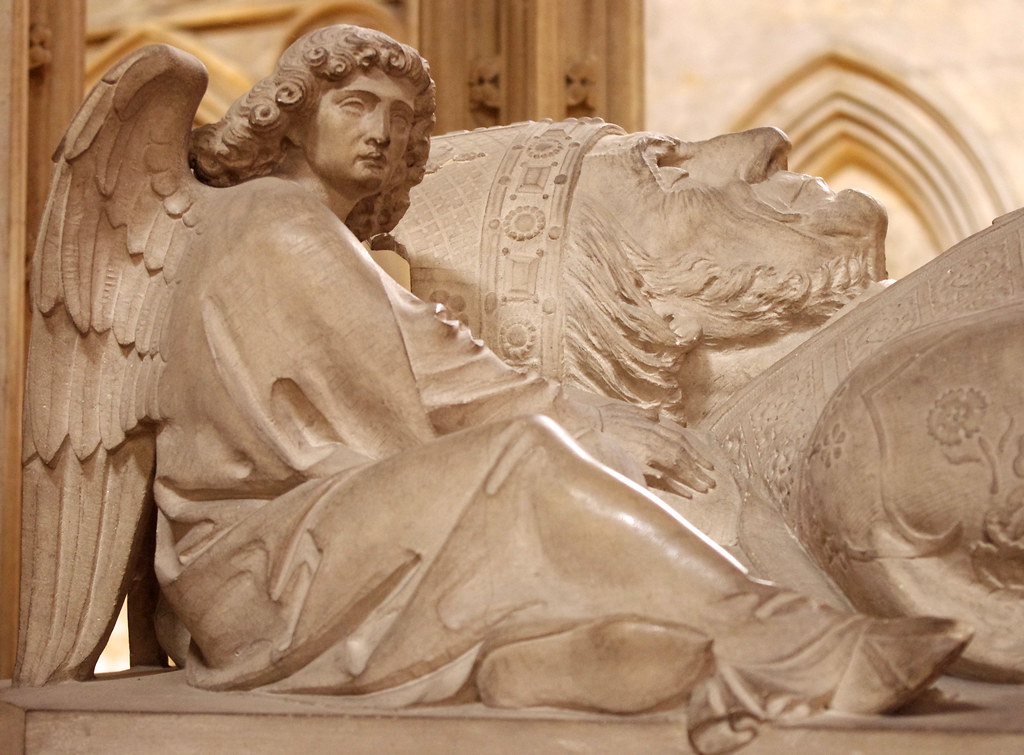
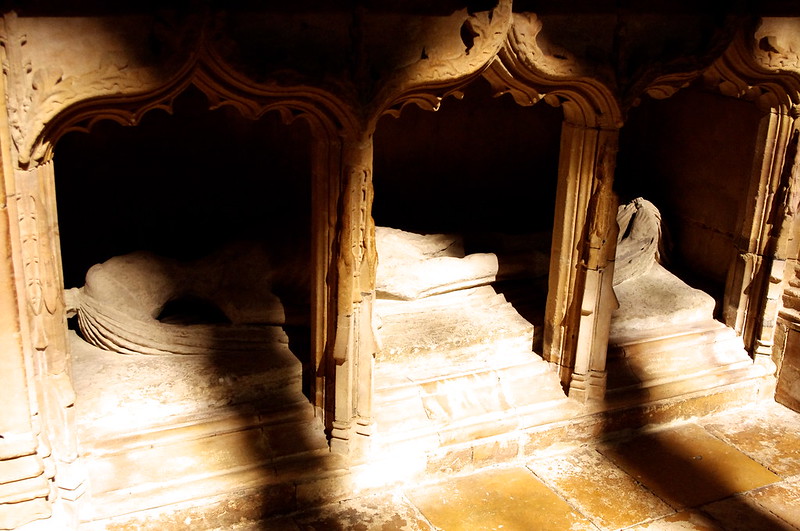
We started off in the eastern portion of the church, where I had been photographing some of the tombs. Both of the ones I had been looking at featured angels sitting next to the head of the deceased; according to Elvis, these showed that the departed individuals were quite important, since the heavenly creatures were waiting to escort the souls straight to Heaven. Another indication of the men's importance was the fact that both had their feet resting on dragons.

One of the tombs had two parts. On the upper half, the carved figure showed the man fully dressed in his finery; on the lower, you could see only skeletal remains. This was meant as a reminder that, underneath it all, everyone is the same--equally susceptible to death and decay.

The skeletal portion of a two-level tomb in which the upper bit shows the deceased in all his finery, while the lower bit shows what happens to all humans after death, regardless of how well they're dressed.

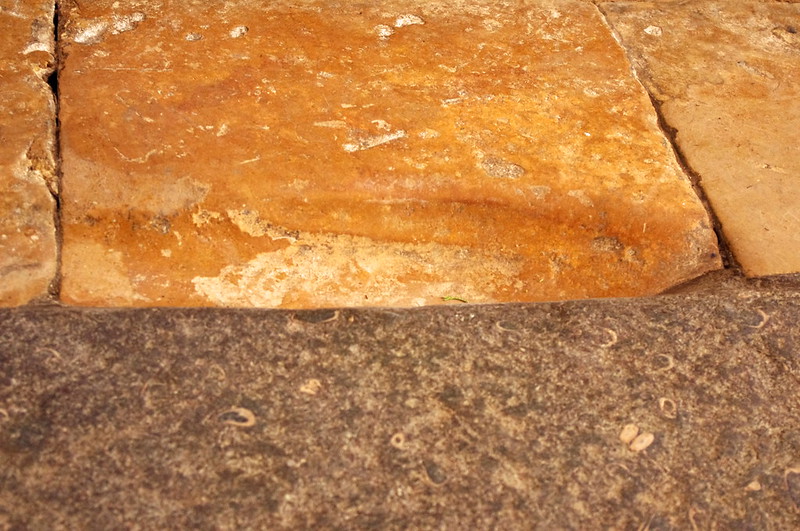
Also near the east window is St. Hugh's head shrine. St. Hugh is often associated with swans--many of which can be seen around the Lincoln Cathedral (not to mention in the river that runs through town). When his body was being moved from one site of interment to another, St. Hugh's head fell off and, eventually, went missing; hence "head shrine." In fact, the rest of Hugh's relics have also been missing since the Reformation. However, this does not deter the many pilgrims who have come to visit the cathedral since his death in the early 13th century. So many have knelt to pray at his shrine that their toes have noticeably worn down the stone there.

The worn stone looks much more dramatic and impressive in person, I promise.

Also on the floor are many plaques marking the "tombs" of deceased parishioners. In fact, nobody is buried underneath the church floor, which rests primarily upon solid stone (left, I believe, from previous versions of the church that were later replaced during reconstructions). Instead, the plaques were situated in these places of honor, but the bodies were put nearby in more amenable (and more easily accessible) burial grounds.

One of my favorite "tombstones." It reminds me of the Baratheon coat of arms in Game of Thrones!

People who were wealthy enough to have plaques decorated with bronze were given the dubious honor of providing Oliver Cromwell with metal to forge swords; all but one such stone were stripped of their finery in the 17th century. Cromwell used the cathedral to house his troops, and metal-stealing is one of the least destructive things he did in the building. He also routinely rode his horse around the church and chopped off decorations--particularly statues' heads--with his sword. If you look closely, you can see joins where these were later reattached. According to Elvis, there is one statue where the body of a female saint has been given a male head--oops!

All of those little indentations should be covered in decorative bronze plating; before they were stolen and melted down to make weapons, those plates would have been decorated with words and/or patterns.

If you face north while standing in the east wing and look up instead of down, you will be able to see the Lincoln Imp. As you might imagine, there is a legend associated with the imp. Apparently it was one of a pair that were wreaking havoc in the cathedral before an angel appeared out of a hymnal and commanded them to stop. When they did not, the angel turned the first imp into stone; the other subsequently escaped. Surprisingly, the imp has since become the city's symbol.


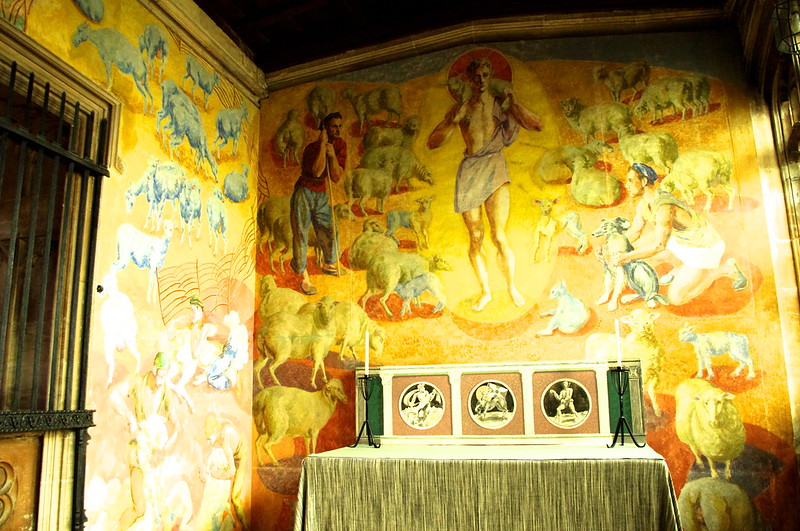
On the other side of the east wing is a small chapel decorated by a brightly colored mural depicting Christ, several shepherds, and some sailors.


You don't have to look too closely to notice that there aren't too many ladies on these walls, or to see that the ones who are present aren't looking too lively or attractive. Men, on the other hand, are not only present, but are also quite athletic, handsome, sensuous, and...lacking in clothes. These qualities did not go unobserved by viewers after the mural was unveiled in the Victorian era; nor did the fact that the men in the painting looked an awful lot like "close acquaintances" of the (male) artist (seen here in the circular portrait above the doorway). As a result of this perceived unseemliness, the chapel was closed for many years until prevailing viewpoints became a bit more liberal.

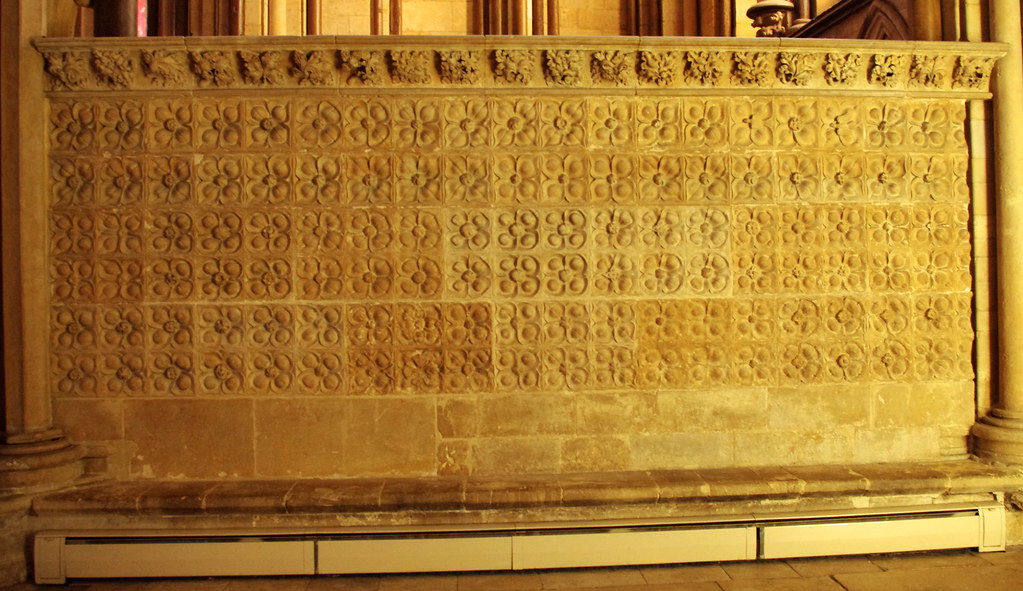
The apprentice wall

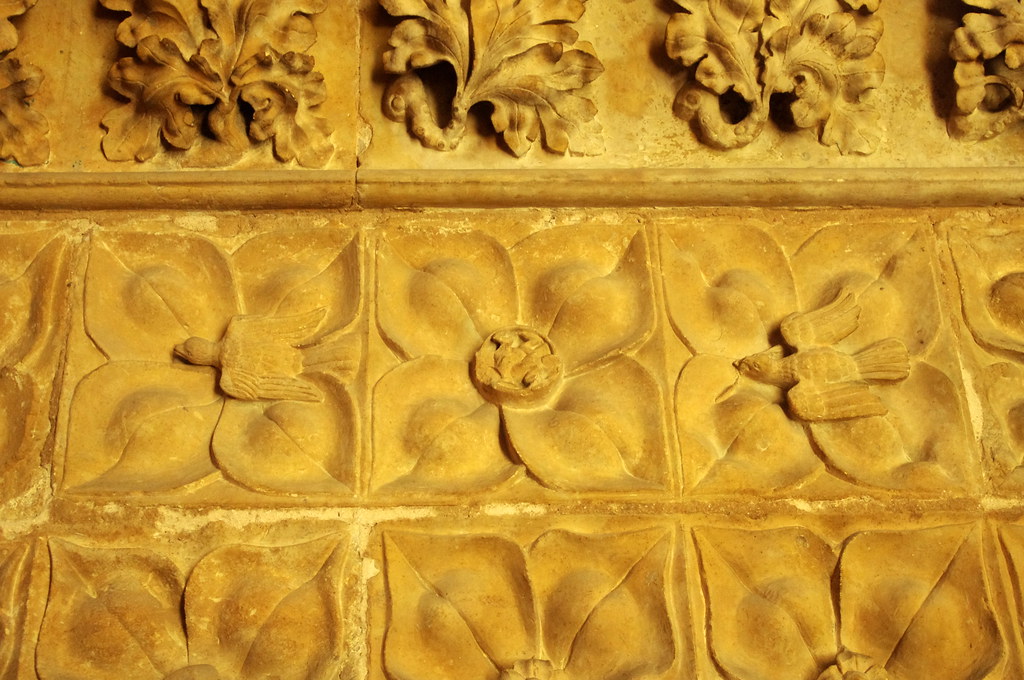
Down the hall from the chapel is something known as the apprentice wall, where apprentices had to prove their skill before they could receive permission to work on more illustrious portions of the building. Each square was worked by a different person, and the variations in style and ability are quite obvious once you know to look for them.

Details of squares on the apprentice wall--each one made by a different artist. Some are just flowers, others also have birds. Even amongst those with similar decorations (e.g., birds), there are considerable differences in technique and detail.

Elvis and I next exited the eastern portion of the cathedral and walked out into the south transept. The doorway in between the two sections is decorated with motifs indicating that the average Joe should stay out in the nave:

In the upper panel (right side of the door), dragons steal grapes and are rewarded with swords through their gullets; in the bottom panel (left side of the door), the naughty dragons are strung up from trees.

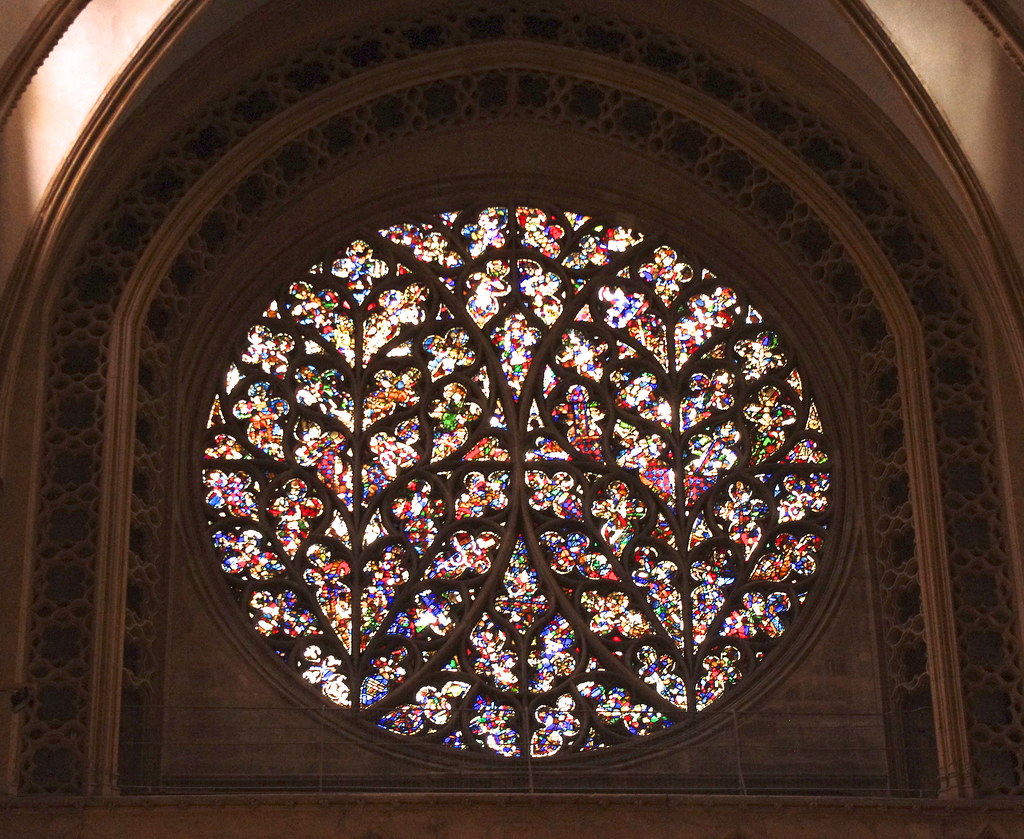
Out in the nave, Elvis pointed out the south-facing rose window, known as the Bishop's Eye. At some point in the cathedral's past, the window fell in and shattered into hundreds of pieces. Rather than restore it to its original form, people simply put the pieces in willy-nilly. At first glance it looks no different from the rose window on the other side of the crossing (the Dean's Eye), but upon closer inspection you can see that it is merely a colorful jumble, rather than a series of panes that tell a story.

According to Elvis, you can get a good view of the mismatched stained glass if you take the tower tour, which gives you an insider's view of all the high places in the cathedral.

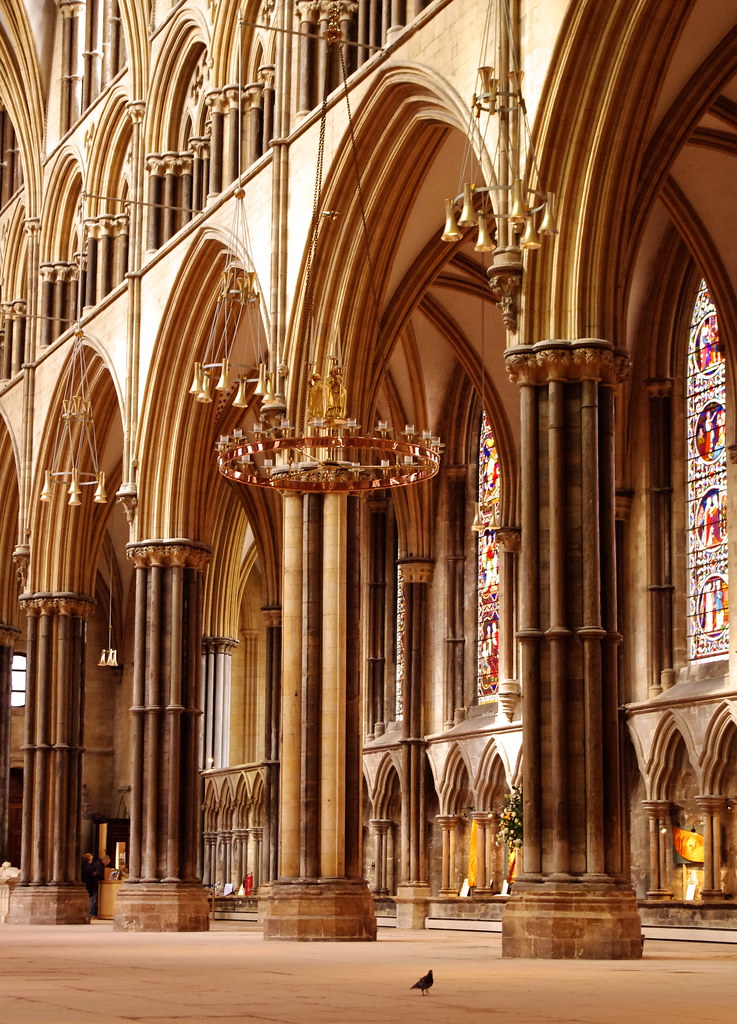
From the crossing, we walked out into the nave, which features 12 columns--one for each of the apostles. Just as one of the apostles was not like the others, so, too, was one of the columns different from the other 11:

The column in the center--with 2 large posts and lighter-colored stone--is the "Judas column".

The Judas column, as Elvis called it, is made with subpar materials and in a slightly different style--though, of course, it is just as capable of supporting weight. Interestingly, all 12 current columns stand about 1-2 feet from where the cathedral's original columns stood. The column closest to the crossing has a small trap door at its base; Elvis waited until nobody was looking and pulled the door open to show me the shorn-off bottom of the original plinth. The contemporary columns are in a new location because the cathedral suffered extreme structural damage after an earthquake struck in the late 12th century. This resulted in extensive reconstruction throughout much of the building. However, funds ran out before the final bit--around the entryway--could be finished.


If you look along the "spine" that runs down the center of the ceiling, you can see that the "new" one (closer to you) is offset from the original one (near the far window) by 1-2 feet.

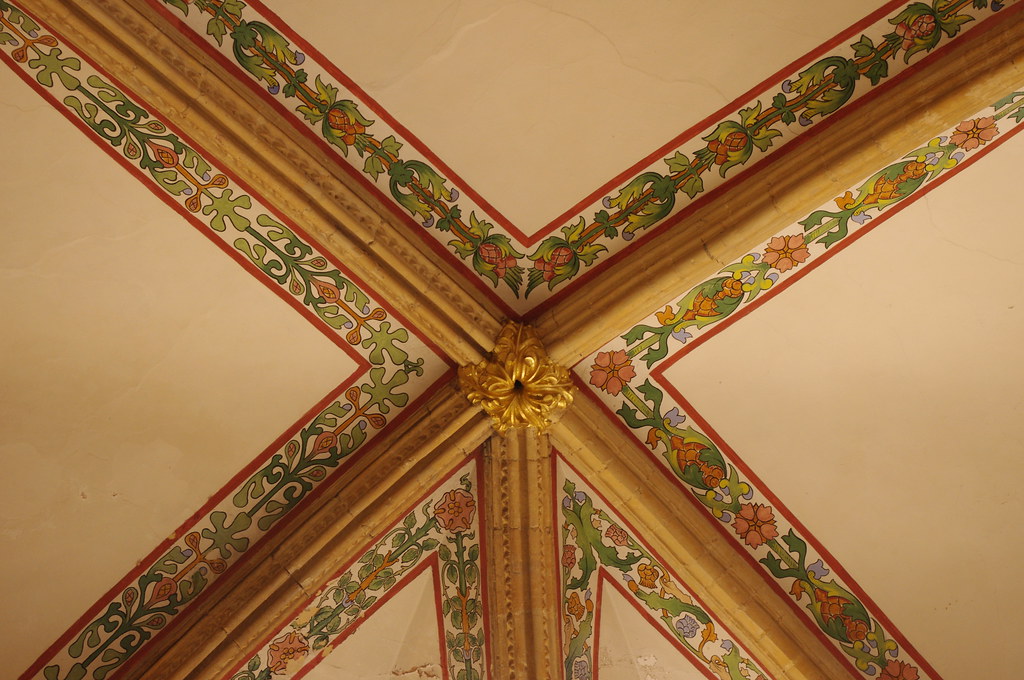
The crossing area also features an ornate choir screen decorated with a variety of objects--flowers, people, even, in one whimsical section, pigs. Here you can see the remnants of the colorful paint that had once been applied throughout the cathedral. I had no idea this type of decoration was ever done in stone churches from this era(s), and I am not sure how widespread the technique was. It has made me wonder about all the other "plain" cathedrals I've ever visited in the past. You can see other colorful remnants elsewhere in the building, as well, though some of them are a bit newer (and brighter) than others:

Colorful paintings on the roof of the south transept chapel.
While in the nave, we took a look at the giant stone font near the entrance of the cathedral. It was made of dark stone that had, Elvis told me, been brought over from France. At least one of Elvis's daughters had been christened there, and I felt that I should take a photograph but it was so dark that I knew it wouldn't turn out well. So, instead, I went back to the crossing and took a picture that was so light it wouldn't turn out well:


If you squint, you might just be able to make out the green man being illuminated by the light inside this tubular sculpture of foliage. The greenery is emerging from the green man's mouth, and terminates on the other side of the arch in a dragon.

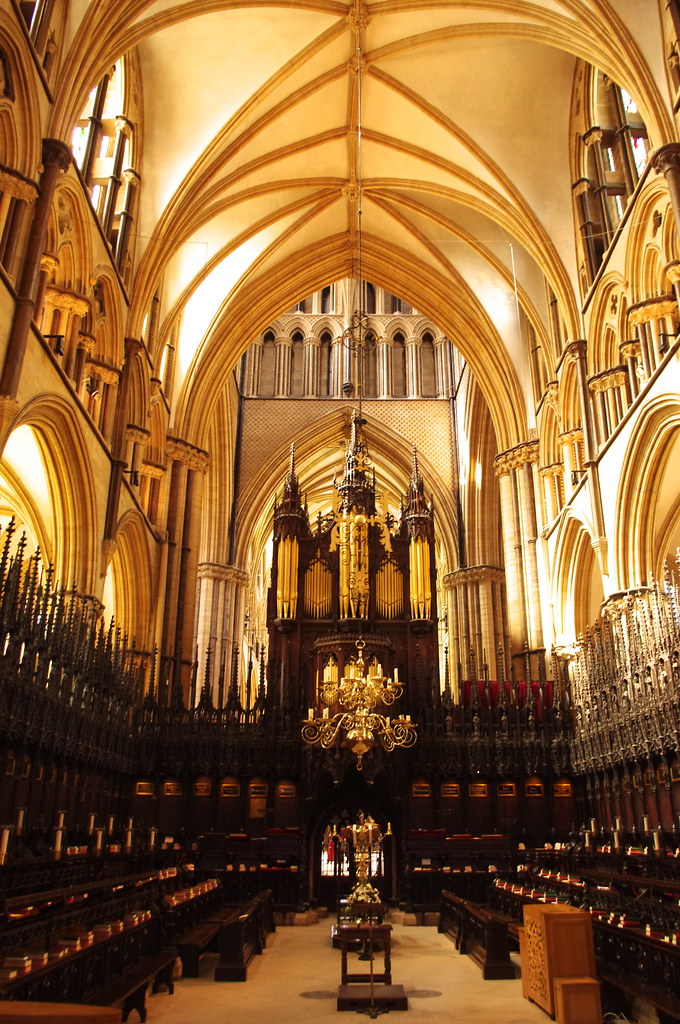
Elvis and I passed under the arch and made our way into the magnificent St. Hugh's Choir:


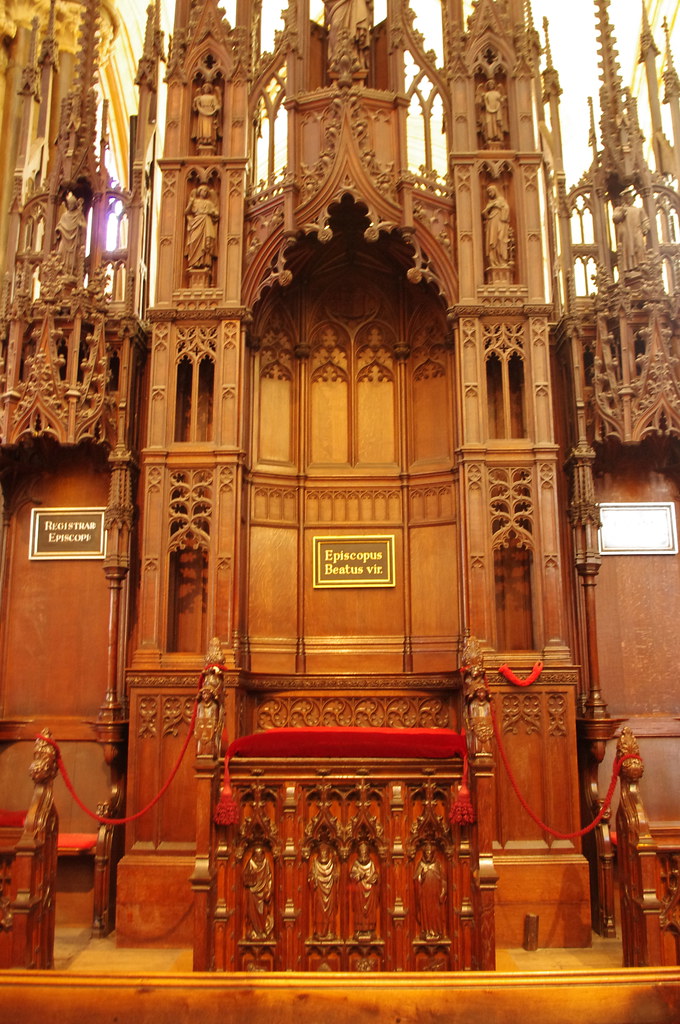
Here you can see a number of beautiful, ornate, and interesting objects--the giant organ (no jokes, please), the eagle lectern, the acoustic sweet spot (you can see it in the image above as the grey bit on the floor, running left to right just in front of the table in the center of the room), the misericord (or mercy seat, used to provide a resting spot for tired bums), and the "cathedral seat," which, Elvis told me, makes the cathedral a cathedral; remove the seat and the cathedral is just a fancy church, and put the seat in any old ordinary building and it will become a cathedral. I have no idea if that's true or not, but here's what it looks like:


After we left the choir, we went through the northeast transept into the cloister area and chapter house. Elvis informed me that the chapter house had been used to shoot some scenes in the The Da Vinci Code, which I will have to look out for next time I catch the movie on TV. The area is currently being used as a venue for an art exhibit, and is also a post-christening gathering spot (though personally I think it's a bit chilly for social activities).

The cloister was evidently never actually used as such, but was added on to the cathedral simply because someone thought it sounded like a good idea and would look nice. Parishioners who wish to be buried "in" the cathedral are actually buried in the western portion of the cloister; Elvis informed me very matter-of-factly that he had already booked his spot (an expediency required by the popularity of these graves). Overlooking the cloister is the cathedral library, which houses a variety of old volumes--some of which are chained in place because of concerns about robbery. On the south side of the area is a cart with a mirror on top; look down into the mirror and you can see another imp carved into the ceiling that covers the passageway.

Shortly after we re-entered the cathedral, Elvis and I parted ways so that he could go meet his son at the castle. I scurried off to photograph the odds and ends I hadn't managed to capture during my first time around the building.

One of the windows is older than the others, and is therefore made with a different type and mixture of stained glass; because it contains more yellow, it gives a warmer light pattern than the other windows, which are dominated by reds and blues.

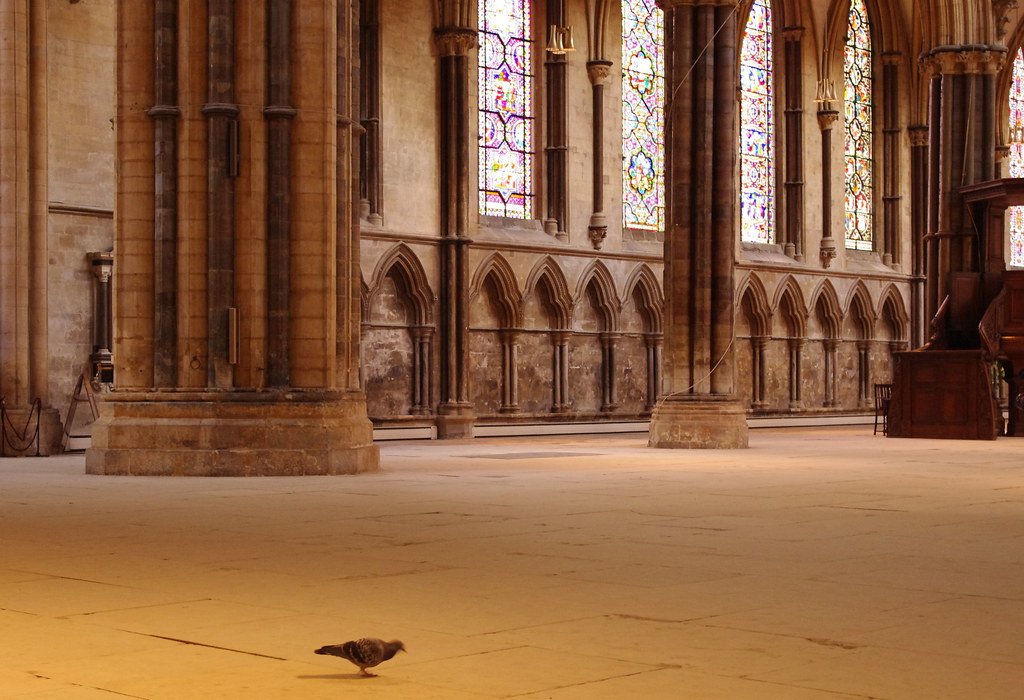
Elvis informed me that this pigeon has been flying around the church for a couple of weeks, and that he (Elvis, not the pigeon) has been feeding it in an attempt to lure it in for a removal.

I also stepped outside for some perspective images of the cathedral:

Just before I headed into the cathedral, I saw a very interesting bird flying above the cathedral tower. On closer inspection of my photograph, I decided that the animal in question looked very much like a peregrine falcon. A subsequent Google search revealed that peregrines do, indeed, live at the cathedral, and that their nests have previously hosted webcams.

The cathedral in its medieval, cobbled milieu.

By this time it was quite late in the afternoon, and I was more than ready to find a cafe where I could have a hot cup of tea and a quick bite (more on which later!). As much as I was anticipating this lovely meal, however, I was a bit sad to bid farewell to the cathedral--and, more importantly, to the very knowledgeable Elvis, who made my afternoon much more interesting and rewarding than it would have been if I had dismissed him and wandered around the building on my own. While I don't think I'll make a habit of hanging out and chatting with people I've never before encountered, my experience at Lincoln Cathedral has taught me that, on some occasions at least, good things do happen when you meet strangers.

(Late) Foodie Penpals Reveal: March 2013

I hope the Foodie Penpals community can forgive me for doing my March reveal a bit late; on the official reveal day last month, I was traipsing about the desert in California, with no access to the Internet. Now, however, I am back in the UK, mostly unpacked, and ready to divulge the treats that awaited me upon my return.


My penpal this month was Lesley, who put together a tremendous package full of new and interesting things for me to try. Having perused my website and read about my interest in baking, Lesley decided to include baking items of both an edible and useful nature:


On the left is a "healthy" crepe mix made from buckwheat rather than standard white flour. On the right is a set of "jumbo" baking cups for cupcakes and muffins. As I told Lesley, the cupcake wrappers made me laugh because they are considered standard size where I come from in the US; the wrappers I encounter here in the UK drive me crazy because they are all so small! Now I will be able to bake a batch of normal-sized treats next time I'm in the mood to indulge my sweet tooth.


Lesley also provided me with a selection of things to snack on right away, should
I want to dive in without any preparation required. She sent a bag of hot wasabi "crisps," to use the British phrase, a package of the rich and delectable syrup waffles that are all the rage in European cafes, and a bag of dried mango. Whenever I have the urge to eat candy, I try to distract myself with dried fruit instead, so the mango is very much appreciated--especially since it is my favorite form of non-candy sweet treat.


Two of the healthier items in my parcel were a small pack of organic seeds and a bag of gourmet popping corn. I have never popped my own corn (outside of a microwave, that is), so I am looking forward to giving that a try; hopefully I won't overcook it, because there are few scents as bad as burned popcorn--a smell that will always remind me of my college days, since my hallmates were seemingly incapable of preventing popcorn disasters.


The last two edible components of the package were a box of tea by pukka, one of my (and seemingly Lesley's) favorite brands, and a little bag of dried rose petals. I have never cooked with rose petals before, though I have used rose water. If we ever get spring and summer down here in Cornwall, I will have to cook up an elegant fruity dessert worthy of rose petal decorations, then eat it in the sunshine on my balcony.

Lesley also sent a handwritten note explaining all the items in the box, as well as a recipe for me to try out--perhaps for one of the upcoming Game of Thrones evenings my husband and I will be hosting at our place? Some cake would add a welcome bit of sweetness to ease the tension associated with watching that very stressful show!


Thanks again to Lesley for her thoughtful and bounteous parcel. Stay tuned to find out what April's package contains!